Lorentz transformation for change in coordinates | Physics | Khan Academy
TL;DR
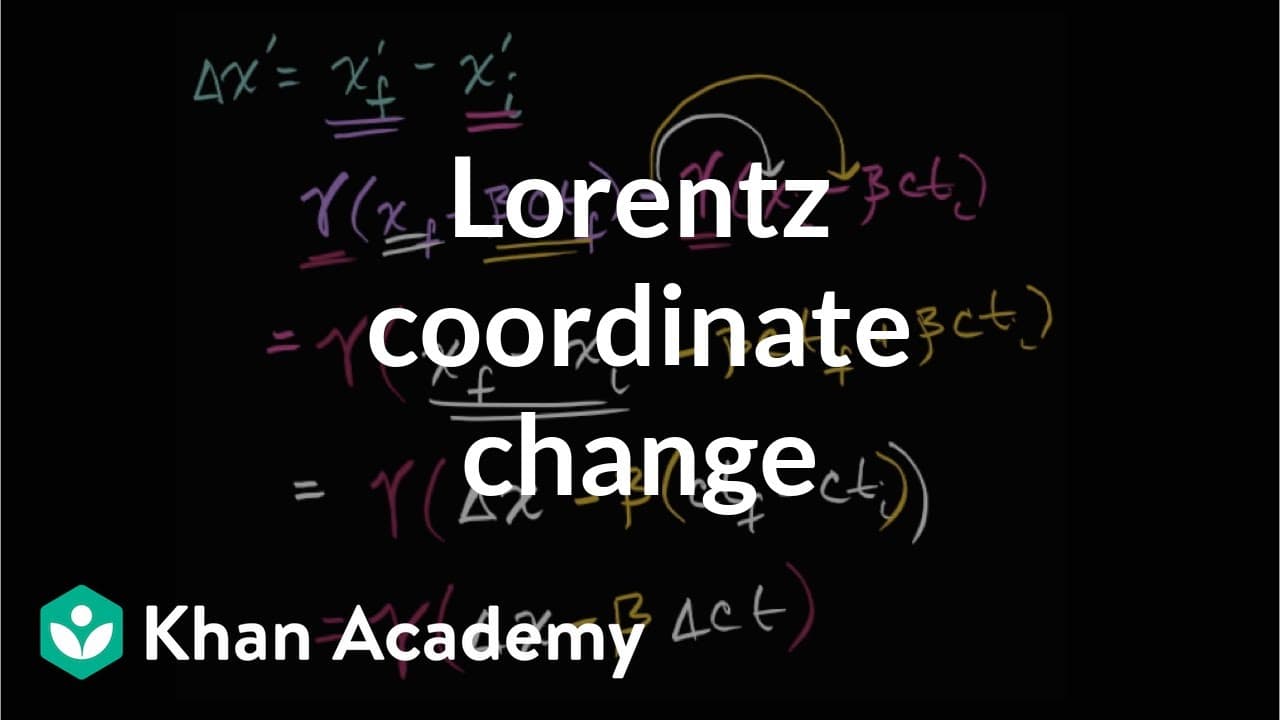
Changes between coordinates follow the same Lorentz transformation form as the coordinates themselves: change in X prime equals gamma times change in X minus beta times change in C T. Because C is constant, change in C T can also be written as C times change in T. Read on for the algebra and the corresponding time-coordinate result.
Transcript
- We've spent several videos now getting familiar with the Lorentz transformations. What I want to do now, instead of thinking of what X prime and C T prime is in terms of X and C T, I wanna think about, what is the change in X prime and the change in C T prime going to be in terms of change in X and change in C T. And we'll see it's just going to ... Read More
Key Insights
- 💱 The change in X prime can be calculated using the formula gamma times change in X minus beta times change in C T.
- 🧑🏭 The Lorentz factor gamma accounts for time dilation and length contraction effects in relativistic scenarios.
- 💱 The change in C T prime can be calculated using the formula gamma times change in C T minus beta times change in X.
Install to Summarize YouTube Videos and Get Transcripts
Explore YouTube Video Summarizer or Get YouTube Transcript Extractor
Questions & Answers
Q: How do you calculate the change in X prime using the Lorentz transformation?
Change in X prime equals gamma times change in X minus beta times change in C T. It is obtained by subtracting X prime initial from X prime final and factoring out gamma.
Q: What is the starting expression for change in X prime?
Change in X prime is X prime final minus X prime initial. Each primed coordinate is then replaced with its Lorentz transformation expression.
Q: How are X prime final and X prime initial written?
X prime final is gamma times X final minus beta times C T final. X prime initial is gamma times X initial minus beta times C T initial.
Q: Why does X final minus X initial become change in X?
Change in X is defined here as the final X coordinate minus the initial X coordinate. This substitution appears after the negative sign is distributed and gamma is factored out.
Q: Why can change in C T be written as C times change in T?
C does not change in the calculation. Therefore, C T final minus C T initial can be viewed as C times change in T.
Q: How do you calculate the change in C T prime?
Change in C T prime equals gamma times change in C T minus beta times change in X. The same result follows by subtracting C T prime initial from C T prime final and applying the same algebraic manipulation.
Q: What algebraic operations produce the transformed coordinate changes?
First subtract the initial transformed coordinate from the final transformed coordinate. Then distribute the negative sign, factor out gamma and beta where appropriate, and identify the final-minus-initial terms as coordinate changes.
Q: Why express the Lorentz transformations in terms of coordinate changes?
Expressing the transformations in terms of changes makes it possible to think about velocities in different frames of reference. The coordinate-change formulas prepare the way for that analysis.
Summary & Key Takeaways
-
Definition: Change in X prime is X prime final minus X prime initial.
-
Definition: Change in C T prime is C T prime final minus C T prime initial.
-
Tool: Substitute the Lorentz transformation expressions for the final and initial primed coordinates.
-
Tool: Distribute the negative sign before grouping the final-minus-initial coordinate terms.
-
Tool: Factor out gamma to expose the changes in X and C T.
-
Definition: Change in X prime equals gamma times change in X minus beta times change in C T.
-
Definition: Change in C T prime equals gamma times change in C T minus beta times change in X.
-
Compare: The transformation for change in X prime has almost the same form as the transformation for X prime.
-
Compare: Since C is constant, change in C T is equivalent to C times change in T.
-
Who: The viewer is encouraged to derive the change in C T prime using the same algebraic argument.
-
When: Coordinate changes are introduced before considering velocities in different frames of reference.
Read in Other Languages (beta)
Share This Summary 📚
Summarize YouTube Videos and Get Video Transcripts with 1-Click
Try YouTube Summary with ChatGPT & Claude or YouTube Transcript Generator
Explore More Summaries from Khan Academy 📚


Summarize YouTube Videos and Get Video Transcripts with 1-Click
Try YouTube Summary with ChatGPT & Claude or YouTube Transcript Generator