Partial derivatives | Multivariable Calculus | Khan Academy
TL;DR
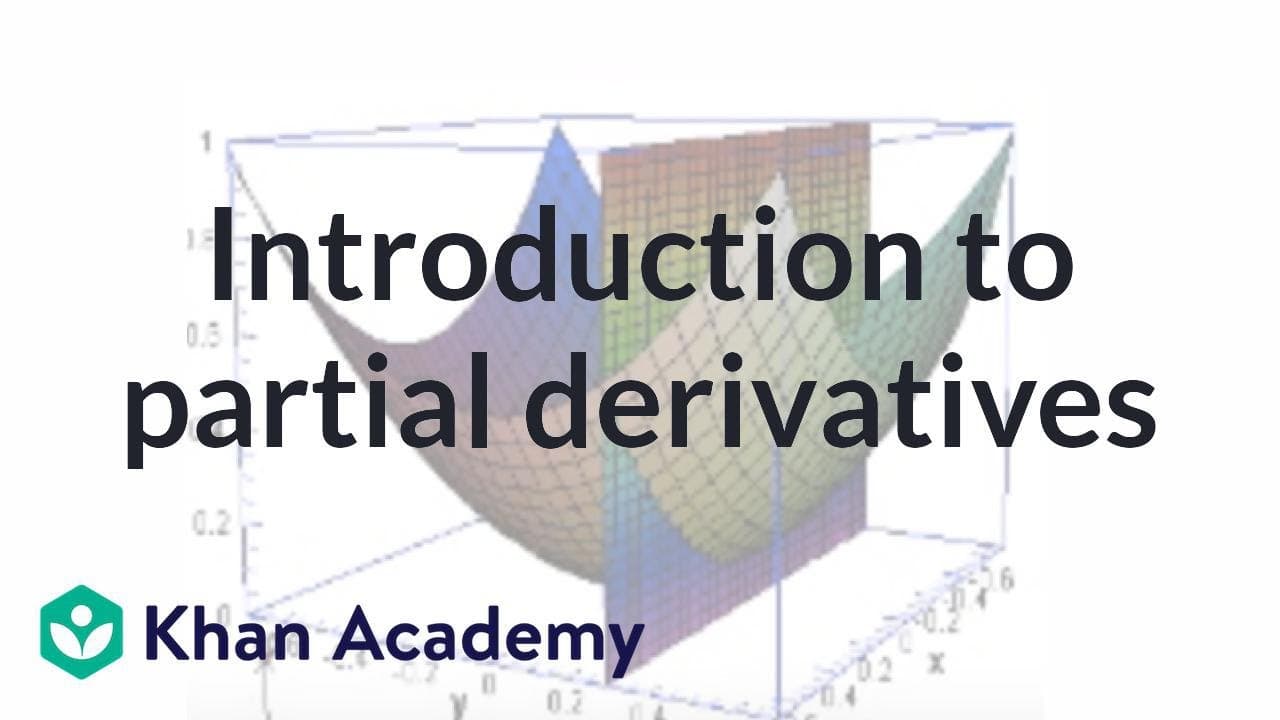
This video explains how to visualize functions in three dimensions and how to find the slope of a surface in a specific direction.
Transcript
Let's now expand our knowledge of calculus to the third dimension. So first of all, just what does a function look like in three dimensions? And actually we'll go over the different types. Because you can have a line in three dimensions, or kind of a curve in three dimensions. You can have a surface. You could have a vector field. There are differe... Read More
Key Insights
- 🫥 Functions in three dimensions can have various representations, including lines, curves, surfaces, and vector fields.
- 💨 Visualizing functions in three dimensions can be challenging, but surfaces are often the most intuitive way to understand them.
- 🫱 The right-hand rule helps establish the orientation of the coordinate system in three dimensions.
Install to Summarize YouTube Videos and Get Transcripts
Explore YouTube Video Summarizer or Get YouTube Transcript Extractor
Questions & Answers
Q: What are the different types of representations of functions in three dimensions?
Functions in three dimensions can be represented as lines, curves, surfaces, or vector fields. Each type has its own characteristics and can be visualized in different ways.
Q: How do we define a surface in three dimensions?
A surface in three dimensions can be defined by expressing z as a function of x and y. This means that for any given x and y values, we can determine the corresponding z value for the surface.
Q: Why do we use the right-hand rule to determine the orientation of the coordinate system?
The right-hand rule is used to establish a convention for the orientation of the coordinate system. In this convention, the cross product of the x-axis with the y-axis is equal to the z-axis. It helps determine the direction of increasing x and establishes consistency in the coordinate system.
Q: How do we find the slope of a surface in three dimensions?
To find the slope of a surface in three dimensions, we need to take the partial derivative. This involves holding one variable constant and taking the derivative with respect to the other variable. The result is the slope of the surface in a particular direction.
Summary & Key Takeaways
-
Functions in three dimensions can take the form of lines, curves, surfaces, or vector fields.
-
A surface in three dimensions is the most intuitive way to visualize functions.
-
To plot points on a surface, we can define z as a function of x and y.
Read in Other Languages (beta)
Share This Summary 📚
Summarize YouTube Videos and Get Video Transcripts with 1-Click
Try YouTube Summary with ChatGPT & Claude or YouTube Transcript Generator
Explore More Summaries from Khan Academy 📚



Summarize YouTube Videos and Get Video Transcripts with 1-Click
Try YouTube Summary with ChatGPT & Claude or YouTube Transcript Generator