How Does Diffusion Work in AI Image Generation?
TL;DR
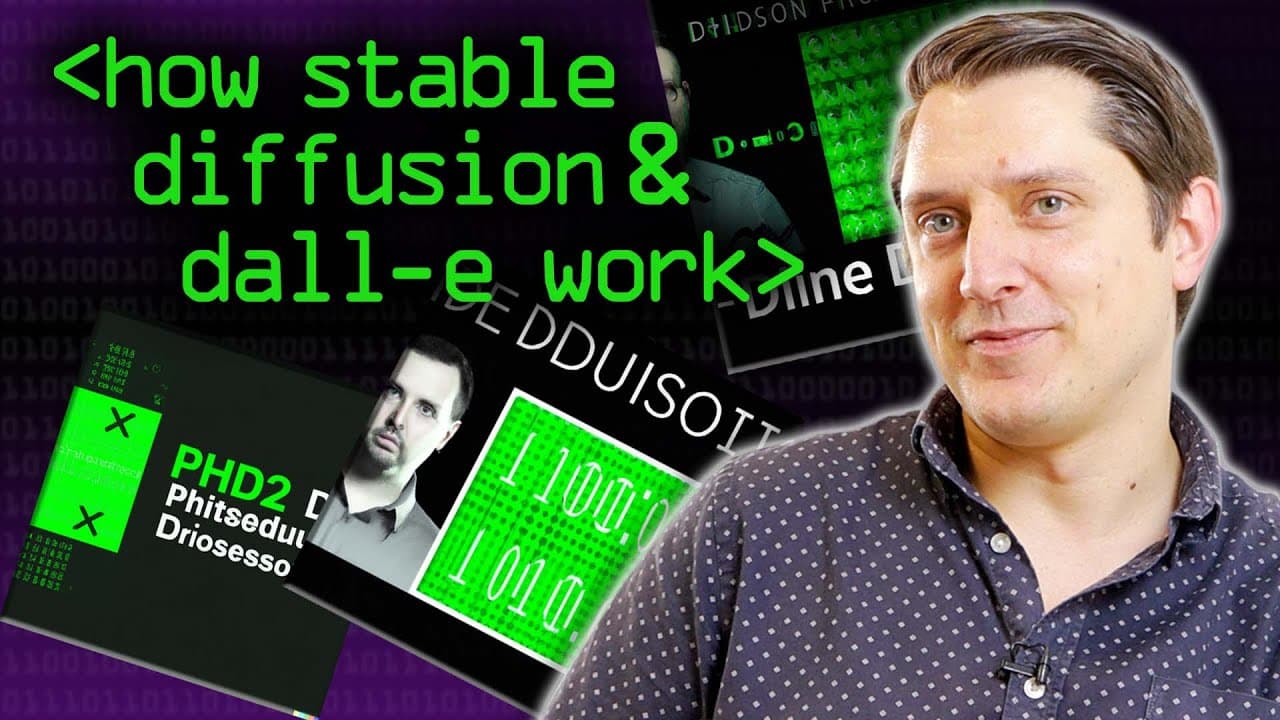
Diffusion models generate images by iteratively removing noise, simplifying the image creation process compared to traditional GANs. This method enhances stability and quality through a controlled noise schedule and can be further refined by using text prompts to guide the generated content.
Transcript
generating images using diffusion what is that right so I should probably find out it's just things like Dolly and Dolly too yeah Imogen from Google stable diffusion now as well I've spent quite a long time messing about a stable diffusion I'm having quite a lot of fun with that so what I thought I'd do is I download the code I'd you know read the ... Read More
Key Insights
- 🍳 Diffusion models simplify the image generation process by breaking it down into iterative noise removal steps.
- 📅 The schedule for adding and removing noise in diffusion models can be customized to achieve desired results.
- ❓ Conditioning the diffusion model with text embeddings enhances image generation by providing specific guidance.
Install to Summarize YouTube Videos and Get Transcripts
Explore YouTube Video Summarizer or Get YouTube Transcript Extractor
Questions & Answers
Q: How do generative adversarial networks (GANs) differ from diffusion models in image generation?
GANs generate images by training a neural network to produce fake images that resemble real ones. In contrast, diffusion models use iterative noise removal steps, making the process more stable and easier to train.
Q: What is the purpose of the second network in the GAN setup?
The second network in the GAN setup discriminates between real and fake images, guiding the generator network to improve its image generation by producing more convincing fakes.
Q: How does a diffusion model handle the creation of random images without specific guidance?
Diffusion models start with a random noise image and gradually remove noise through iterative steps. While they can produce image-like outputs, they lack specific guidance and may not create images that resemble recognizable objects.
Q: How does conditioning the diffusion model with text embeddings improve image generation?
Conditioning the diffusion model with text embeddings allows for more targeted image generation. By providing text descriptions or instructions, the model can generate images that match specific themes or concepts.
Summary & Key Takeaways
-
Generative adversarial networks (GANs) are the standard method for image generation, but they can be difficult to train and prone to issues like mode collapse.
-
Diffusion models offer a more stable and easier-to-train approach by breaking down the image generation process into iterative steps of noise removal.
-
By using a schedule to control the amount of noise added and removed at each step, diffusion models can generate high-quality images.
-
The process can be further enhanced by conditioning the network with text embeddings to guide the image generation towards specific themes or concepts.
Read in Other Languages (beta)
Share This Summary 📚
Summarize YouTube Videos and Get Video Transcripts with 1-Click
Try YouTube Summary with ChatGPT & Claude or YouTube Transcript Generator
Explore More Summaries from Computerphile 📚


Summarize YouTube Videos and Get Video Transcripts with 1-Click
Try YouTube Summary with ChatGPT & Claude or YouTube Transcript Generator