Coding Challenge #92: XOR Problem
TL;DR
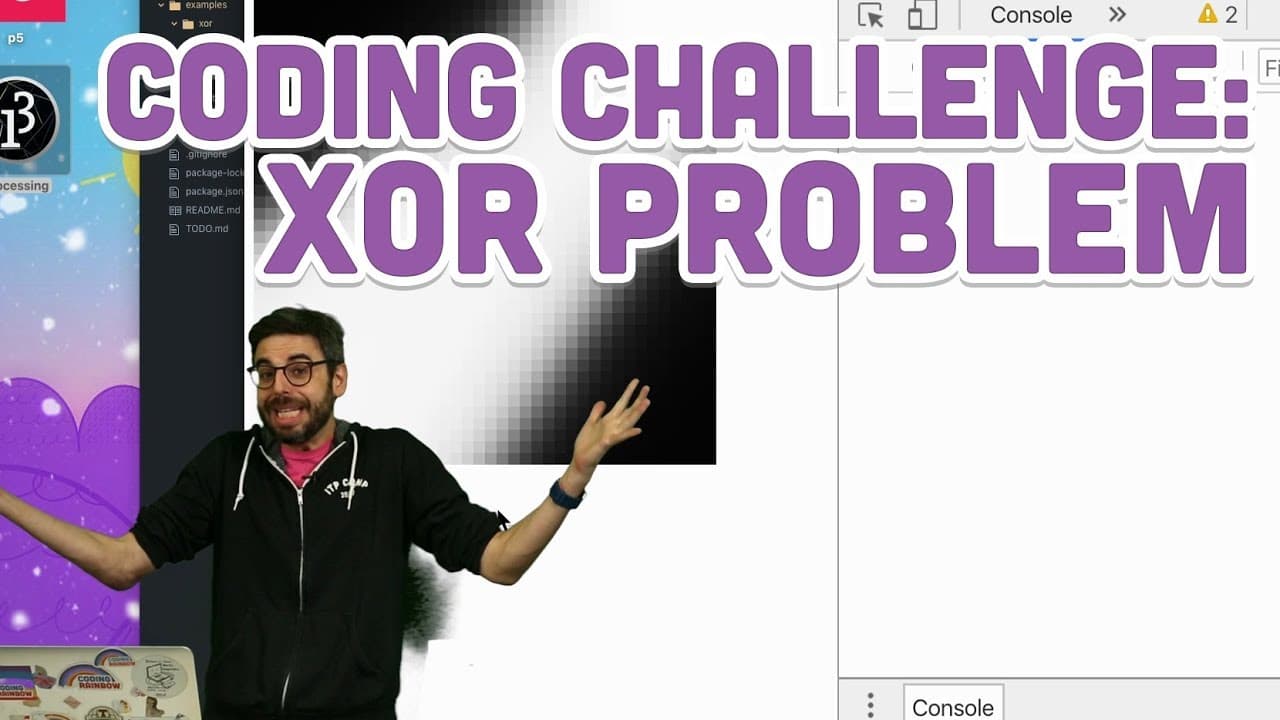
In this coding challenge, the creator tests a neural network library they built by solving the XOR problem.
Transcript
hello welcome to a coding challenge in this coding challenge I am going to it's gonna sound really weird solve X or with a neural network now why would anyone want to do this why would I want to do this well what this is actually this is a video in which I am going to test a neural network library I've been building in JavaScript and in fact if you... Read More
Key Insights
- 🎮 The video introduces the concept of machine learning and the role of data and algorithms in the learning process.
- 🔂 The creator discusses the XOR problem and the limitations of a single neuron perceptron in solving it.
- 🪡 The structure and architecture of neural networks, including the need for hidden layers, are explained.
- 🏋️ The process of training a neural network by adjusting weights to minimize errors is demonstrated.
- 🔅 The creator visualizes the output of the neural network by creating a grid and assigning color brightness values to represent predictions.
- 💋 The video highlights the possibility of the neural network getting stuck in local optima and suggests ways to overcome this issue.
- 🎰 The importance of exploring and experimenting with different datasets and visualization techniques in machine learning is emphasized.
Install to Summarize YouTube Videos and Get Transcripts
Explore YouTube Video Summarizer or Get YouTube Transcript Extractor
Questions & Answers
Q: What is the purpose of this coding challenge?
The purpose of this coding challenge is to test the neural network library built by the creator and demonstrate its ability to solve the XOR problem.
Q: What is the XOR problem?
The XOR problem is a boolean operation that only resolves to true if one of the two boolean expressions is true. It is not solvable by a single neuron perceptron and requires a neural network with a hidden layer.
Q: How does the training process work?
The training process involves inputting known data and expected outputs into the neural network. The network adjusts its weights to minimize the difference between the predicted output and the expected output.
Q: How is the output of the neural network visualized?
The output is visualized by creating a grid and assigning a color brightness value to each cell based on the neural network's prediction for the corresponding input.
Q: Can the neural network get stuck during training?
Yes, the weights of the neural network are initialized randomly, and depending on the initial weights, it may get stuck in local optima. Adjusting the learning rate or adding more hidden nodes can help overcome this issue.
Q: What is the next challenge mentioned in the video?
The next challenge mentioned is to recognize handwritten digits using the MNIST dataset and potentially allowing the neural network to detect handwritten digits drawn by the creator.
Summary & Key Takeaways
-
The video introduces the concept of machine learning, where data is input into a machine learning algorithm to produce an output.
-
The creator demonstrates how they built a toy neural network library in JavaScript and uses it to solve the XOR problem.
-
The XOR problem is explained, and the structure and architecture of the neural network used to solve it are discussed.
-
The creator writes code to train the neural network and visualize its output.
Read in Other Languages (beta)
Share This Summary 📚
Summarize YouTube Videos and Get Video Transcripts with 1-Click
Try YouTube Summary with ChatGPT & Claude or YouTube Transcript Generator
Explore More Summaries from The Coding Train 📚



Summarize YouTube Videos and Get Video Transcripts with 1-Click
Try YouTube Summary with ChatGPT & Claude or YouTube Transcript Generator