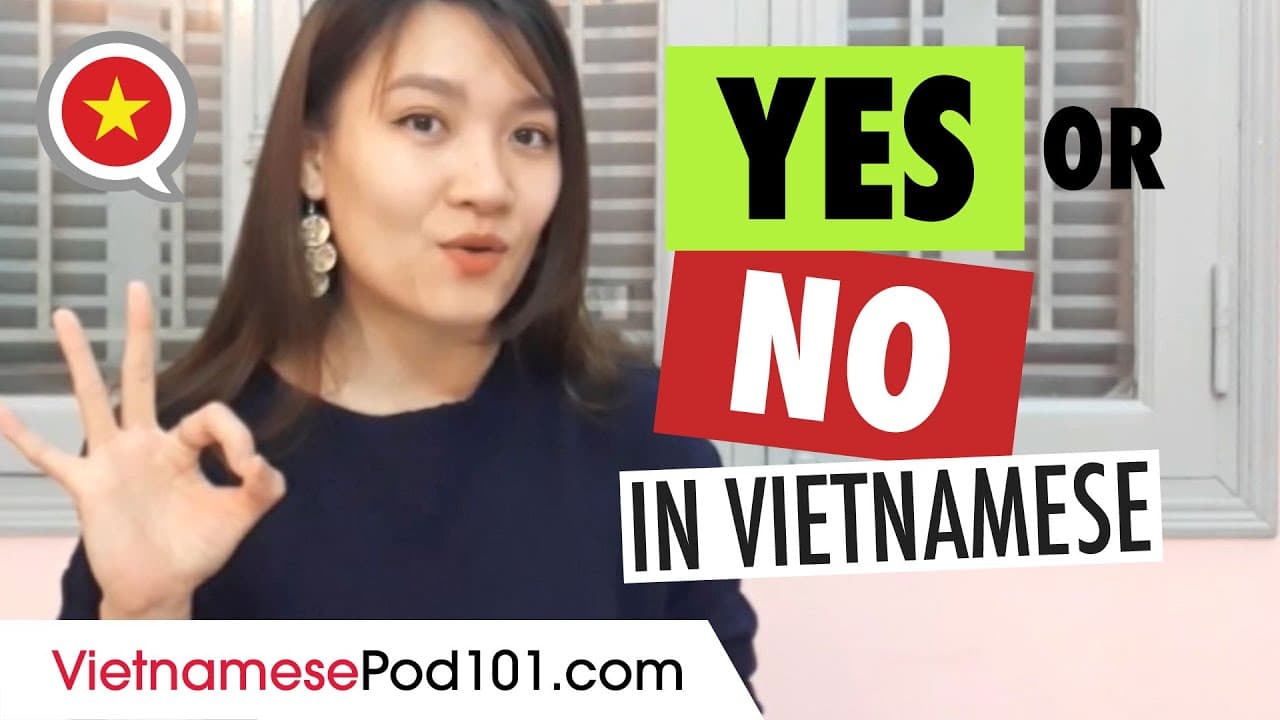
How to Say YES and NO in Vietnamese
TL;DR
Learn to say yes and no in Vietnamese with context.
Transcript
want to speak real vietnamese from your first lesson sign up for your free lifetime account at vietnamesepod101.com why there are so many how to say yes or no in vietnamese properly hello everyone welcome back to vietnamesegolf101.com the fastest easiest and most fun way to learn vietnamese my name is ling and welcome back today i'm gonna show you ... Read More
Key Insights
- The video introduces three types of yes/no questions in Vietnamese, each requiring different responses depending on the context of the question.
- The first type of question, known as 'tag questions,' often ends with specific words indicating a need for confirmation, such as 'phải không.'
- For tag questions, 'uh' is used to confirm (yes), while 'không' indicates disagreement (no).
- The second type of yes/no question involves questions that end with 'không,' commonly used to inquire about possession or ability.
- In response to questions ending with 'không,' 'có' is used for affirmation (yes), and 'không' is used for negation (no).
- The third type of question involves the present perfect tense, often ending with 'chưa,' indicating whether an action has been completed.
- For questions ending with 'chưa,' 'rồi' confirms completion (yes), while 'chưa' indicates incompletion (no).
- Understanding these nuances is crucial for effective communication in Vietnamese, especially in affirming or negating statements.
Install to Summarize YouTube Videos and Get Transcripts
Explore YouTube Video Summarizer or Get YouTube Transcript Extractor
Questions & Answers
Q: What are tag questions in Vietnamese?
Tag questions in Vietnamese are questions that require confirmation and often end with words like 'phải không.' These questions imply a high level of certainty from the speaker and expect the listener to confirm or deny the statement. The typical responses are 'uh' for yes or 'không' for no.
Q: How do you respond to questions ending with 'không'?
Questions ending with 'không' are often about possession or ability, such as 'Do you have a laptop?' The correct responses are 'có' for affirmation (yes) and 'không' for negation (no). This type of question is straightforward and commonly used in daily Vietnamese conversations.
Q: What is the significance of 'chưa' in Vietnamese questions?
The word 'chưa' in Vietnamese questions is used to inquire about the completion of an action, similar to the present perfect tense in English. It asks whether something has been done yet. The responses are 'rồi' for yes, indicating the action is completed, and 'chưa' for no, indicating it is not completed.
Q: Why is context important in Vietnamese yes/no questions?
Context is crucial in Vietnamese yes/no questions because the language uses different words for yes and no depending on the type of question. Understanding whether a question is a tag question, a question about possession or ability, or a question about completion helps in providing the correct response, ensuring clear communication.
Q: What is the purpose of the video from VietnamesePod101?
The purpose of the video from VietnamesePod101 is to teach learners how to say 'yes' and 'no' in Vietnamese accurately. It aims to help beginners understand the different contexts in which these words are used and provides practical examples to enhance comprehension and communication skills in Vietnamese.
Q: How does the video help absolute beginners in Vietnamese?
The video assists absolute beginners by breaking down the complex aspects of saying 'yes' and 'no' into simple, understandable parts. It uses clear examples and explanations in both Vietnamese and English, allowing learners to grasp the nuances of the language and improve their listening comprehension skills effectively.
Q: What resources does VietnamesePod101 offer for learning Vietnamese?
VietnamesePod101 offers a variety of resources for learning Vietnamese, including free lifetime accounts, structured lessons, and real teacher interactions. These resources are designed to help learners quickly become conversational by providing comprehensive learning programs that cover essential language skills in an engaging and accessible manner.
Q: How does the video emphasize practical usage of Vietnamese language?
The video emphasizes practical usage by focusing on real-life scenarios where saying 'yes' or 'no' is necessary. It provides context-specific examples, helping learners understand how to use these words correctly in conversations. This approach ensures that learners can apply what they learn in everyday interactions, enhancing their language proficiency.
Summary & Key Takeaways
-
The video explores how to say 'yes' and 'no' in Vietnamese, emphasizing the importance of context. It covers three types of questions, each requiring different responses.
-
Tag questions ending with 'phải không' require 'uh' for yes and 'không' for no. Questions ending with 'không' use 'có' for yes and 'không' for no.
-
Present perfect questions ending with 'chưa' use 'rồi' for yes and 'chưa' for no. These distinctions are vital for proper communication.
Read in Other Languages (beta)
Share This Summary 📚
Summarize YouTube Videos and Get Video Transcripts with 1-Click
Try YouTube Summary with ChatGPT & Claude or YouTube Transcript Generator
Explore More Summaries from Learn Vietnamese with VietnamesePod101.com 📚




Summarize YouTube Videos and Get Video Transcripts with 1-Click
Try YouTube Summary with ChatGPT & Claude or YouTube Transcript Generator