Introduction to File, Operation on File, Reading and Writing a Characters and String from and to a F
TL;DR
This video provides an overview of file handling operations, including file opening, reading and writing characters and strings, and file closing.
Transcript
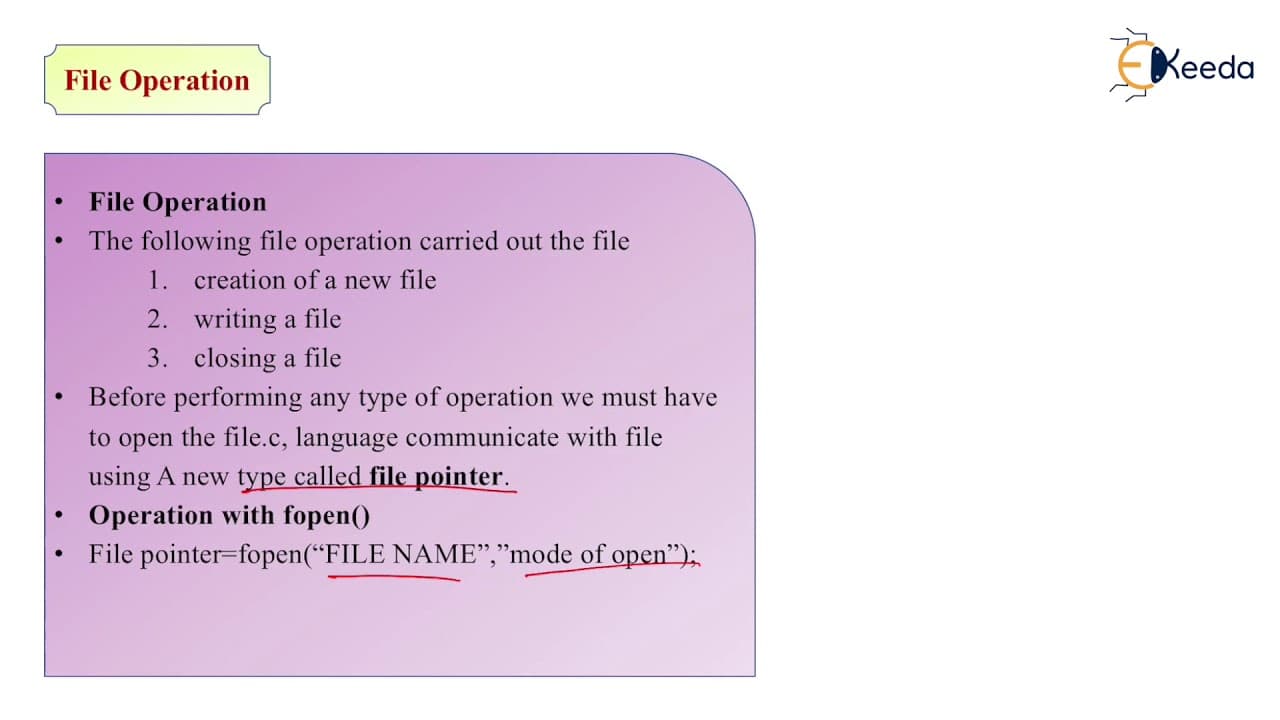
hello friends in this video we are going to see the overall file handling with the introduction operations reading and writing a character on a string from and to five fine handing the file is a permanent storage medium in which we can store the data permanently types of file can be handles are sequential file random access file and binary file ope... Read More
Key Insights
- 📁 File handling involves opening, reading, writing, and closing files.
- 🍵 There are three types of files that can be handled: sequential, random access, and binary.
- 📂 The F open function is used to open a file and establish communication with it.
- 🫠 Reading characters from a file can be done using the get C function.
- 🎅 Writing characters to a file can be done using the put C and put S functions.
- 📁 Copying one file to another file can be achieved using file handling operations.
- 😚 F close is used to close a specific file, while F close all is used to close all open files.
Install to Summarize YouTube Videos and Get Transcripts
Explore YouTube Video Summarizer or Get YouTube Transcript Extractor
Questions & Answers
Q: How many types of files can be handled in file handling operations?
File handling operations can handle three types of files: sequential, random access, and binary files.
Q: What is the purpose of the F open function in file handling?
The F open function is used to open a file and establish communication with it before performing any operations.
Q: How do we read a character from a file?
To read a character from a file, we use the get C function, which reads a character into a character variable.
Q: What is the purpose of the F gates function?
The F gates function is used to read a string from a file, and the syntax for using it is F gates (string length, file pointer).
Summary & Key Takeaways
-
The video introduces file handling and discusses the three types of files that can be handled: sequential, random access, and binary.
-
It explains the process of opening a file using the F open function and different modes of opening.
-
The video covers reading and writing characters to a file using functions like get C, put C, and put S, as well as reading and writing strings using get W and put W.
-
It also demonstrates a code example for copying one file to another file and showcases the use of F close, F close all, and F gates for file operations.
Read in Other Languages (beta)
Share This Summary 📚
Summarize YouTube Videos and Get Video Transcripts with 1-Click
Try YouTube Summary with ChatGPT & Claude or YouTube Transcript Generator
Explore More Summaries from Ekeeda 📚


Summarize YouTube Videos and Get Video Transcripts with 1-Click
Try YouTube Summary with ChatGPT & Claude or YouTube Transcript Generator