What Are State-Action Rewards and Finite Horizon MDPs?
TL;DR
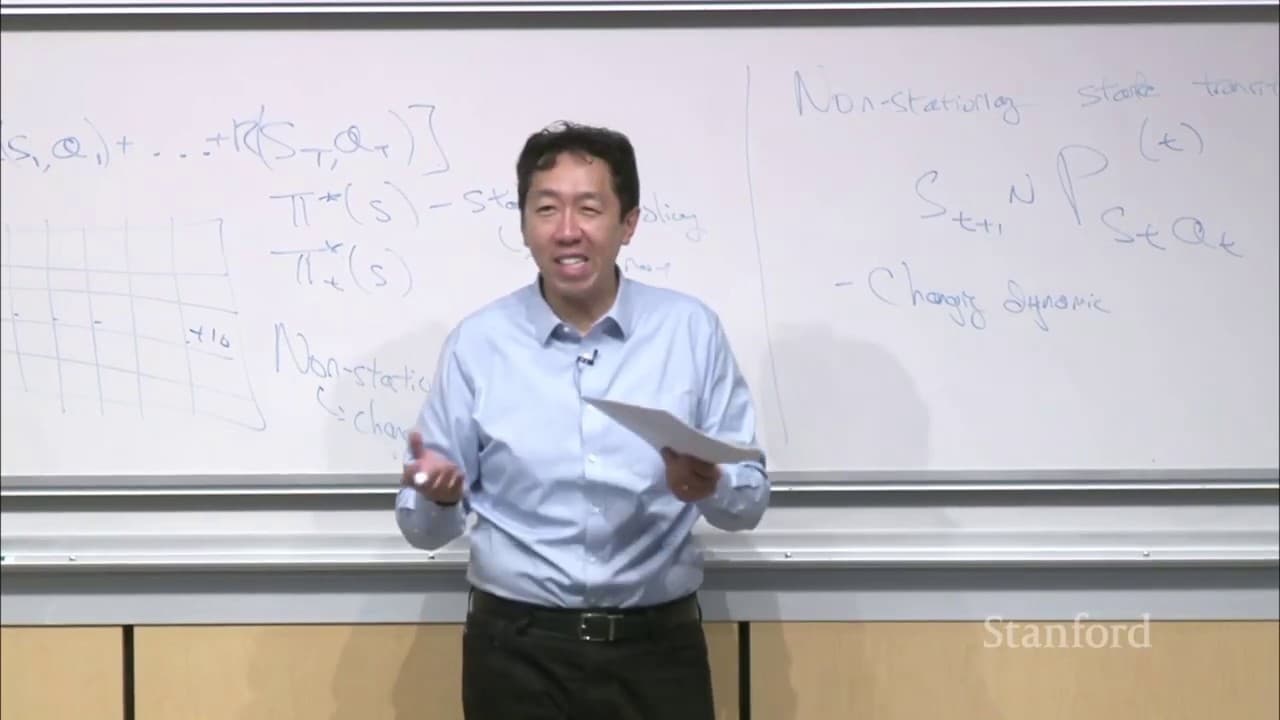
State-action rewards allow for different costs based on the specific actions taken in a Markov Decision Process (MDP), enhancing modeling flexibility. Finite horizon MDPs replace the discount factor with a time horizon, making the decision-making process relevant only for a specific number of time steps. Both concepts improve the efficiency of modeling complex problems in reinforcement learning.
Transcript
Okay, hey everyone. So welcome to the final week of the class. Uh, what I wanna do today, is share with you a few generalizations of, um, reinforcement learning and of MDPs. So you've learned about the basic MDP formulas of state action, state transition probability, discount factor and rewards. Um, the first thing you see today is two, you know, s... Read More
Key Insights
- 🤖 Generalizations of MDPs to state-action rewards and finite horizon MDPs make it easier to model specific problems and types of robots or automation tasks.
- 👾 Linear dynamical systems are particularly useful in solving MDPs with infinite or continuous state spaces without the need for function approximation.
- ❓ Noise in MDPs is important to consider, but the specific details of the noise may not matter as much as ensuring it is included in the system.
- 🇨🇷 LQR is a specific reinforcement learning algorithm that is highly effective for MDPs with linear dynamical systems and quadratic cost functions.
Install to Summarize YouTube Videos and Get Transcripts
Explore YouTube Video Summarizer or Get YouTube Transcript Extractor
Questions & Answers
Q: What are the advantages of generalizing MDPs to state-action rewards and finite horizon MDPs?
Generalizing MDPs to state-action rewards and finite horizon MDPs makes it easier to model specific types of problems, such as problems with different costs for different actions or problems with a specific time limit.
Q: What is the significance of linear dynamical systems in solving MDPs?
Linear dynamical systems allow for solving MDPs with infinite or continuous state spaces by using functions and value iterations. This eliminates the need for function approximation and allows for computing the exact value function.
Q: What is the role of noise in MDPs, and why is it important to consider?
Noise is often added to MDPs to account for uncertainties and to reflect real-world situations. While the exact details of the noise may not matter as much, ensuring that some noise is included is crucial for robust learning and policy formation.
Q: How does LQR differ from other reinforcement learning algorithms?
LQR is a specific reinforcement learning algorithm that works specifically for MDPs with linear dynamical systems and quadratic cost functions. It allows for the computation of the optimal policy and does not involve any approximation.
Summary & Key Takeaways
-
The analysis covers the generalizations of MDPs to state-action rewards and finite horizon MDPs, making it easier to model certain types of problems.
-
Linear dynamical systems are discussed, specifically in the context of fitted value iteration, which allows for solving MDPs with infinite or continuous state spaces.
-
The importance of properly modeling and adding noise to MDPs is emphasized, as well as the convenience and effectiveness of LQR in solving MDPs.
Read in Other Languages (beta)
Share This Summary 📚
Summarize YouTube Videos and Get Video Transcripts with 1-Click
Try YouTube Summary with ChatGPT & Claude or YouTube Transcript Generator
Explore More Summaries from Stanford Online 📚

Summarize YouTube Videos and Get Video Transcripts with 1-Click
Try YouTube Summary with ChatGPT & Claude or YouTube Transcript Generator