Stanford ENGR108: Introduction to Applied Linear Algebra | 2020 | Lecture 7 - VMLS linear functions
TL;DR
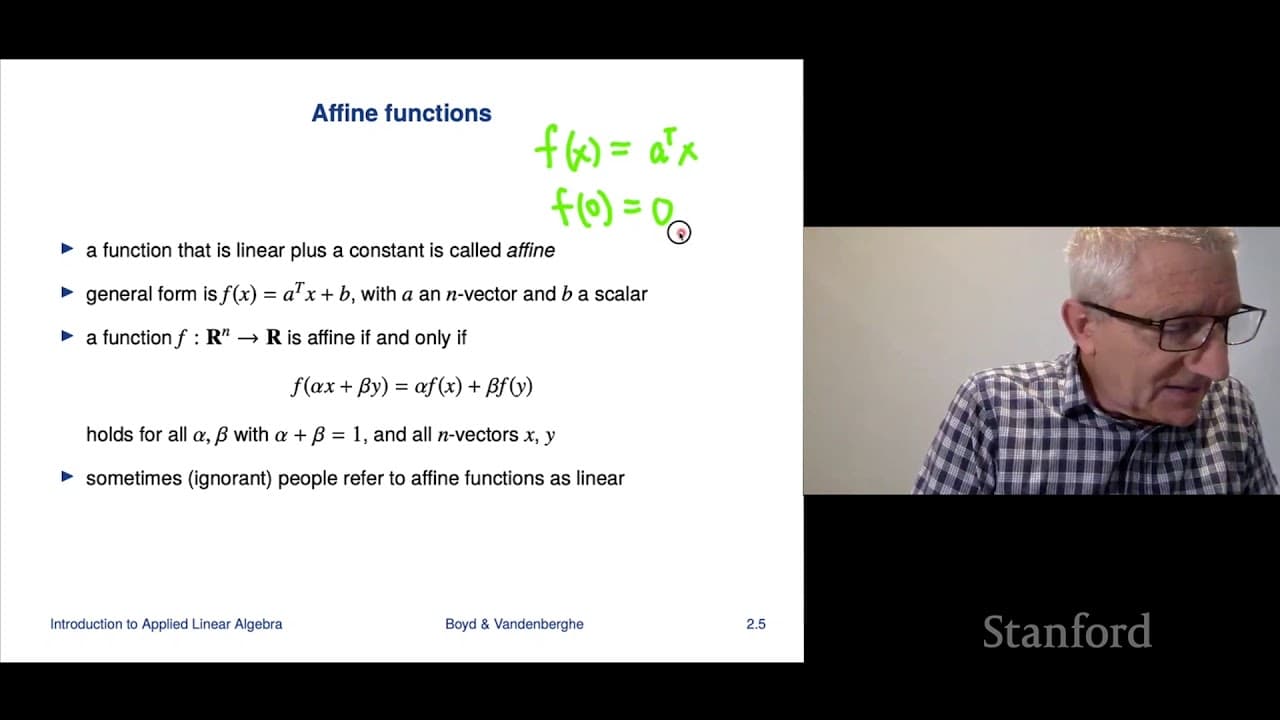
Linear and affine functions are mathematical concepts that involve mapping vectors to real numbers, with linear functions satisfying the superposition property and affine functions adding a constant offset.
Transcript
let's look at chapter two on linear functions so we'll start by talking about linear and affine functions i find as we'll see is a slight extension of linear functions which is also very useful comes up in a lot of applications okay so let's start with some notation so looks complicated but this is standard mathematical notation this thing that say... Read More
Key Insights
- 🔢 Linear functions take n-dimensional vectors as input and return real numbers as output.
- 👻 The superposition property allows linear functions to be flexible in the order of operations.
- 👻 Affine functions are a combination of linear functions and a constant offset, allowing for a shifted output.
- ❓ Linear functions satisfy the superposition property exactly, while some functions in the wild may approximately satisfy it.
- 🍹 The inner product function is an example of a linear function that calculates a weighted sum of entries in a vector.
- 🍽️ The inner product representation can be used to characterize linear functions.
- ❓ Affine functions are often mistakenly referred to as linear functions.
Install to Summarize YouTube Videos and Get Transcripts
Explore YouTube Video Summarizer or Get YouTube Transcript Extractor
Questions & Answers
Q: What does the notation for linear functions represent?
The notation f: R^n -> R indicates that f is a function that takes an n-dimensional vector as input and returns a real number as output.
Q: What is the superposition property for linear functions?
The superposition property states that for linear functions, the order of forming linear combinations and applying the function does not matter. This property allows for flexibility in mathematical operations.
Q: Are all linear functions also affine functions?
Yes, all linear functions are affine functions because they can be represented as the sum of a linear term and a constant term.
Q: How is an affine function different from a linear function?
An affine function is a linear function with an additional constant offset. This offset can shift the entire function without affecting its linearity.
Q: Can affine functions have negative weights in linear combinations?
Yes, affine functions can have negative weights as long as the sum of the weights in a linear combination adds up to one. This property is known as the superposition property for affine functions.
Summary & Key Takeaways
-
Linear functions take n numbers as input and return a real number as output.
-
The superposition property states that linear functions commute with forming linear combinations, allowing for flexibility in the order of operations.
-
Affine functions are a combination of linear functions and a constant offset.
Read in Other Languages (beta)
Share This Summary 📚
Summarize YouTube Videos and Get Video Transcripts with 1-Click
Try YouTube Summary with ChatGPT & Claude or YouTube Transcript Generator
Explore More Summaries from Stanford Online 📚


Summarize YouTube Videos and Get Video Transcripts with 1-Click
Try YouTube Summary with ChatGPT & Claude or YouTube Transcript Generator