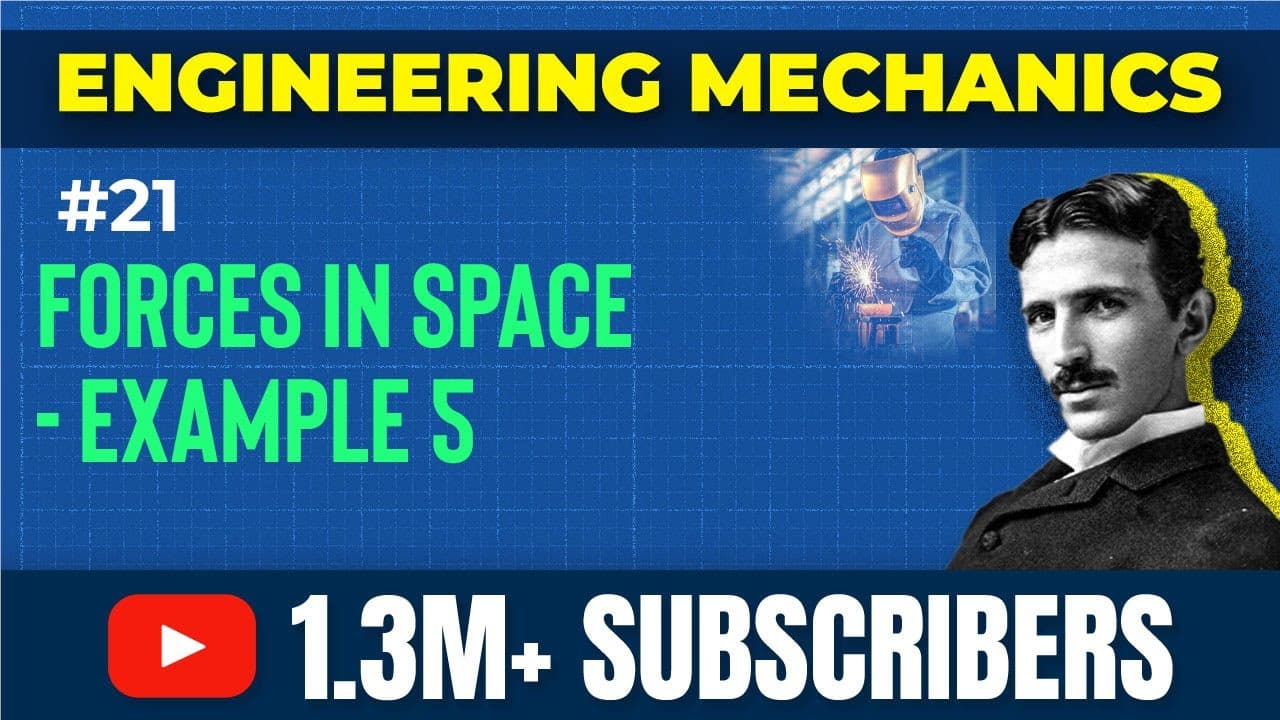
Forces in Space Example 5 - Forces in Space - Engineering Mechanics
TL;DR
Learn how to calculate the magnitude and direction of a force vector in a space using given components and magnitude.
Transcript
do subscribe to ekeeda and press bell icon to get updates about latest engineering hsc and iit-jee mains and advanced videos hello students in this video we will see how to go about solving the next example for forces in space in this example you can see the force vector is already given to us what we need to do is we need to find out the magnitude... Read More
Key Insights
- ❎ The magnitude of a force vector can be calculated by taking the square root of the sum of the squares of its components.
- 💄 The direction of a force vector can be determined by calculating the angles it makes with each axis.
- ❎ When the magnitude of a force vector is negative, the direction angle will also be negative.
- 🤪 The component of a force vector along the z-axis can be negative if the angle with respect to the z-axis is greater than 90 degrees.
- 👾 Understanding how to calculate the magnitude and direction of force vectors is essential in solving problems related to forces in space.
- 🖐️ The components and magnitude of a force vector play a crucial role in determining its magnitude and direction.
- ❎ The mathematical concept of finding the square root of the sum of squares is commonly used in calculating force magnitudes.
Install to Summarize YouTube Videos and Get Transcripts
Explore YouTube Video Summarizer or Get YouTube Transcript Extractor
Questions & Answers
Q: How do you calculate the magnitude of a force vector?
To calculate the magnitude of a force vector, take the square root of the sum of the squares of its components.
Q: How do you find the direction of a force vector?
To find the direction of a force vector, calculate the angles it makes with each axis using the components and magnitude of the force.
Q: What happens when the magnitude of a force vector is negative?
When the magnitude of a force vector is negative, the direction angle will also be negative. This is because the cosine component becomes negative when the angle is greater than 90 degrees.
Q: How can I determine the component of a force vector along the z-axis?
To determine the component of a force vector along the z-axis, calculate the angle with respect to the z-axis. If the angle is greater than 90 degrees, the component will be negative.
Summary & Key Takeaways
-
The video explains how to solve an example problem for forces in space.
-
It shows how to find the magnitude of the force using the components and the square root of their squares.
-
It also demonstrates how to determine the direction of the force by calculating the angles with respect to each axis.
Read in Other Languages (beta)
Share This Summary 📚
Summarize YouTube Videos and Get Video Transcripts with 1-Click
Try YouTube Summary with ChatGPT & Claude or YouTube Transcript Generator
Explore More Summaries from Ekeeda 📚





Summarize YouTube Videos and Get Video Transcripts with 1-Click
Try YouTube Summary with ChatGPT & Claude or YouTube Transcript Generator