Domain and range 2 | Functions and their graphs | Algebra II | Khan Academy
TL;DR
Graphing a function with a given domain and range on the coordinate plane.
Transcript
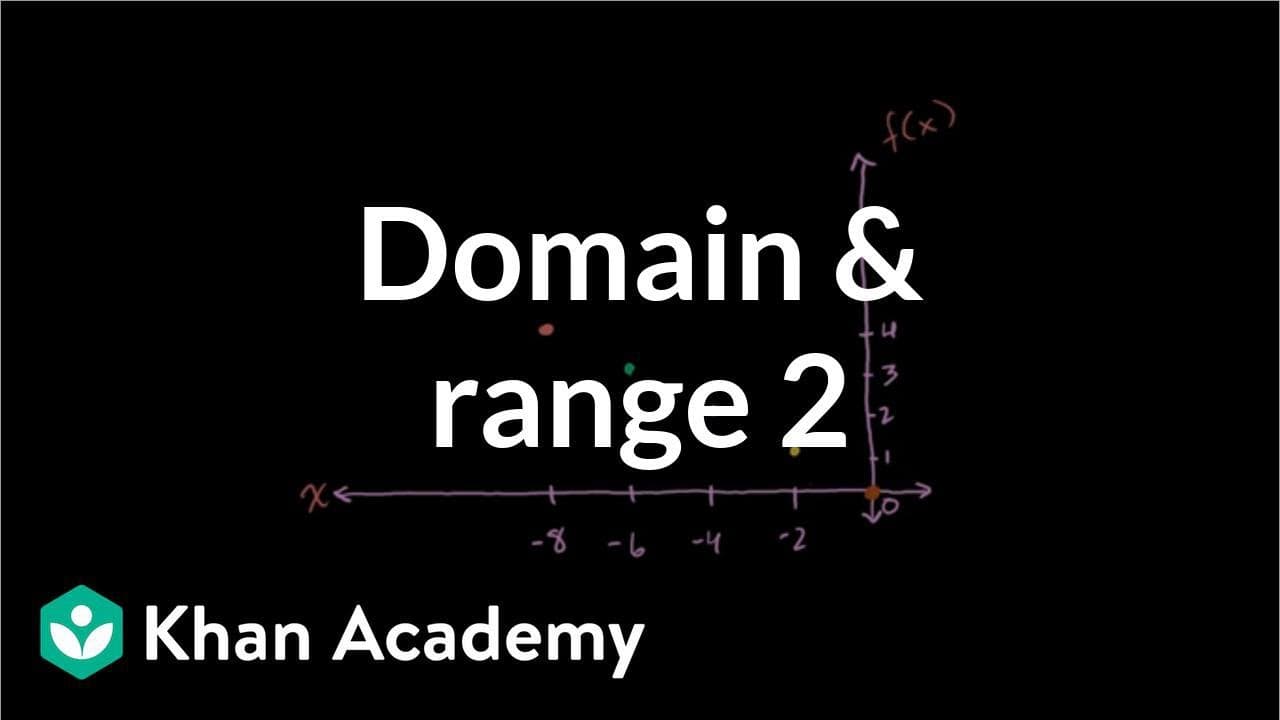
We are asked to represent the following function on the coordinate plane. And they give us domain, and then they give us a range, a set of values that our function can take on. And the way the question has been phrased, I'm assuming they assume that the negative 8 maps to the 4, the negative 6 maps to the 3, the negative 4 maps to the 2, the negati... Read More
Key Insights
- ✈️ The given content discusses how to represent a function on a coordinate plane.
- 🧡 The assumption is made that the values in the domain and range are mapped in order.
- #️⃣ The function's domain consists of non-positive numbers, while the range consists of positive numbers.
- 😥 Graphing the function involves plotting points based on the mapping between domain and range.
- 🧡 Multiple functions can have the same domain and range, but the specific mapping determines the function.
- 😥 The graph of the function in this case consists of five points.
- ❎ The domain values range from 0 to negative 8, with each even negative number included.
- 🧡 The range values range from 0 to 4.
Install to Summarize YouTube Videos and Get Transcripts
Explore YouTube Video Summarizer or Get YouTube Transcript Extractor
Questions & Answers
Q: How do you determine the domain and range of the function in this context?
In this context, the domain is determined by the given values, which include 0 through negative 8 and every even negative number. The range, on the other hand, is determined by the positive values given in the question.
Q: Can there be multiple functions with the same domain and range in this scenario?
Yes, there can be multiple functions with the same domain and range. The specific mapping from the domain to the range determines the function. However, for the purpose of representing the given function, the assumption is made that the mapping is in order.
Q: How are the points on the coordinate plane plotted for this function?
The points are plotted by matching the values of the domain with their corresponding values from the range. For example, if the function maps negative 8 to 4, the point (-8, 4) is plotted on the coordinate plane.
Q: What does the graph of this function look like?
The graph of the function consists of five points plotted on the coordinate plane. These points are (-8, 4), (-6, 3), (-4, 2), (-2, 1), and (0, 0).
Summary & Key Takeaways
-
The question asks to represent a function on the coordinate plane, given a specific domain and range.
-
The function's domain consists of non-positive numbers, while the range consists of positive numbers.
-
By assuming a specific mapping of values from the domain to the range, the function can be graphed on the coordinate plane.
Read in Other Languages (beta)
Share This Summary 📚
Summarize YouTube Videos and Get Video Transcripts with 1-Click
Try YouTube Summary with ChatGPT & Claude or YouTube Transcript Generator
Explore More Summaries from Khan Academy 📚



Summarize YouTube Videos and Get Video Transcripts with 1-Click
Try YouTube Summary with ChatGPT & Claude or YouTube Transcript Generator