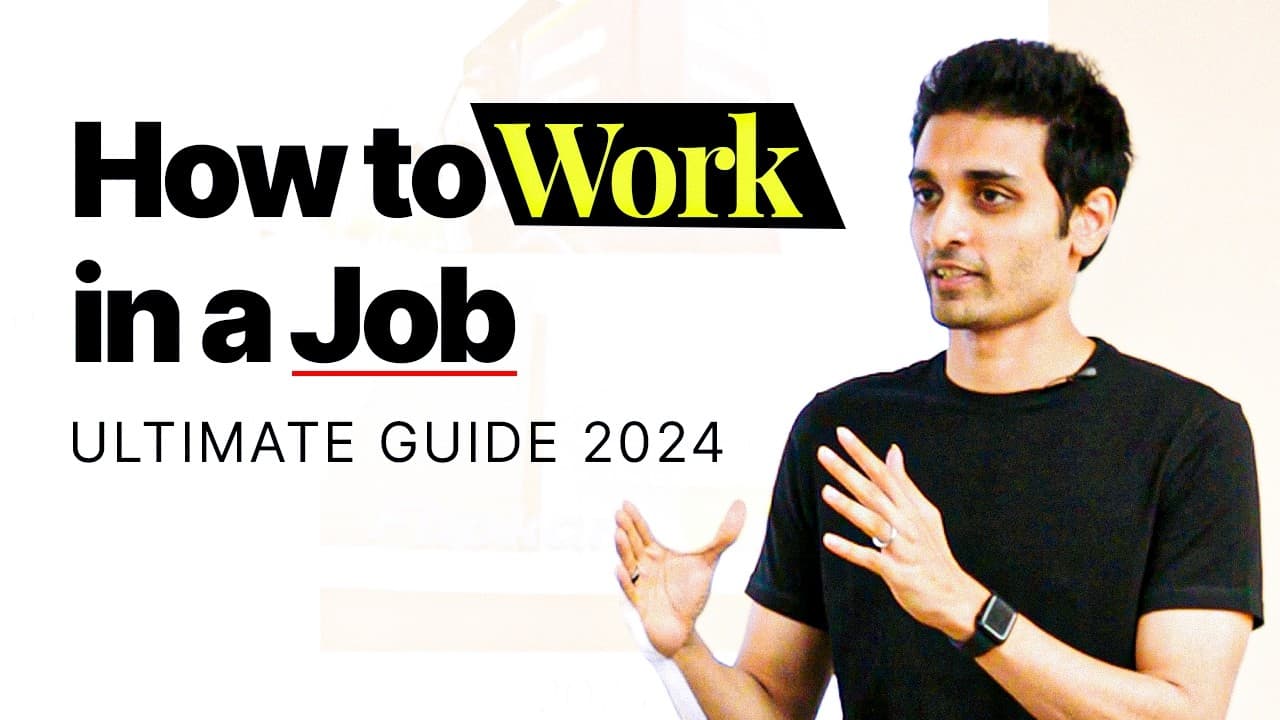
Guide To Work In A Company 2024 | Must Watch | Salaries, Equity, Raises, Negotiations
TL;DR
The pandemic reshaped career trajectories, emphasizing execution over theory, and the challenges young professionals face.
Transcript
something happened after the pandemic something happened after Gio in India uh the modern employees brain is gone case you actually don't get equity for doing work you get equity for taking risk companies don't want Theory anymore they want execution can you build a product that solves a problem for most of you any ESOP you get in any company wheth... Read More
Key Insights
- 🏣 The expectations of the modern workforce have shifted significantly post-pandemic, emphasizing practical outcomes over traditional educational qualifications.
- 📣 There exists a prevalent gap between perceived potential and actual performance metrics, creating challenges for career advancement.
- 💦 Many young professionals are misled by influencers promoting instant success through entrepreneurship, neglecting the realities of hard work and gradual growth.
- 📁 Companies seek serious, committed employees who can show direct contributions to profitability, rather than merely fulfilling theoretical roles.
- 🖐️ Brand equity plays a significant role in career progression; experience with recognized companies can enhance future job prospects.
- 🫡 Longevity in a company often correlates with financial reward and respect, contrary to the rapid job-hopping culture currently observed.
- ℹ️ Social media platforms contribute to unrealistic career benchmarks, making it essential for employees to rely on credible sources of information.
Install to Summarize YouTube Videos and Get Transcripts
Explore YouTube Video Summarizer or Get YouTube Transcript Extractor
Questions & Answers
Q: How did the pandemic change the expectations of modern employees?
The pandemic created a generation of workers who entered the job market without the traditional transition, impacting their perceptions of work ethics and what successful careers should look like. Many young professionals emerged into a landscape dominated by digital content, which often misrepresented realistic career progressions, leading to confusion and frustration.
Q: What skills are employers currently prioritizing in candidates?
Employers especially value practical experience and execution skills over theoretical knowledge. They seek employees who can demonstrate problem-solving abilities and solid outcomes from their work. This shift signifies a move away from classic educational benchmarks towards a results-oriented approach in hiring.
Q: Why is understanding company economics important for employees?
Understanding how a company generates profit, manages expenses, and approaches client relations is critical for employees. This knowledge enables individuals to align their work with the company's goals and adds value, which can improve career stability and growth opportunities within the organization.
Q: What misconceptions do young professionals often have about success?
Many young professionals believe they can achieve quick wealth through entrepreneurship or minimal work efforts, influenced by misleading portrayals in social media. The reality is that achieving financial stability typically requires years of hard work, learning, and sometimes failed ventures before reaching any level of success.
Q: What distinguishes serious companies from unserious ones?
Serious companies have established systems for growth, offer market-competitive salaries, and prioritize employee contributions toward their goals. In contrast, unserious companies often lack clear client bases, financial structures, and viable long-term plans, which can lead to higher employee turnover and less job security.
Q: How can employees negotiate for raises effectively?
Employees should approach negotiations with an understanding of their contribution to the company and the business's financial situation. Demonstrating proven outcomes and alignment with company growth goals can provide leverage when discussing salary increases, particularly after sustained tenure and demonstrated loyalty.
Summary & Key Takeaways
-
The pandemic impacted how modern employees approach their careers, leading to confusion and unrealistic expectations about work and success.
-
Young professionals often lack mentorship on navigating workplace dynamics, making them vulnerable to misinformation from social media about career growth.
-
Successful careers now require a balance of hard work, adaptability, and understanding company economics, challenging the myth of quick riches through entrepreneurship.
Read in Other Languages (beta)
Share This Summary 📚
Summarize YouTube Videos and Get Video Transcripts with 1-Click
Try YouTube Summary with ChatGPT & Claude or YouTube Transcript Generator
Explore More Summaries from Varun Mayya 📚



Summarize YouTube Videos and Get Video Transcripts with 1-Click
Try YouTube Summary with ChatGPT & Claude or YouTube Transcript Generator