Stanford Seminar - Discovering Inspirational Examples in Engineering Design
TL;DR
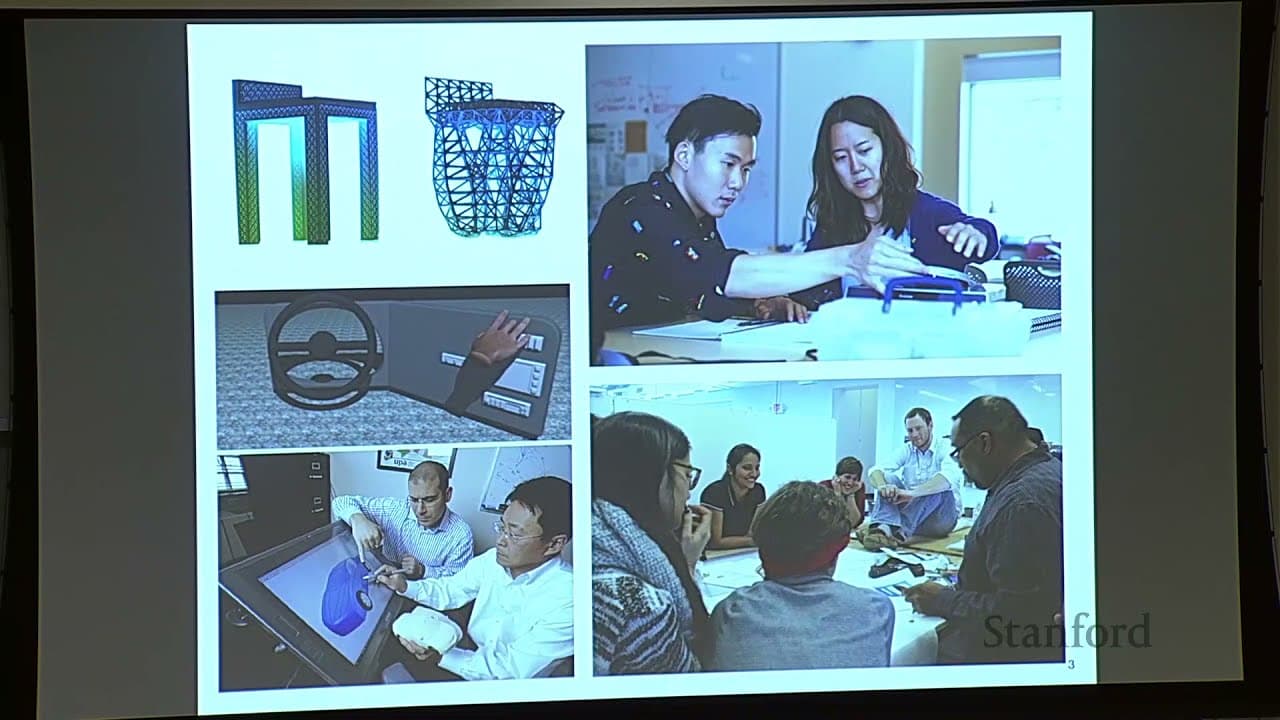
The talk explores the intersection of design behavior, computation, and cognitive science, focusing on finding good examples for designers to inspire their creativity and problem-solving.
Transcript
it's my first time in person also anywhere since beginning of pandemic and i have to admit you know i woke i was telling sean this i woke up this morning i was like why did i sign up to do in person again instead of just lighting on zoom and rolling out but it's also like super invigorating and exciting to do something out of the ordinary instead o... Read More
Key Insights
- 🧑🏭 The research focuses on understanding design behavior by studying factors such as creativity, analogical reasoning, and expertise differences.
- 🎨 The intersection of human behavior, cognition, and computation provides valuable insights into design processes, allowing researchers to learn different aspects of design behavior.
- 👋 Providing good examples and analogies is crucial in inspiring designers and enhancing their decision-making process.
- 😒 Measuring similarity between design concepts is challenging, requiring the use of various computational methods and consideration of appearance and function.
- 🎨 Design support tools need to be scalable, incorporating cognitive and computational methods to measure decision-making strategies and provide personalized examples for designers.
- 🎨 The user experience and interface design of design tools play a significant role in facilitating effective interaction and enhancing the overall design process.
Install to Summarize YouTube Videos and Get Transcripts
Explore YouTube Video Summarizer or Get YouTube Transcript Extractor
Questions & Answers
Q: How does the speaker's research contribute to understanding the differences between experts and novices in the design process?
The speaker's research involves controlled experiments and behavioral studies that aim to understand the differences between experts and novices in design thinking and problem-solving. They explore factors such as creativity, brainstorming methods, and analogical reasoning to identify what makes someone an expert in design.
Q: What challenges are involved in measuring similarity between design concepts, especially in terms of appearance and function?
The speaker acknowledges that measuring similarity between design concepts is challenging. They discuss the use of various computational methods, such as vector-based metrics and network-based methods, to quantify similarity. However, the speaker highlights the difficulties in defining function and the need for more research to improve the accuracy and effectiveness of measuring similarity.
Q: How does the speaker's research address the issue of providing scalable design support tools?
The speaker's research focuses on developing future design support tools that can automatically provide new examples to designers based on their design work. They discuss the use of cognitive and computational methods to measure people's decision-making strategies and monitor their design concepts. The goal is to provide designers with new examples that can influence their decision-making process and potentially lead to more sustainable or feasible designs.
Q: How does the speaker's research incorporate human-computer interaction principles in designing effective interfaces for design tools?
The speaker recognizes the importance of user experience and interface design in facilitating effective interaction between designers and design tools. They discuss the ongoing work of iterating on the interface they have developed and involving professional designers to gather feedback. The aim is to create a user-friendly interface that mediates between human designers and the underlying data, enhancing the overall design process.
Summary & Key Takeaways
-
The speaker discusses their research in studying design behavior, particularly in understanding the processes involved in design and the use of analogies to inspire creativity.
-
They highlight the importance of exploring the intersection of human behavior, cognitive science, and computational methods to gain insights into design behavior.
-
The speaker presents experiments involving crowdsourcing, neuroimaging, and computational modeling to examine the effects of using examples and analogies in the design process.
Read in Other Languages (beta)
Share This Summary 📚
Summarize YouTube Videos and Get Video Transcripts with 1-Click
Try YouTube Summary with ChatGPT & Claude or YouTube Transcript Generator
Explore More Summaries from Stanford Online 📚





Summarize YouTube Videos and Get Video Transcripts with 1-Click
Try YouTube Summary with ChatGPT & Claude or YouTube Transcript Generator