Exponential Growth Or Decay Problem No 1 - Applications of Differential Equations - Diploma Maths II
TL;DR
Learn how to solve problems involving exponential decay and growth using differential equations.
Transcript
click the Bell icon to get latest videos from equator hello friends in this video we are going to see problems which are based on exponential decay or exponential growth using differential equations so let us start with problem number one bacteria multiply at the rate proportional to the numbers present if the original number n doubles in three hou... Read More
Key Insights
- ☠️ The rate of growth or decay is proportional to the original number of bacteria.
- ❓ To solve problems involving exponential growth or decay, differential equations are used.
- ❓ The values of the constants in the general equation can be found by using the given conditions in the problem.
Install to Summarize YouTube Videos and Get Transcripts
Explore YouTube Video Summarizer or Get YouTube Transcript Extractor
Questions & Answers
Q: What does it mean when the rate of growth is proportional to the original number of bacteria?
When the rate of growth is proportional to the original number of bacteria, it means that as the number of bacteria increases, the rate of growth also increases. Similarly, if the number of bacteria decreases, the rate of decay also increases.
Q: How do you solve the differential equation for exponential growth or decay?
To solve the differential equation, you can separate the variables and integrate both sides. This will give you the general equation for exponential growth or decay.
Q: How do you find the values of the constants in the general equation?
The values of the constants can be found by using the conditions given in the problem. For example, if the original number doubles in three hours, you can substitute the values into the equation and solve for the constants.
Q: How can you determine the time it takes for the number of bacteria to reach a certain value?
To determine the time it takes for the number of bacteria to reach a certain value, substitute that value into the general equation and solve for the time variable. This will give you the time it takes for the bacteria to reach that specific number.
Summary & Key Takeaways
-
This video discusses how to solve problems involving exponential decay and growth using differential equations.
-
The rate of growth or decay is proportional to the number of bacteria present.
-
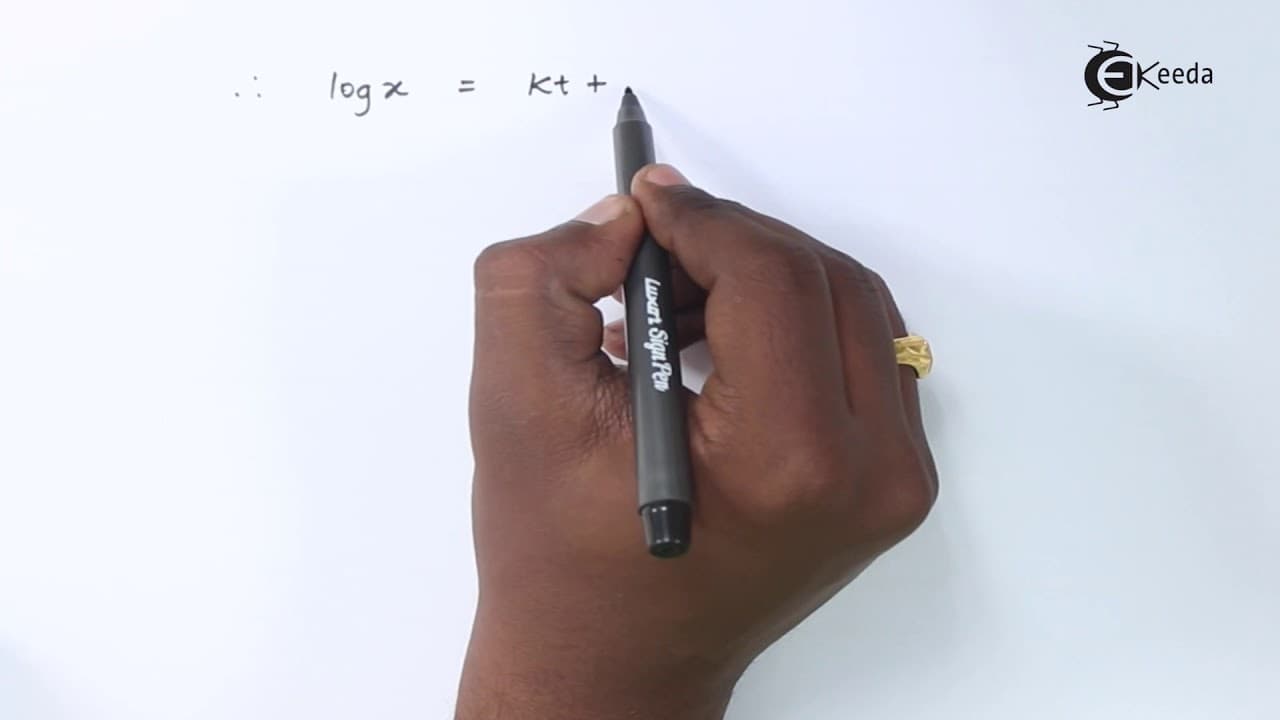
By assuming the number of bacteria at any time T and using differential equations, the general equation can be obtained.
Read in Other Languages (beta)
Share This Summary 📚
Summarize YouTube Videos and Get Video Transcripts with 1-Click
Try YouTube Summary with ChatGPT & Claude or YouTube Transcript Generator
Explore More Summaries from Ekeeda 📚






Summarize YouTube Videos and Get Video Transcripts with 1-Click
Try YouTube Summary with ChatGPT & Claude or YouTube Transcript Generator