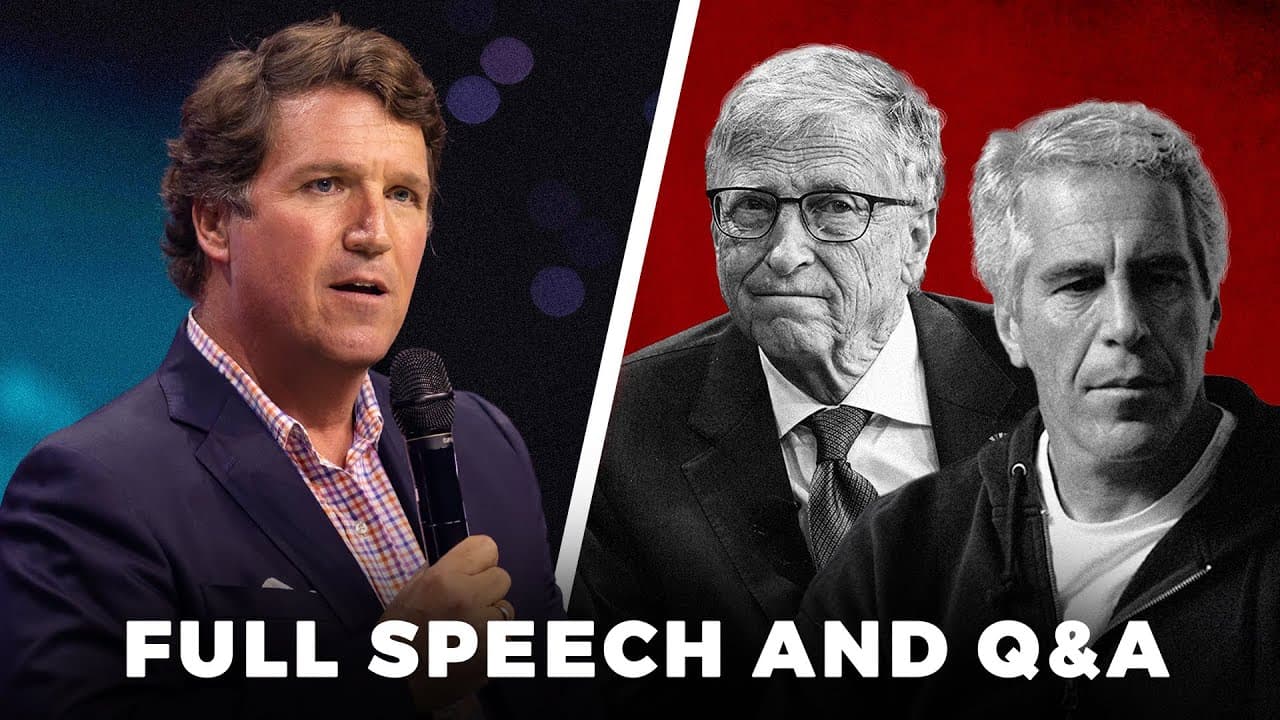
Tucker Carlson’s Message to America on the Epstein Cover-Up | Full Speech
TL;DR
Tucker Carlson questions government transparency and accountability, focusing on Epstein's case.
Transcript
Read and summarize the transcript of this video on Glasp Reader (beta).
Key Insights
- Tucker Carlson criticizes the lack of transparency and accountability in government, particularly regarding the Epstein case, arguing that citizens have a right to ask questions and demand answers.
- He expresses frustration with the political style that dismisses legitimate questions by labeling them as conspiracy theories or hate speech, emphasizing the importance of open dialogue.
- Carlson suggests that Epstein's connections may have involved foreign intelligence services, and he criticizes the taboo surrounding discussions of potential Israeli involvement.
- He argues that the real issue with the Epstein case is the perception that a certain class of people consistently evades justice, which fuels public frustration and distrust.
- Carlson highlights economic issues, such as the inability of young people to afford homes, as a national emergency that needs urgent attention from the government.
- He criticizes the focus on foreign threats and wars, stating that domestic issues like the drug epidemic and economic disparity should be prioritized.
- Carlson calls for a reassessment of US foreign policy, particularly in relation to Cuba and other Latin American countries, suggesting a focus on the Western Hemisphere.
- He argues against dual citizenship and serving in foreign militaries, stating that loyalty should be to one nation, and he questions the current immigration policies.
Install to Summarize YouTube Videos and Get Transcripts
Explore YouTube Video Summarizer or Get YouTube Transcript Extractor
Questions & Answers
Q: Why does Tucker Carlson criticize the government's handling of the Epstein case?
Tucker Carlson criticizes the government's handling of the Epstein case due to a perceived lack of transparency and accountability. He argues that the government dismisses legitimate questions by labeling them as conspiracy theories, which he finds unacceptable. Carlson believes that citizens have the right to demand answers and that the government's refusal to provide them fuels public frustration and distrust.
Q: What is Carlson's stance on dual citizenship?
Tucker Carlson is against dual citizenship, arguing that loyalty should be to one nation. He believes that individuals cannot serve two masters and that serving in foreign militaries should result in the loss of US citizenship. Carlson emphasizes that national loyalty is essential and questions the current policies that allow dual citizenship, suggesting that they undermine national unity.
Q: How does Carlson view the economic challenges facing young Americans?
Carlson views the economic challenges facing young Americans, such as the inability to afford homes, as a national emergency. He argues that these issues should be prioritized over foreign threats and criticizes the economic system that benefits the wealthy at the expense of the middle class. Carlson believes that the inability of young people to own homes affects their sense of ownership and stability, contributing to broader societal issues.
Q: What are Carlson's views on US foreign policy in Latin America?
Carlson suggests a reassessment of US foreign policy in Latin America, arguing that the focus should be on the Western Hemisphere rather than distant regions like the Middle East. He believes that the issues in Latin America, such as migration and drug trafficking, have direct effects on the US and should be prioritized. Carlson questions the effectiveness of current policies, such as the embargo on Cuba, and calls for a focus on regional stability and security.
Q: Why does Carlson criticize the ruling class in America?
Carlson criticizes the ruling class in America for their perceived evasion of justice and the economic system that disproportionately benefits them. He argues that a certain class of people consistently gets away with unethical behavior, which fuels public frustration and distrust. Carlson believes that the economic disparity and lack of accountability contribute to societal unrest and calls for greater transparency and accountability from the ruling class.
Q: What is Carlson's perspective on immigration and amnesty for farm workers?
Carlson is opposed to amnesty for farm workers and criticizes the current immigration policies that he believes have not benefited the country. He argues that the influx of illegal immigrants has not made the country richer or more unified and calls for stricter immigration enforcement. Carlson believes that amnesty is a bad idea and suggests that deportation should be considered instead.
Q: How does Carlson view the criticism of Israel and its government?
Carlson argues that criticism of Israel and its government should not be considered hate speech or anti-Semitic. He believes that US citizens have the right to question the actions of foreign governments, especially when they may affect US interests. Carlson emphasizes that citizenship should be the unifying factor and that identity politics and accusations of bigotry should not be used to silence legitimate questions.
Q: What does Carlson suggest about the US military's focus and deployment?
Carlson questions the US military's focus and deployment, suggesting that resources should be reoriented towards addressing issues in the Western Hemisphere rather than distant regions like the Middle East. He argues that the military should focus on securing the US and addressing domestic issues, such as the drug epidemic and economic disparity, rather than spending resources on foreign conflicts that do not pose an imminent threat to the US.
Summary & Key Takeaways
-
Tucker Carlson's speech at TPUSA in Tampa focuses on the lack of government transparency, particularly regarding the Epstein case. He criticizes the dismissal of legitimate questions as conspiracy theories and emphasizes the right of citizens to demand answers from their government.
-
Carlson discusses the economic challenges facing young Americans, such as the inability to afford homes, and argues that these issues should be prioritized over foreign threats. He criticizes the ruling class for their perceived evasion of justice and the economic system that benefits the wealthy.
-
He suggests a reassessment of US foreign policy, particularly in relation to Cuba and other Latin American countries, and argues against dual citizenship and serving in foreign militaries. Carlson emphasizes the importance of national loyalty and questions current immigration policies.
Read in Other Languages (beta)
Share This Summary 📚
Summarize YouTube Videos and Get Video Transcripts with 1-Click
Try YouTube Summary with ChatGPT & Claude or YouTube Transcript Generator
Explore More Summaries from Tucker Carlson 📚


Summarize YouTube Videos and Get Video Transcripts with 1-Click
Try YouTube Summary with ChatGPT & Claude or YouTube Transcript Generator