Coding Marching Squares
TL;DR
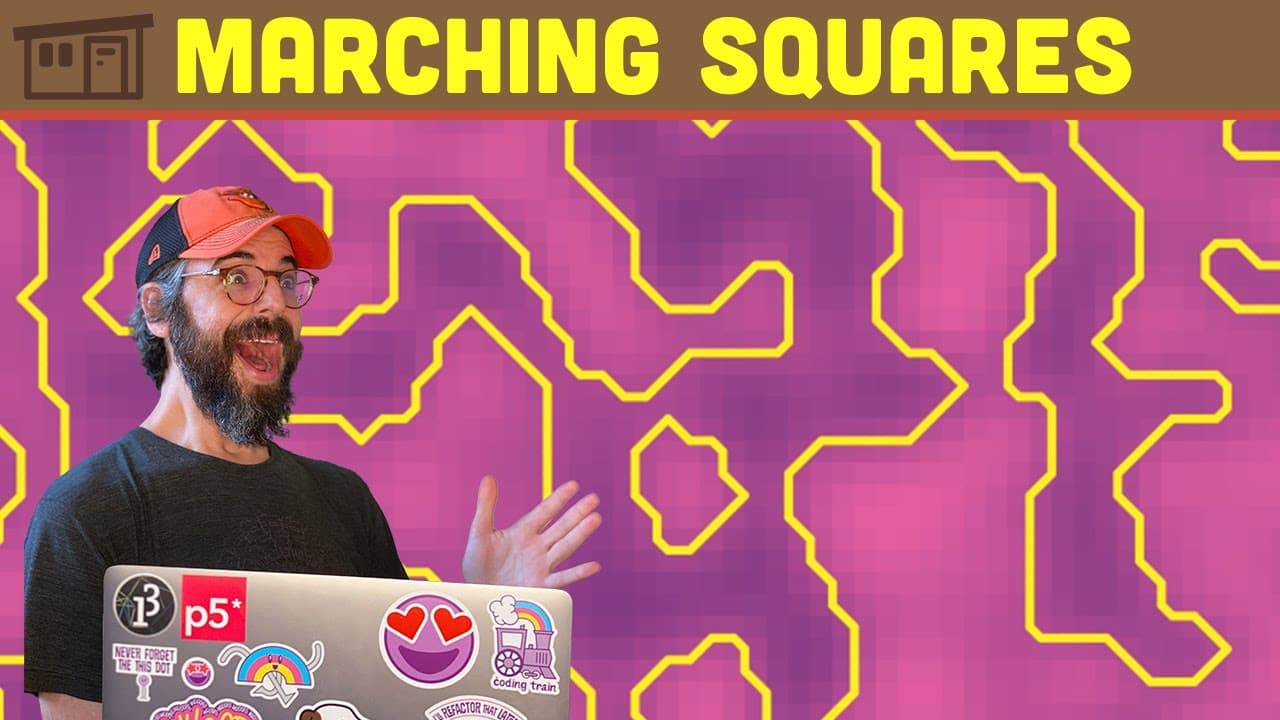
The video explores the application of the marching squares algorithm to create contours and patterns in a two-dimensional scalar field using open simplex noise.
Transcript
welcome to another episode of coding in the Cabana today I am going to tackle something called marching squares the topic of marching squares are marching cubes was originally suggested for the coding train on February 18 2019 by Quinn the sunrise so I do want to try marching cubes I suppose that'll either be in a follow-up video whether it's a Cab... Read More
Key Insights
- 🏑 The marching squares algorithm is a powerful tool for creating contours and patterns in a two-dimensional scalar field.
- ❓ The algorithm can be used with various noise algorithms and variables to generate different effects.
- ❓ Understanding the binary representation of the corner values is important in implementing the algorithm correctly.
- 🥺 Exploring the potential of linear interpolation can lead to smoother and more aesthetically pleasing patterns.
- 👻 The algorithm's versatility allows for a wide range of creative possibilities and applications in computer graphics and visualization.
- 🤗 The video provides a step-by-step explanation of the algorithm and demonstrates its implementation using open simplex noise.
- 🕴️ The marching squares algorithm can be further expanded and modified to suit specific needs and desired visual outcomes.
Install to Summarize YouTube Videos and Get Transcripts
Explore YouTube Video Summarizer or Get YouTube Transcript Extractor
Questions & Answers
Q: What is the purpose of the marching squares algorithm?
The marching squares algorithm is used to generate contours and patterns in a two-dimensional scalar field by analyzing the values of individual points in the grid.
Q: How can the marching squares algorithm be expanded beyond 2D contours?
The algorithm can be expanded to create a variety of effects by using different noise algorithms, incorporating variables such as color, and exploring other fields like 3D terrain generation.
Q: How many possible configurations are there in the marching squares algorithm?
There are 16 possible configurations in the marching squares algorithm, each representing a different arrangement of zeros and ones in the four corners of a square.
Q: Can the marching squares algorithm be used in conjunction with other algorithms?
Yes, the algorithm can be combined with other algorithms, such as meta balls or terrain generation, to create more complex and varied effects in both two and three-dimensional spaces.
Summary & Key Takeaways
-
The video introduces the concept of the marching squares algorithm and its potential for creating contours in a two-dimensional scalar field.
-
The algorithm utilizes the values of individual points in a grid to determine the configuration and draw appropriate lines.
-
The video demonstrates the algorithm by using open simplex noise to generate a noise space and visualize the contours.
Read in Other Languages (beta)
Share This Summary 📚
Summarize YouTube Videos and Get Video Transcripts with 1-Click
Try YouTube Summary with ChatGPT & Claude or YouTube Transcript Generator
Explore More Summaries from The Coding Train 📚




Summarize YouTube Videos and Get Video Transcripts with 1-Click
Try YouTube Summary with ChatGPT & Claude or YouTube Transcript Generator