Statistical Learning: 10.6 Fitting Neural Networks
TL;DR
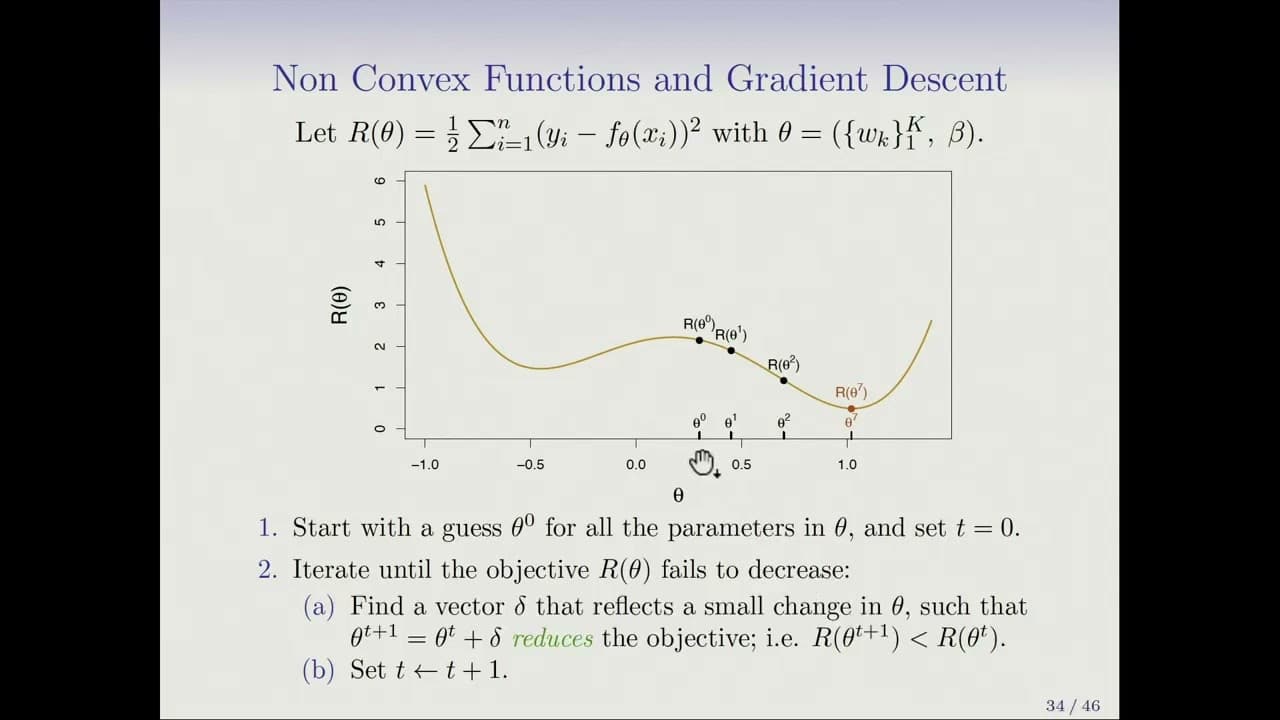
Optimization of neural networks is complex due to non-convex objectives, but effective algorithms have been developed. Techniques include gradient descent, backpropagation, regularization, and data augmentation.
Transcript
so we've got a few more topics the the next topic is fitting neural networks and you see we put the the little uphill car there because this this is potentially a little bit more challenging challenging sorry can i leave now can you leave that now this is if you can if you're going to fall asleep please don't snow it's fascinating stuff okay so we ... Read More
Key Insights
- 🚱 Fitting neural networks involves optimizing non-convex objective functions.
- 🐢 Gradient descent is a slow but effective method to find local minima.
- ❓ Backpropagation facilitates the computation of gradients for network parameter updates.
- 🌉 Regularization techniques, like dropout and ridge regularization, help prevent overfitting.
Install to Summarize YouTube Videos and Get Transcripts
Explore YouTube Video Summarizer or Get YouTube Transcript Extractor
Questions & Answers
Q: Why is fitting neural networks challenging?
Fitting neural networks is challenging because the objective function is often non-convex, meaning it has multiple local minima that need to be avoided. Additionally, finding the global minimum may lead to overfitting.
Q: What is gradient descent?
Gradient descent is an optimization algorithm used to iteratively update the network parameters in the direction of decreasing objective value. It works by calculating the gradient of the objective with respect to the parameters and taking small steps in the opposite direction of the gradient to reach a minimum.
Q: How is backpropagation used in neural network optimization?
Backpropagation is a technique used to compute the gradients of the objective function with respect to the network parameters. It involves propagating the error from the output layer back through the network to update the weights and biases.
Q: How does regularization help in neural network optimization?
Regularization techniques, such as ridge and lasso, can be used to shrink the weights at each layer, preventing overfitting. Dropout is another popular form of regularization that randomly removes units during training to improve generalization.
Summary & Key Takeaways
-
Fitting neural networks involves minimizing the objective, which is often non-convex and challenging.
-
Gradient descent is a common optimization method where parameters are iteratively updated in the direction of decreasing objective value.
-
Backpropagation is used to compute gradients, and the chain rule is applied to calculate derivatives of the objective function with respect to the network parameters.
Read in Other Languages (beta)
Share This Summary 📚
Summarize YouTube Videos and Get Video Transcripts with 1-Click
Try YouTube Summary with ChatGPT & Claude or YouTube Transcript Generator
Explore More Summaries from Stanford Online 📚

Summarize YouTube Videos and Get Video Transcripts with 1-Click
Try YouTube Summary with ChatGPT & Claude or YouTube Transcript Generator