Pigeonhole Principle
TL;DR
The pigeonhole principle is a simple yet powerful combinatorial tool.
Transcript
Read and summarize the transcript of this video on Glasp Reader (beta).
Key Insights
- The pigeonhole principle states that if you have more items than containers, at least one container must hold more than one item.
- Understanding the principle involves identifying the 'pigeons' and 'pigeonholes' in a problem, which can be challenging.
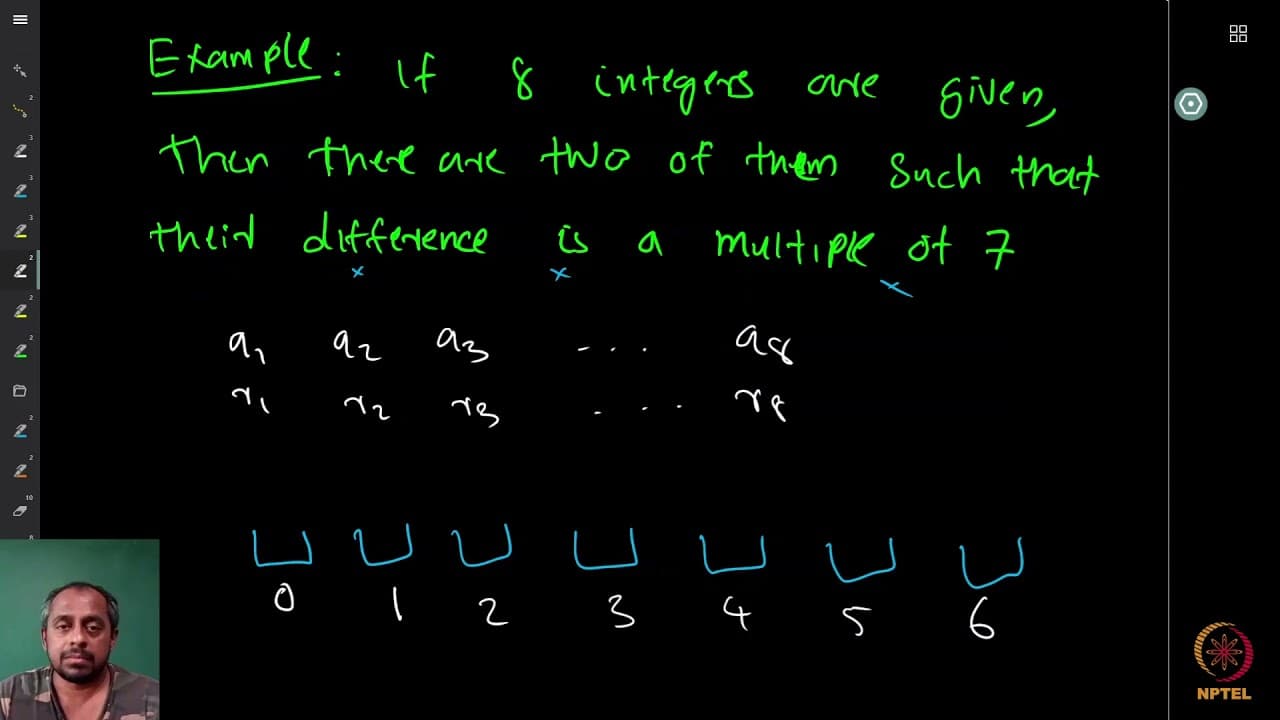
- The principle can be applied to prove that among any group of integers, there are two whose difference is divisible by a given number.
- Combinatorics requires extensive practice as it relies on problem-specific insights rather than general methods.
- The pigeonhole principle can demonstrate that any group of people has either three mutual acquaintances or strangers.
- Graphs can model relationships in combinatorics, with vertices representing entities and edges representing connections.
- Edge coloring in graphs can represent different relationships, such as friendships or enmities.
- Ramsey theory, a significant area in combinatorics, explores order and structure within large, seemingly chaotic sets.
Install to Summarize YouTube Videos and Get Transcripts
Explore YouTube Video Summarizer or Get YouTube Transcript Extractor
Questions & Answers
Q: What is the pigeonhole principle?
The pigeonhole principle is a basic concept in combinatorics which states that if you have more items than containers, at least one container must contain more than one item. This principle is often used to prove the existence of certain properties in mathematical sets, such as demonstrating that within a group, there are two elements with a specific relationship.
Q: How is the pigeonhole principle applied in number theory?
In number theory, the pigeonhole principle can be applied to prove that among any set of integers, there are two whose difference is divisible by a given number. This is done by considering the integers as 'pigeons' and their remainders when divided by the number as 'pigeonholes', ensuring that at least two integers share the same remainder.
Q: Why is practice important in combinatorics?
Practice is crucial in combinatorics because solving problems often requires specific insights rather than general methods. Each problem may demand a unique approach, and gaining familiarity with different types of problems through practice helps in developing the necessary intuition and problem-solving skills.
Q: What is Ramsey theory?
Ramsey theory is an area in combinatorics that explores the emergence of order and structure within large, seemingly chaotic sets. It investigates conditions under which a particular property must appear in sufficiently large collections of objects, such as finding subgroups with specific relationships despite the overall complexity.
Q: How are graphs used in combinatorics?
Graphs are used in combinatorics to model relationships between entities. A graph consists of vertices, representing entities, and edges, representing connections or relationships between them. Graphs can be used to visualize and solve problems involving relationships, such as determining mutual acquaintances or strangers in a group.
Q: What is edge coloring in graph theory?
Edge coloring in graph theory involves assigning colors to the edges of a graph to represent different types of relationships or properties between vertices. For example, in a social network graph, edges could be colored to indicate friendships or enmities, helping to visualize and analyze the structure of the network.
Q: What is a complete graph?
A complete graph is a type of graph in which every pair of distinct vertices is connected by a unique edge. In a complete graph, all possible edges are present, making it a useful model for problems where every entity has a direct relationship with every other entity, such as in certain social network analyses.
Q: How does the pigeonhole principle relate to order in large sets?
The pigeonhole principle relates to order in large sets by demonstrating that within any sufficiently large collection, certain patterns or structures must emerge. Even in large, seemingly disordered sets, the principle ensures the presence of subgroups with specific properties, highlighting the inherent order that arises from the constraints of the set.
Summary & Key Takeaways
-
The pigeonhole principle is a fundamental concept in combinatorics, often used to prove the existence of certain properties in sets. It states that if there are more items than containers, at least one container must hold multiple items. This principle is simple yet powerful, with applications in various mathematical problems.
-
Applying the pigeonhole principle involves identifying what constitutes the 'pigeons' and 'pigeonholes' in a given problem. This identification can be challenging, but once done, the principle can be used to prove results such as the existence of two integers whose difference is divisible by a specific number.
-
Combinatorics is a field that requires practice and experience, as solving problems often involves specific insights rather than general methods. The pigeonhole principle can also be applied to demonstrate that within any group of six or more people, there are three mutual acquaintances or strangers, illustrating the emergence of order within large sets.
Read in Other Languages (beta)
Share This Summary 📚
Summarize YouTube Videos and Get Video Transcripts with 1-Click
Try YouTube Summary with ChatGPT & Claude or YouTube Transcript Generator
Explore More Summaries from NPTEL-NOC IITM 📚






Summarize YouTube Videos and Get Video Transcripts with 1-Click
Try YouTube Summary with ChatGPT & Claude or YouTube Transcript Generator