Fuel and their properties - Part 2 - Gaseous and Liquid fuels
TL;DR
Gaseous fuels are cleaner but less dense; liquid fuels need vaporization.
Transcript
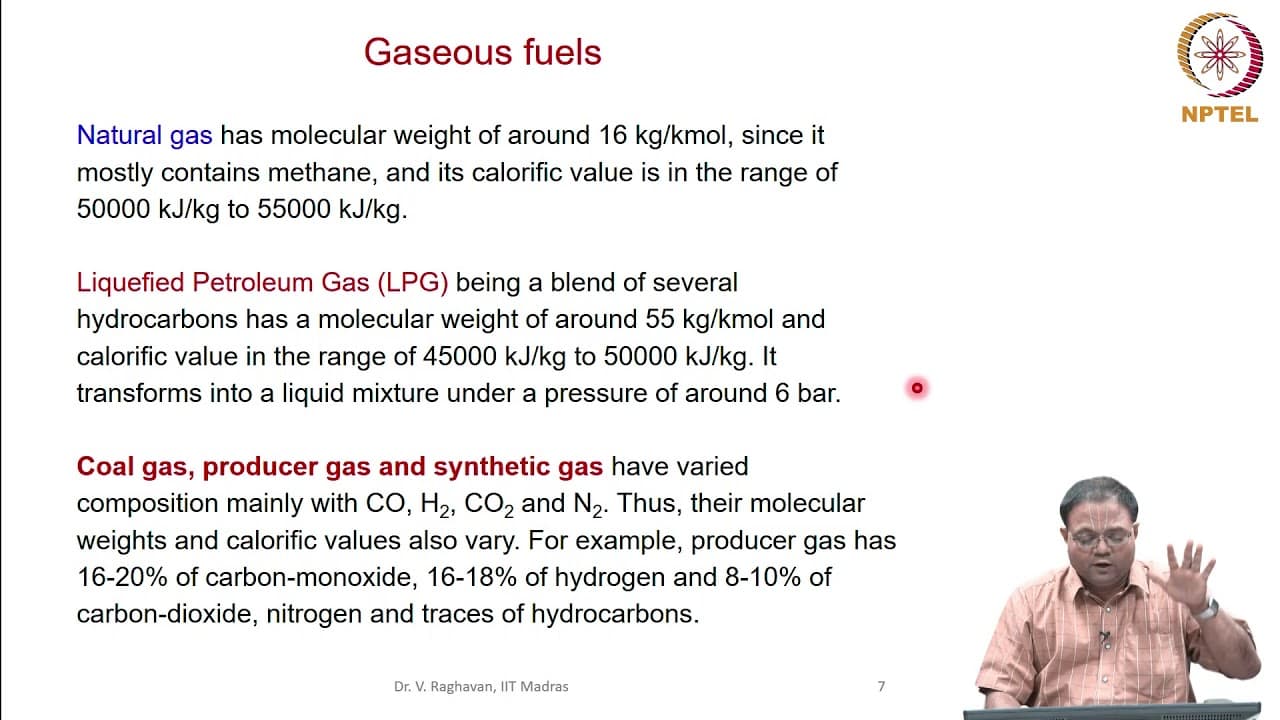
so let us uh see the characteristics of fuels uh starting from gaseous wheels okay so gaseous fuels basically can be classified as a cleaner fuel than when you compare that with the liquid or solid fuels this is because gaseous fields are lighter and they can be stored in a compressed form and when you use this we can just pause it on through some ... Read More
Key Insights
- Gaseous fuels are considered cleaner than liquid or solid fuels due to their ease of use and minimal preprocessing requirements.
- The primary challenge with gaseous fuels is their low density, necessitating compression for storage, which requires careful design of storage vessels.
- Natural gas, primarily methane, and LPG, composed of various hydrocarbons, are common gaseous fossil fuels used for domestic and commercial purposes.
- Synthetic gases are produced from solid fuels like coal and biomass through gasification, offering an alternative to fossil fuels.
- Biogas, derived from animal and plant waste, is a renewable energy source, though its calorific value is lower due to inert gases like CO2.
- Liquid fuels have higher energy density than gaseous fuels, allowing more energy storage in a smaller volume, despite requiring vaporization for combustion.
- Properties like flash point, fire point, and boiling point are crucial for understanding the volatility and flammability of liquid fuels.
- Atomization of liquid fuels is essential for effective combustion, influenced by properties like viscosity and surface tension.
Install to Summarize YouTube Videos and Get Transcripts
Explore YouTube Video Summarizer or Get YouTube Transcript Extractor
Questions & Answers
Q: What are the main advantages of gaseous fuels over liquid fuels?
Gaseous fuels are considered cleaner than liquid fuels because they require no preprocessing and can be directly fed into combustion chambers. This ease of use makes them preferable in applications where minimal handling and processing are desired. Additionally, gaseous fuels can be stored in compressed form, although this requires careful design of storage vessels.
Q: What are the challenges associated with storing gaseous fuels?
The primary challenge with storing gaseous fuels is their low density, which necessitates compression for effective storage. This requires pressure vessels designed to withstand high pressures and equipped with proper valves and regulators to ensure safe and controlled flow into combustion systems. Ensuring leak-proof storage is also crucial to prevent safety hazards.
Q: How are synthetic gases produced, and what are their components?
Synthetic gases are produced through the gasification of solid fuels such as coal and biomass. This process involves partial combustion, resulting in fuel gases like carbon monoxide and hydrogen. The composition can vary based on the gasification process, but these gases often contain inert components like nitrogen and carbon dioxide, which affect their calorific value.
Q: What is biogas, and how is it produced?
Biogas is a renewable energy source produced from the fermentation of animal and plant waste, such as cow dung and vegetable waste. The fermentation process generates a mixture of methane and carbon dioxide. Biogas is considered a sustainable alternative to fossil fuels, although its calorific value is lower due to the presence of inert gases like CO2.
Q: Why is atomization important for liquid fuels in combustion?
Atomization is crucial for liquid fuels because it allows the fuel to vaporize effectively, which is necessary for combustion. By disintegrating the liquid into fine droplets, atomization increases the surface area for vaporization. This process is influenced by the fuel's viscosity and surface tension, which affect how easily the liquid can be atomized and vaporized.
Q: What are the key properties that determine the volatility of liquid fuels?
The volatility of liquid fuels is determined by properties such as flash point, fire point, boiling point, latent heat of vaporization, and specific heat. These properties indicate how easily a fuel can vaporize and combust. A lower flash point means the fuel can produce vapors at lower temperatures, making it more flammable and potentially hazardous.
Q: How do flash point and fire point affect the classification of liquid fuels?
Flash point and fire point are critical for classifying liquid fuels based on their flammability. The flash point is the minimum temperature at which sufficient vapors form to ignite momentarily, while the fire point is the temperature where a sustained flame occurs. Fuels with lower flash and fire points are more flammable and require careful handling.
Q: What is the significance of boiling point in the context of liquid fuels?
The boiling point is significant because it represents the temperature at which a liquid fuel begins to vaporize fully. This property is crucial for understanding how much energy is required to convert the liquid into vapor, which is necessary for combustion. Fuels with higher boiling points require more energy to vaporize, impacting their ease of use in combustion systems.
Summary & Key Takeaways
-
Gaseous fuels are cleaner and easier to use than liquid or solid fuels, requiring no preprocessing. However, their low density poses storage challenges, necessitating compression. Natural gas and LPG are common gaseous fuels, while synthetic gases are produced from solid fuels like coal through gasification.
-
Biogas, derived from waste, is a renewable energy source but has a lower calorific value due to inert gases. Liquid fuels, though requiring vaporization for combustion, offer higher energy density. Properties like flash point and boiling point are crucial for assessing liquid fuel volatility and flammability.
-
Atomization of liquid fuels is essential for combustion, influenced by viscosity and surface tension. Understanding these properties helps in designing burners and combustion chambers for using various fuels efficiently, highlighting the importance of fuel properties in energy applications.
Read in Other Languages (beta)
Share This Summary 📚
Summarize YouTube Videos and Get Video Transcripts with 1-Click
Try YouTube Summary with ChatGPT & Claude or YouTube Transcript Generator
Explore More Summaries from NPTEL-NOC IITM 📚





Summarize YouTube Videos and Get Video Transcripts with 1-Click
Try YouTube Summary with ChatGPT & Claude or YouTube Transcript Generator