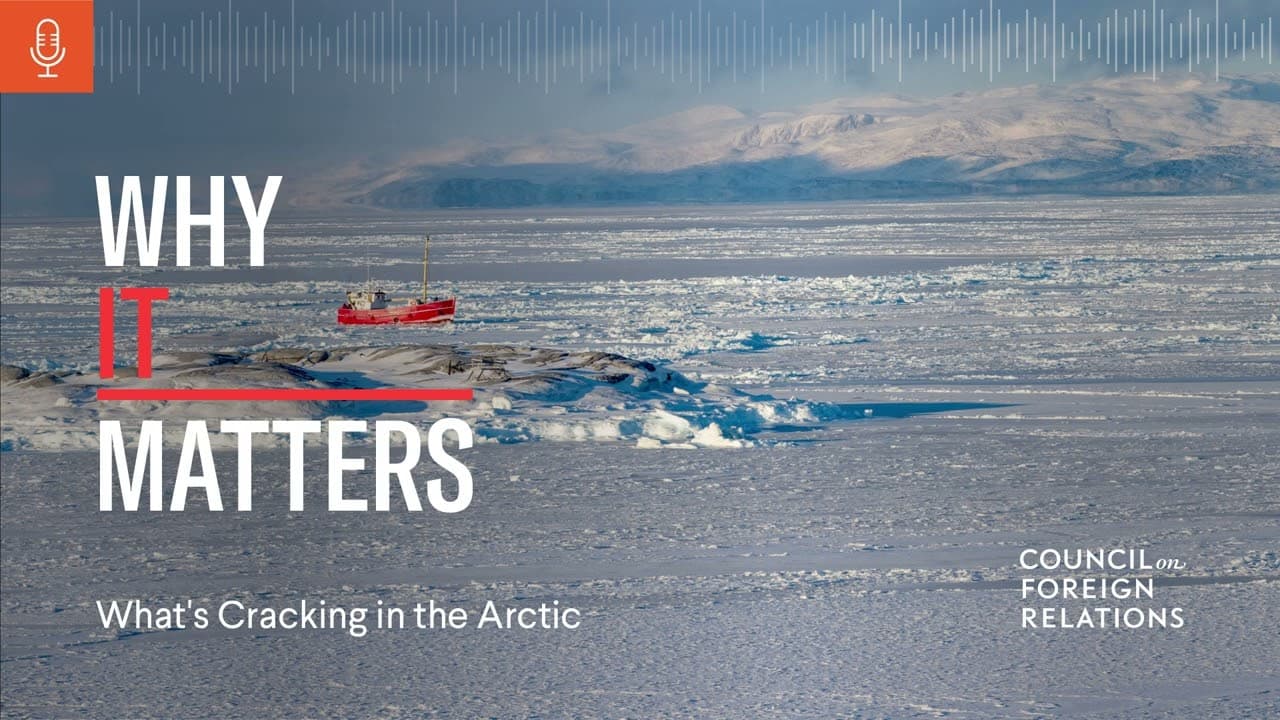
Why is Competition Heating Up in the Arctic?
TL;DR
Melting Arctic ice is sparking geopolitical tensions and resource competition.
Transcript
Captain Jeff RANDALL: Imagine a place that is very white. And all you see around you is ice. All you see is vastness. All you see is great expanses of nothing. The ice never seems to end. It goes on forever. It's an area of immense beauty or immense loneliness. That is the region that is the Arctic. Gabrielle SIERRA: The Arctic. It sits at the t... Read More
Key Insights
- The Arctic is a region of extremes, home to 4 million people and a wealth of resources, making it a focal point for geopolitical interests.
- Climate change is rapidly melting Arctic ice, opening new shipping routes and access to untapped resources, thus increasing global competition.
- No single country owns the Arctic; it is governed by international laws like the United Nations Convention on the Law of the Sea.
- China, though not an Arctic country, has increased its investments in the region, focusing on mineral extraction and military research.
- The Arctic supplies 10% of the world's oil and a quarter of its natural gas, with potential for more resources as ice melts.
- Indigenous communities face threats from climate change and commercial ventures, impacting their traditional ways of life and food sources.
- Russia has increased its military presence in the Arctic, raising concerns among NATO countries about potential conflicts.
- The Arctic Council, an international forum for Arctic cooperation, faces challenges due to geopolitical tensions, particularly involving Russia.
Install to Summarize YouTube Videos and Get Transcripts
Explore YouTube Video Summarizer or Get YouTube Transcript Extractor
Questions & Answers
Q: Why is the Arctic region becoming more important globally?
The Arctic is gaining global importance due to climate change, which is melting ice and opening new shipping routes and access to untapped resources like oil and gas. This has led to increased geopolitical competition among nations seeking to exploit these resources and navigate new trade routes.
Q: What role does the United Nations Convention on the Law of the Sea play in the Arctic?
The United Nations Convention on the Law of the Sea provides a legal framework for governing the Arctic's open waters, prescribing rules for maritime boundaries, resource extraction, and navigation. However, ambiguities remain, leading to disputes over territorial claims and rights to resources.
Q: How is China involved in the Arctic despite not being an Arctic nation?
China has increased its involvement in the Arctic by investing in mineral extraction, scientific research, and military initiatives. It has declared itself a near-Arctic nation and integrated the Arctic into its Belt and Road initiative, aiming to become a 'polar great power.'
Q: What are the potential economic benefits of melting Arctic ice?
Melting Arctic ice opens new shipping routes that can significantly reduce travel distances and fuel costs for global trade. It also provides access to untapped oil and gas reserves, making the region economically attractive for countries and commercial enterprises.
Q: How are Indigenous communities in the Arctic affected by climate change?
Indigenous communities face threats from climate change as it alters migration patterns and impacts traditional food sources. Many communities lack basic infrastructure, making them vulnerable to environmental changes and forcing some to consider relocation.
Q: What is the current military situation in the Arctic?
Russia has expanded its military presence in the Arctic, upgrading bases and investing in infrastructure. This has raised concerns among NATO countries about potential conflicts, leading to increased military exercises and strategic investments in the region.
Q: What challenges does the Arctic Council face?
The Arctic Council, an international forum for Arctic cooperation, faces challenges due to geopolitical tensions, particularly involving Russia. The council's ability to foster cooperation is uncertain, as geopolitical rivalries threaten to overshadow collaborative efforts.
Q: What is the significance of the Arctic's natural resources?
The Arctic is rich in natural resources, supplying 10% of the world's oil and a quarter of its natural gas. As ice melts, more resources may become accessible, providing significant economic opportunities but also leading to increased competition and geopolitical tensions.
Summary & Key Takeaways
-
The Arctic is becoming a geopolitical hotspot due to climate change, which is melting ice and opening new routes and access to resources. This has led to increased competition among nations, particularly the U.S., Russia, and China.
-
The region is governed by international laws, but ambiguities remain, leading to disputes over territorial claims and resource extraction. Indigenous communities are particularly vulnerable to these changes.
-
Military presence is increasing, with Russia expanding its bases and NATO countries responding. The Arctic Council's cooperation is uncertain due to geopolitical tensions, highlighting the need for sustained attention and investment.
Read in Other Languages (beta)
Share This Summary 📚
Summarize YouTube Videos and Get Video Transcripts with 1-Click
Try YouTube Summary with ChatGPT & Claude or YouTube Transcript Generator
Explore More Summaries from Council on Foreign Relations 📚
Summarize YouTube Videos and Get Video Transcripts with 1-Click
Try YouTube Summary with ChatGPT & Claude or YouTube Transcript Generator