Curly arrow conventions in organic chemistry
TL;DR
Understanding the different types of curly arrows used in organic chemistry reactions and their variations.
Transcript
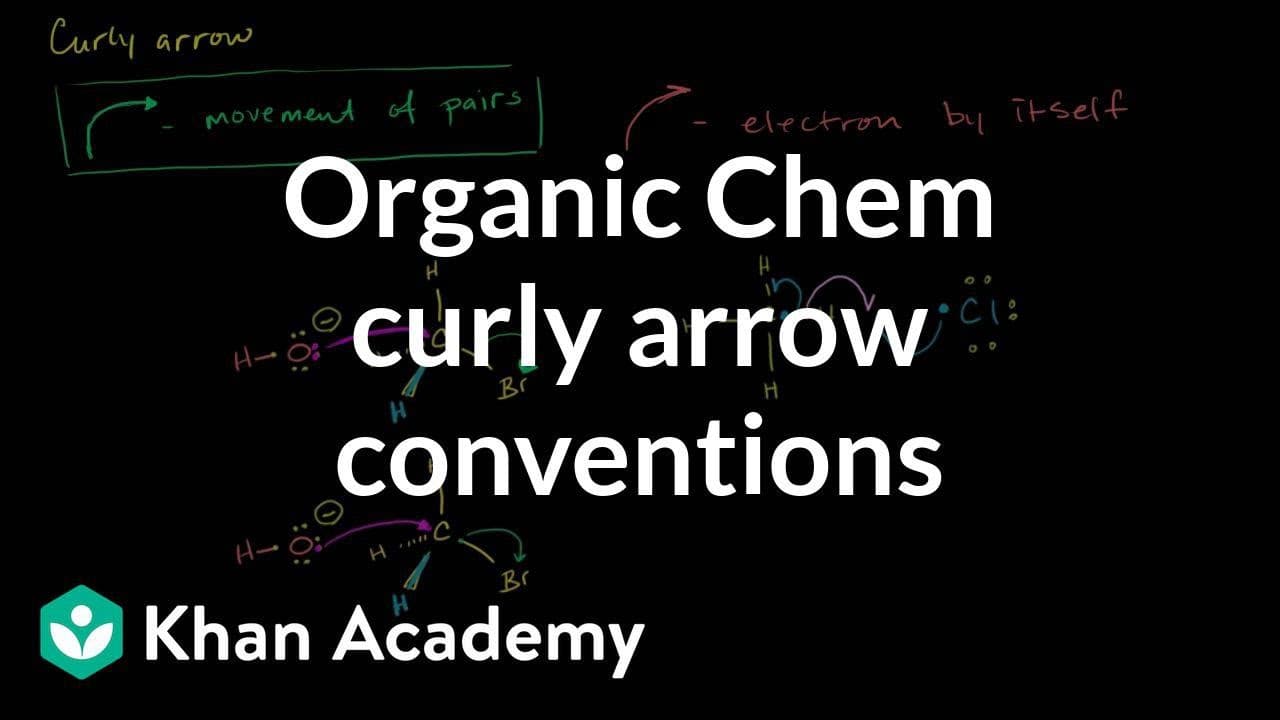
Sal: What I want to do in this video is talk a little bit about the curly arrow conventions used in organic chemistry and the slight variations I use in many of the videos here on Khan Academy. There's two types of curly arrows you will see. You will see a curly full arrow like this, a curly full arrow like this. And I make sure to draw it curly, y... Read More
Key Insights
- 💘 Curly arrows are used to represent electron movement in organic chemistry reactions.
- 💘 Full arrows depict the movement of electron pairs, while half arrows represent electrons moving individually.
- 💘 Curly arrow variations help in accounting for electrons and understanding reaction mechanisms.
- 💘 Full arrows are commonly used in organic chemistry, while half arrows are more prevalent in free radical reactions.
- 💘 Breaking bonds can be visualized as one atom gaining both electrons using a full arrow or each atom gaining one electron using half arrows.
- 💘 Curly arrows help simplify complex electron distributions in covalent bonds.
- 💘 Understanding the conventions of curly arrows aids in building intuition and conceptualizing electron movement.
Install to Summarize YouTube Videos and Get Transcripts
Explore YouTube Video Summarizer or Get YouTube Transcript Extractor
Questions & Answers
Q: What are the two types of curly arrows used in organic chemistry?
The two types of curly arrows used are full arrows, representing the movement of electron pairs, and half arrows, representing the movement of electrons by themselves.
Q: How does the slight variation in curly arrow conventions help?
The variation in drawing the full arrow helps in accounting for electrons and visualizing how electron movement occurs in a reaction.
Q: When are full arrows typically used?
Full arrows are typically used to represent the movement of electron pairs and are commonly observed in most organic chemistry reactions.
Q: When are half arrows used?
Half arrows, also known as fish hook arrows, are used to represent the movement of electrons by themselves, especially in free radical reactions.
Summary & Key Takeaways
-
There are two types of curly arrows used in organic chemistry: curly full arrows and curly half arrows.
-
The convention is that the full arrow represents the movement of electron pairs, while the half arrow represents the movement of electrons by itself.
-
The slight variation in curly arrow conventions helps in visualizing and conceptualizing electron movement.
Read in Other Languages (beta)
Share This Summary 📚
Summarize YouTube Videos and Get Video Transcripts with 1-Click
Try YouTube Summary with ChatGPT & Claude or YouTube Transcript Generator
Explore More Summaries from Khan Academy 📚



Summarize YouTube Videos and Get Video Transcripts with 1-Click
Try YouTube Summary with ChatGPT & Claude or YouTube Transcript Generator