Products
Features
YouTube Video Summarizer
Summarize YouTube videos
Web & PDF Highlighter
Highlight web pages & PDFs
Chat with PDF
Ask any PDF questions with AI
Ask AI Clone
Chat with your highlights & memories
Audio Transcriber
Transcribe audio files to text
Glasp Reader
Read and highlight articles
Kindle Highlight Export
Export your Kindle highlights
Idea Hatch
Hatch ideas from your highlights
Integrations
Obsidian Plugin
Notion Integration
Pocket Integration
Instapaper Integration
Medium Integration
Readwise Integration
Snipd Integration
Hypothesis Integration
Apps & Extensions
Chrome Extension
Safari Extension
Edge Add-ons
Firefox Add-ons
iOS App
Android App
Discover
Discover
Ideas
Discover new ideas and insights
Articles
Curated articles and insights
Books
Book recommendations by great minds
Posts
Essays and notes from readers
Quotes
Inspiring quotes collection
Videos
Curated videos and summaries
Explore Glasp
Glasp Newsletter
Weekly insights and updates
Glasp Talk
Interview series with great minds
Glasp Blog
Latest news and articles
Glasp Use Cases
Learn how others use Glasp
Build & Support
Glasp API
Access Glasp's API for developers
MCP Connector
Connect Glasp to Claude & ChatGPT
Community
Glasp Reddit Community
Students
Student discount and benefits
FAQs
Frequently Asked Questions
AboutPricing
DashboardLog inSign up

Stanford Seminar - Online Political Ad Transparency
December 10, 2020
by
Stanford Online
YouTube video player
Stanford Seminar - Online Political Ad Transparency

TL;DR

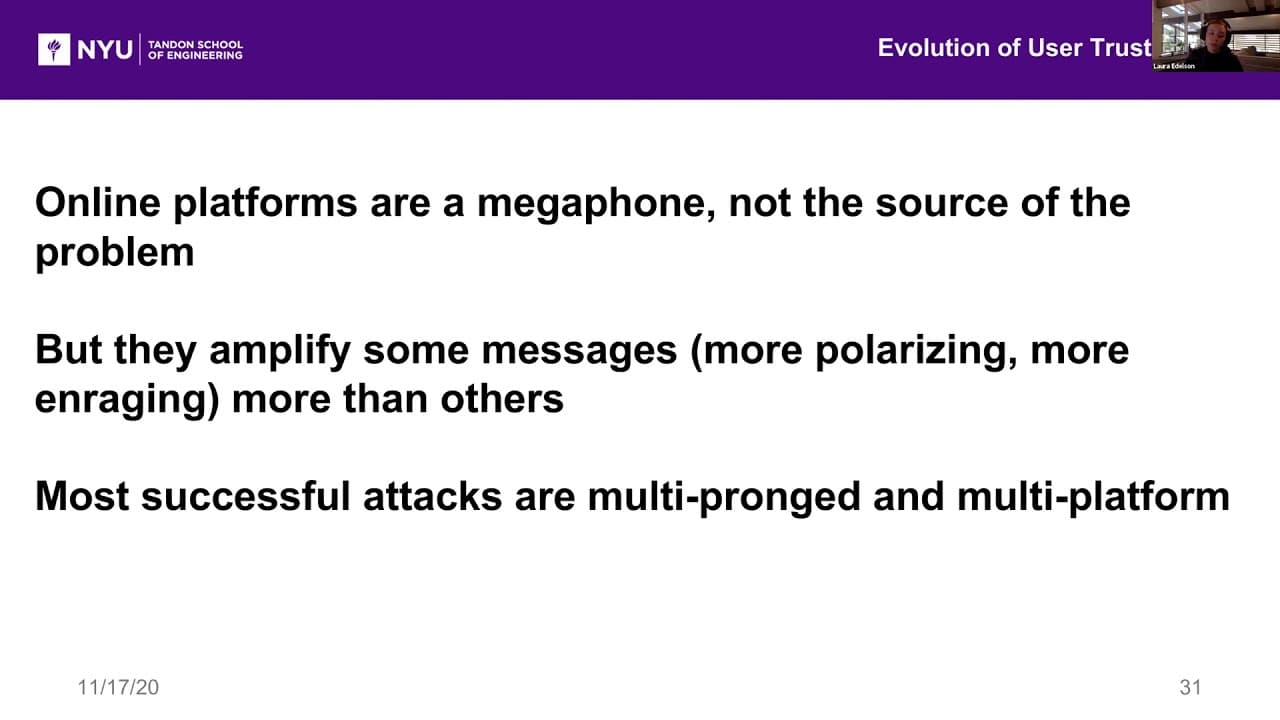
User trust attacks in digital political advertising exploit users' trust in social networks and institutions to promote false beliefs for specific actions.

Transcript

good day um my name is dennis allison i'm hosting uh ee 380 the stanford computer systems colloquium today's speakers are damon mccoy and laura edelson they're at nyu where they're doing work in well the internet and all the things that come along with it um in any case uh you're on um you know i very interested in hearing what you've been doing an... Read More

Key Insights

  • 👊 User trust attacks exploit trust in social networks and institutions for political advertising purposes.
  • 🎯 False beliefs are promoted through questions, non-specific claims, and targeted messaging.
  • 👊 These attacks have evolved to include commercially motivated campaigns.
  • 👊 Transparency initiatives and enforcement are critical in countering user trust attacks.
  • 📟 Clustering and data analysis tools can help identify undisclosed coordinated pages.
  • 👤 Future solutions may involve better user control and prioritization of content.
  • 😵 Cross-platform collaboration is necessary to combat user trust attacks effectively.

Install to Summarize YouTube Videos and Get Transcripts

Explore YouTube Video Summarizer or Get YouTube Transcript Extractor

Questions & Answers

Q: What are user trust attacks in digital political advertising?

User trust attacks are tactics used by advertisers to exploit users' trust in social networks and institutions, promoting false beliefs to manipulate actions and perceptions.

Q: How do user trust attacks exploit trust in identity and location?

Advertisers may pretend to share identity metrics or pretend to be nearby neighbors to gain trust. They may also pose as trusted institutions or exploit trust in the offices they hold.

Q: What types of false beliefs do these attacks promote?

User trust attacks promote false beliefs related to topics such as fraudulent mail-in voting, leftist violence in suburbs, or Joe Biden's stance on fracking. They often ask questions or make non-specific threatening claims to manipulate users' beliefs.

Q: Why is careful targeting essential for user trust attacks to be effective?

User trust attacks need to target users within specific trust networks to be most effective. Ads shown outside of the trust network have less credibility, making it easier to detect the manipulative nature of the ads.

Summary & Key Takeaways

  • User trust attacks exploit trust in social networks and institutions, using tactics such as pretending to share identity or geographic location.

  • These attacks promote false beliefs, often asking questions or making non-specific threatening claims to manipulate users' perception of reality.

  • User trust attacks are evolving, with advertisers using more polarizing campaigns and targeting specific trust networks.


Read in Other Languages (beta)

English

Share This Summary 📚

Summarize YouTube Videos and Get Video Transcripts with 1-Click

Download browser extensions on:

Try YouTube Summary with ChatGPT & Claude or YouTube Transcript Generator

Explore More Summaries from Stanford Online 📚
Stanford CS224N NLP with Deep Learning | Winter 2021 | Lecture 16 - Social & Ethical Considerations thumbnail
Stanford CS224N NLP with Deep Learning | Winter 2021 | Lecture 16 - Social & Ethical Considerations
Stanford Online
Stanford CS229: Machine Learning | Summer 2019 | Lecture 20 - Variational Autoencoder thumbnail
Stanford CS229: Machine Learning | Summer 2019 | Lecture 20 - Variational Autoencoder
Stanford Online
Stanford Webinar - GPT-3 & Beyond thumbnail
Stanford Webinar - GPT-3 & Beyond
Stanford Online
Bayesian Networks 4 - Probabilistic Inference | Stanford CS221: AI (Autumn 2021) thumbnail
Bayesian Networks 4 - Probabilistic Inference | Stanford CS221: AI (Autumn 2021)
Stanford Online
Stanford AA228/CS238 Decision Making Under Uncertainty I Policy Gradient Estimation and Optimization thumbnail
Stanford AA228/CS238 Decision Making Under Uncertainty I Policy Gradient Estimation and Optimization
Stanford Online

Summarize YouTube Videos and Get Video Transcripts with 1-Click

Download browser extensions on:

Try YouTube Summary with ChatGPT & Claude or YouTube Transcript Generator

Apps & Extensions

  • Chrome Extension
  • Safari Extension
  • Edge Add-ons
  • Firefox Add-ons
  • iOS App
  • Android App

Key Features

  • YouTube Video Summarizer
  • Web & PDF Summarizer
  • Web & PDF Highlighter
  • Chat with PDF
  • Ask AI Clone
  • Audio Transcriber
  • Glasp Reader
  • Kindle Highlight Export
  • Idea Hatch

Integrations

  • Obsidian Plugin
  • Notion Integration
  • Pocket Integration
  • Instapaper Integration
  • Medium Integration
  • Readwise Integration
  • Snipd Integration
  • Hypothesis Integration

More Features

  • APIs
  • MCP Connector
  • Blog & Post
  • Embed Links
  • Image Highlight
  • Personality Test
  • Quote Shots

Company

  • About us
  • Blog
  • Community
  • FAQs
  • Job Board
  • Newsletter
  • Pricing
Terms

•

Privacy

•

Guidelines

© 2026 Glasp Inc. All rights reserved.