What Are Common English Idioms and Their Meanings?
TL;DR
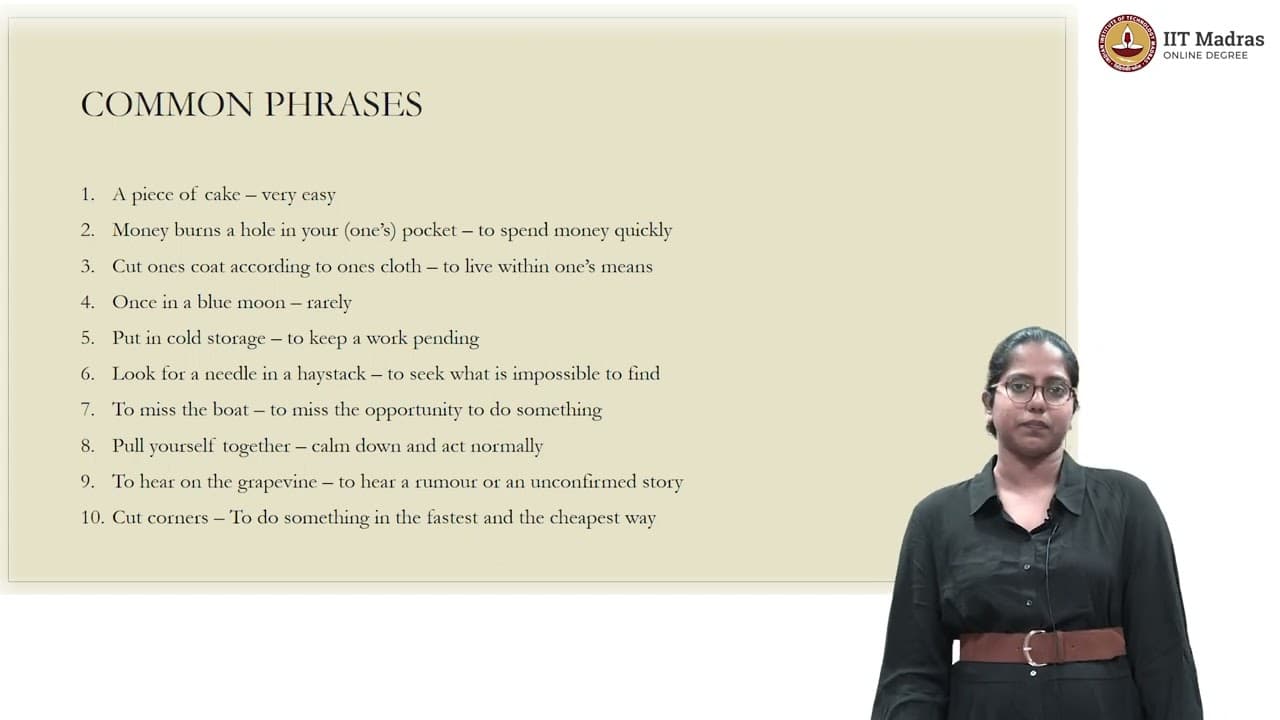
Common English idioms convey metaphorical meanings that enhance communication. For example, 'kick the bucket' means 'to die,' and 'bite the bullet' means to endure a painful situation. Understanding these idiomatic expressions can significantly improve your ability to communicate expressively and effectively.
Transcript
Read and summarize the transcript of this video on Glasp Reader (beta).
Key Insights
- Phrases are groups of words with specific meanings, often idiomatic, like 'kick the bucket' or 'all rights reserved'.
- Euphemisms are polite expressions for topics that might be uncomfortable, such as 'kicked the bucket' for death.
- Proverbs express truths based on experience, like 'An apple a day keeps the doctor away', emphasizing health benefits.
- Idioms have metaphorical meanings distinct from their literal words, such as 'break a leg' meaning 'good luck'.
- Examples of common idioms include 'a dark horse' for an unexpected winner and 'bite the bullet' for facing difficulties.
- 'Kill two birds with one stone' means achieving two goals with one effort, illustrating efficiency in actions.
- Expressions like 'out of my league' signify feeling inferior, while 'blessing in disguise' indicates hidden benefits.
- 'Actions speak louder than words' and 'bite off more than you can chew' emphasize the importance of actions over words.
Install to Summarize YouTube Videos and Get Transcripts
Explore YouTube Video Summarizer or Get YouTube Transcript Extractor
Questions & Answers
Q: What is a euphemism and can you provide an example?
A euphemism is a polite word or expression used to refer to subjects that might be upsetting or embarrassing. For example, the phrase 'kicked the bucket' is a euphemism for dying. Euphemisms are often used to soften the impact of discussing sensitive topics like death, sex, or bodily functions.
Q: How do idioms differ from their literal meanings?
Idioms are phrases whose meanings are metaphorical and differ from the literal meanings of their words. For instance, 'break a leg' is an idiom that means 'good luck', not literally breaking a leg. The metaphorical sense of idioms is widely accepted and used in common language, providing colorful and expressive ways to communicate ideas.
Q: Can you explain the idiom 'kill two birds with one stone'?
The idiom 'kill two birds with one stone' means to achieve two objectives with a single effort. It emphasizes efficiency and effectiveness in actions. For example, listening to audiobooks while jogging allows someone to both exercise and learn, thus achieving two goals simultaneously with one activity.
Q: What does the phrase 'a dark horse' refer to?
The phrase 'a dark horse' refers to an unexpected winner or someone whose abilities or achievements are not initially apparent. It is often used in contexts like competitions or elections where an individual or entity surprises others by succeeding or performing better than anticipated.
Q: How is the expression 'blessing in disguise' used?
The expression 'blessing in disguise' describes a situation that initially seems bad but ultimately turns out to be beneficial. For example, a car breaking down might seem unfortunate, but if it leads to reduced unnecessary travel and cost savings, it can be considered a blessing in disguise.
Q: What does 'out of my league' imply?
The phrase 'out of my league' implies that someone perceives another person as superior or unattainable, often in terms of attractiveness, intelligence, or social status. It reflects feelings of inadequacy or inferiority when comparing oneself to someone perceived as better or more accomplished.
Q: Explain the idiom 'bite off more than you can chew'.
The idiom 'bite off more than you can chew' means attempting to do something that is too difficult or beyond one's capacity. It suggests overestimating one's abilities or resources, leading to challenges or failure. For example, taking on multiple jobs simultaneously might result in being overwhelmed and unable to manage them effectively.
Q: What does 'actions speak louder than words' signify?
The phrase 'actions speak louder than words' signifies that what a person actually does has more significance and impact than what they say they will do. It highlights the importance of deeds over promises, emphasizing that true intentions and capabilities are better demonstrated through actions rather than mere words.
Summary & Key Takeaways
-
This module explores phrases, sayings, and idioms to enhance everyday language. It covers definitions and examples of euphemisms, proverbs, and idioms. Key phrases like 'a dark horse' and 'bite the bullet' are explained with usage examples, showing how they enrich communication.
-
The lesson provides a comprehensive understanding of idiomatic expressions, including 'kill two birds with one stone' for achieving dual goals and 'blessing in disguise' for unexpected benefits. These idioms help convey complex ideas succinctly and memorably.
-
The course, taught by Ms. Karthika Sathyanathan, aims to improve expressive communication by teaching idiomatic phrases. It includes practical examples and usage scenarios, emphasizing the importance of understanding metaphorical meanings for effective language use.
Read in Other Languages (beta)
Share This Summary 📚
Summarize YouTube Videos and Get Video Transcripts with 1-Click
Try YouTube Summary with ChatGPT & Claude or YouTube Transcript Generator
Explore More Summaries from IIT Madras - B.S. Degree Programme 📚




Summarize YouTube Videos and Get Video Transcripts with 1-Click
Try YouTube Summary with ChatGPT & Claude or YouTube Transcript Generator