What Are Key Concepts in Weeks 1-4 of Course?
TL;DR
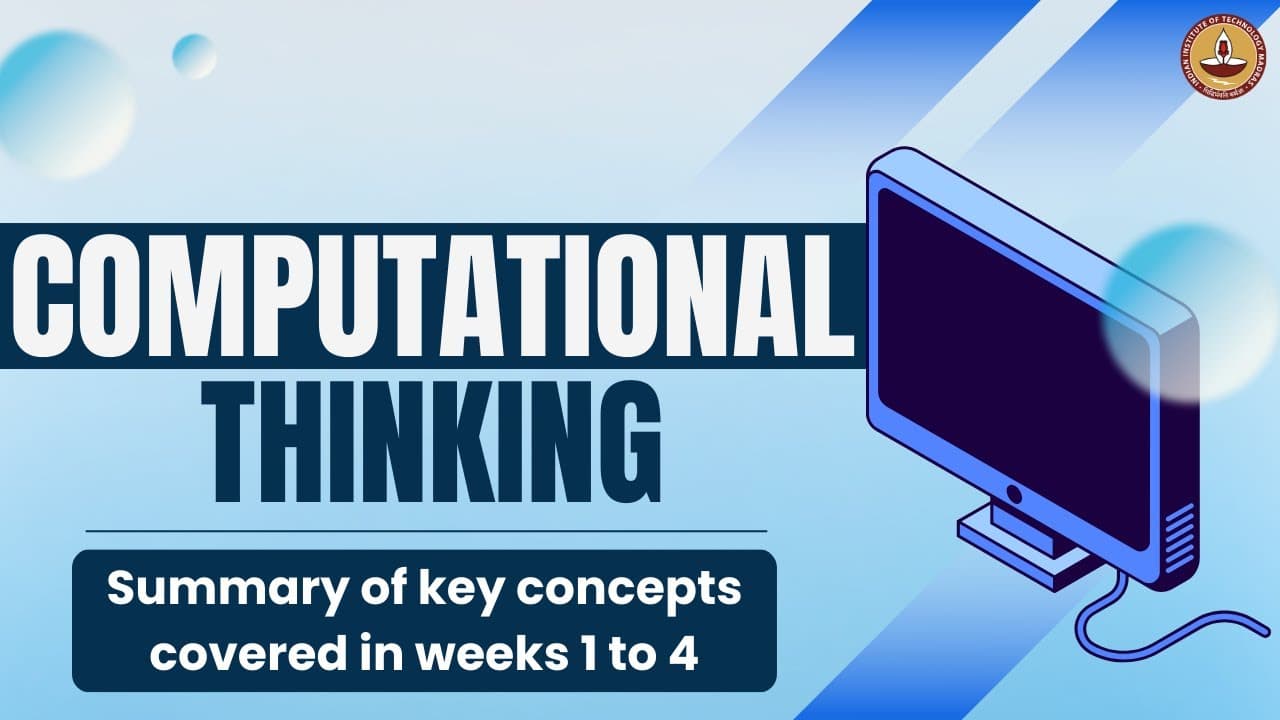
The first four weeks of the course cover foundational concepts such as iteration, variables, data types, and pseudocode. Students learn about iterators, flowcharts, and filtering techniques. These concepts are crucial for understanding computational thinking and will be tested in the upcoming qualifier exam.
Transcript
So, we have now finished four weeks of classes in this course, so it might be a good idea to take stock of where we are, what we have studied in the four weeks, especially since what you studied in these four weeks will also make up for the content that you will have for the qualifier exam which is coming shortly. So, take a quick review of all the... Read More
Key Insights
- Iteration is a fundamental pattern in computational thinking, involving repeated steps until a condition is met.
- Variables are used to store changing values during iteration, while constants remain unchanged.
- Flowcharts can visually represent iteration processes using symbols like terminal, process, and decision boxes.
- Pseudocode provides a textual way to express flowcharts, using constructs like assignment statements and loops.
- Data types such as Boolean, integer, character, and string are essential for ensuring data integrity.
- Filtering within iteration allows for selective processing based on conditions, using if statements.
- Procedures help manage code complexity by encapsulating reusable code with parameters.
- Descriptive statistics involve using iteration to summarize data, such as calculating averages or identifying maximum values.
Install to Summarize YouTube Videos and Get Transcripts
Explore YouTube Video Summarizer or Get YouTube Transcript Extractor
Questions & Answers
Q: What is iteration in computational thinking?
Iteration is a fundamental pattern in computational thinking that involves executing a series of steps repeatedly until a specific condition is met. It is commonly used to automate repetitive tasks, and understanding iteration is crucial for problem-solving in programming. The process typically involves initialization, execution of repeated steps, and a condition to determine when to stop.
Q: How do variables function in iteration?
In iteration, variables are used to store values that change throughout the execution of the repeated steps. They are initialized at the beginning and updated during each iteration cycle. This allows for dynamic tracking of data, such as accumulating sums or counts, enabling the computation of final results like totals or averages by the end of the iteration.
Q: What role do flowcharts play in iteration?
Flowcharts serve as a visual representation of the iteration process, using specific symbols to denote different actions. They help in outlining the sequence of steps, including starting and ending points, decision-making processes, and variable updates. Flowcharts aid in planning and communicating the logic of iteration, making complex processes easier to understand and implement.
Q: Why is pseudocode important in programming?
Pseudocode is important because it provides a structured, language-agnostic way to describe algorithms and computational processes. It bridges the gap between human thinking and computer programming by using simple, readable syntax to outline the logic of a program. Pseudocode helps in planning and testing algorithms before actual coding, ensuring clarity and reducing errors.
Q: What are basic data types and their significance?
Basic data types, such as Boolean, integer, character, and string, define the kind of data that can be stored and manipulated within a program. They ensure data integrity by restricting the values that variables can hold. Understanding data types is crucial for effective data management and operations, as they dictate the permissible actions and constraints on data elements.
Q: How does filtering work within iteration?
Filtering within iteration involves applying conditions to selectively process certain data elements. Using if statements, programmers can decide whether to execute specific operations based on the attributes of each element. This allows for targeted data manipulation, such as summing only the marks of male students or identifying items that meet certain criteria, enhancing the efficiency of data processing.
Q: What is the purpose of procedures in programming?
Procedures are used in programming to encapsulate reusable code segments, reducing redundancy and simplifying complex programs. By defining a procedure, programmers can execute the same set of instructions with different parameters, improving code readability and maintainability. Procedures help in organizing code logically, making it easier to debug and extend functionalities without rewriting code.
Q: How are descriptive statistics used in programming?
Descriptive statistics in programming involve using iteration to compute aggregate values, such as averages or maximums, from a dataset. These statistics summarize data and provide insights into its distribution and trends. By calculating descriptive statistics, programmers can perform comparative analyses, such as identifying students above average, and make informed decisions based on the aggregated data.
Summary & Key Takeaways
-
The course begins with an introduction to iteration, a key computational pattern, and the use of variables to track changing values. Students learn to represent iteration using flowcharts and pseudocode, which help in structuring computational tasks. Understanding these concepts is essential for effective problem-solving in programming.
-
Data types play a crucial role in maintaining data integrity, with basic types like Boolean, integer, character, and string. The course also introduces filtering techniques within iteration, allowing selective processing of data elements. Students explore how to apply conditions to decide on processing specific data elements.
-
Procedures are introduced as a way to simplify code by encapsulating repetitive tasks with parameters. The course covers descriptive statistics, using iteration to obtain aggregate values such as averages. Students learn to compare data elements against these aggregates, a technique useful in data analysis and decision-making.
Read in Other Languages (beta)
Share This Summary 📚
Summarize YouTube Videos and Get Video Transcripts with 1-Click
Try YouTube Summary with ChatGPT & Claude or YouTube Transcript Generator
Explore More Summaries from IIT Madras - B.S. Degree Programme 📚
Summarize YouTube Videos and Get Video Transcripts with 1-Click
Try YouTube Summary with ChatGPT & Claude or YouTube Transcript Generator