Example: Correlation coefficient intuition | Mathematics I | High School Math | Khan Academy
TL;DR
Correlation coefficients measure the strength and direction of the relationship between two variables, with values ranging from -1 to 1.
Transcript
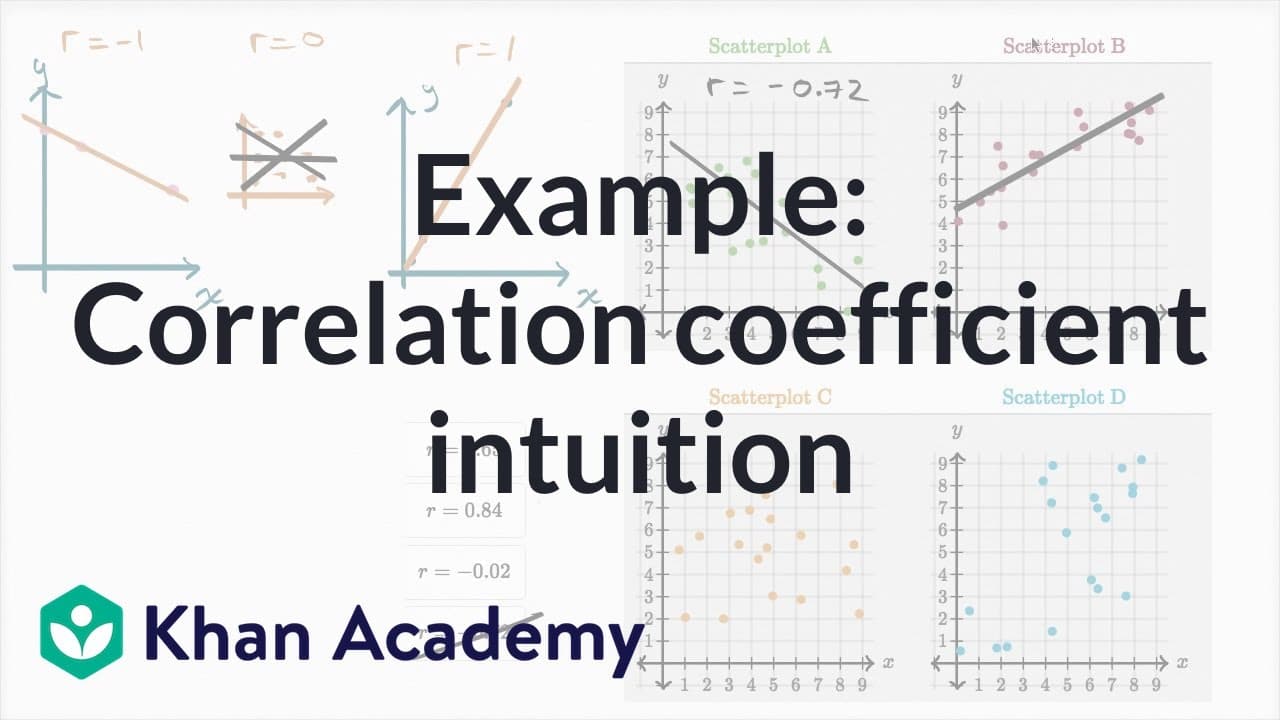
- I took some screen captures from the Khan Academy exercise on correlation coefficient intuition. They've given us some correlation coefficients and we have to match them to the various scatterplots on that exercise. There's a little interface where we can drag these around in a table to match them to the different scatterplots. The point isn't to... Read More
Key Insights
- 🧡 Correlation coefficients range from -1 to 1, indicating the strength and direction of the linear relationship between variables.
- 💯 A correlation coefficient of 1 or -1 represents a perfect positive or negative correlation, respectively.
- ❓ A correlation coefficient of 0 suggests no linear relationship between the variables.
- 🆘 Scatterplots provide visual representations of data, helping us to analyze and understand the relationship between variables.
- 🫥 When fitting a line to a scatterplot, points that deviate significantly from the line indicate a weaker fit and lower correlation coefficient.
- ❓ Understanding correlation coefficient intuition is essential for interpreting and analyzing data.
- 🔨 Correlation coefficients are a valuable tool in statistics, enabling researchers to quantify relationships between variables.
Install to Summarize YouTube Videos and Get Transcripts
Explore YouTube Video Summarizer or Get YouTube Transcript Extractor
Questions & Answers
Q: What do correlation coefficients measure?
Correlation coefficients measure the strength and direction of the linear relationship between two variables. They provide a numerical value that indicates how well a linear model can describe the relationship.
Q: How is a correlation coefficient of 1 different from a correlation coefficient of -1?
A correlation coefficient of 1 indicates a perfect positive correlation, meaning that as one variable increases, the other also increases. On the other hand, a correlation coefficient of -1 indicates a perfect negative correlation, where as one variable increases, the other decreases.
Q: What does a correlation coefficient of 0 signify?
A correlation coefficient of 0 indicates no linear relationship between the variables. In other words, changes in one variable do not affect the other variable in a predictable manner.
Q: How do scatterplots help in understanding correlation coefficients?
Scatterplots visually represent the relationship between two variables, allowing us to see patterns and trends. By examining the scatterplot, we can gain insights into the correlation coefficient and determine if there is a linear relationship.
Summary & Key Takeaways
-
Correlation coefficients are used to measure how well a linear model can describe the relationship between two variables.
-
A correlation coefficient of 1 indicates a perfect positive correlation, where as one variable increases, the other also increases.
-
A correlation coefficient of -1 indicates a perfect negative correlation, where as one variable increases, the other decreases.
-
A correlation coefficient of 0 indicates no linear relationship between the variables.
Read in Other Languages (beta)
Share This Summary 📚
Summarize YouTube Videos and Get Video Transcripts with 1-Click
Try YouTube Summary with ChatGPT & Claude or YouTube Transcript Generator
Explore More Summaries from Khan Academy 📚



Summarize YouTube Videos and Get Video Transcripts with 1-Click
Try YouTube Summary with ChatGPT & Claude or YouTube Transcript Generator