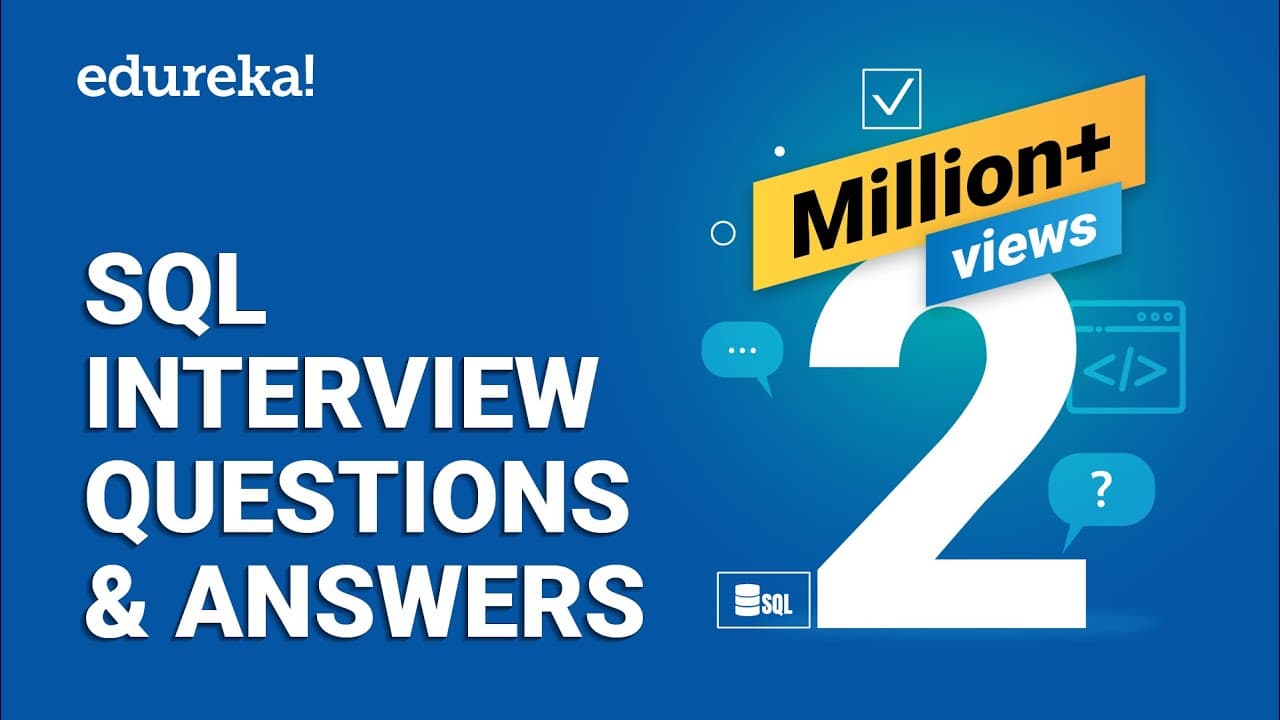
Top 65 SQL Interview Questions and Answers | SQL Interview Preparation | SQL Training | Edureka
TL;DR
Comprehensive guide on top SQL interview questions and answers.
Transcript
Read and summarize the transcript of this video on Glasp Reader (beta).
Key Insights
- SQL is essential for database management, especially in handling relational databases which are widely used across industries.
- Understanding the difference between SQL commands like DELETE and TRUNCATE is crucial as they affect data handling differently.
- SQL is divided into subsets such as DDL, DML, DCL, and TCL, each serving different functions in database management.
- Normalization and denormalization are key concepts in SQL that affect how data is organized and accessed.
- Indexes in SQL, including clustered and non-clustered, play a critical role in optimizing data retrieval speeds.
- The difference between SQL and MySQL is fundamental, with SQL being a language and MySQL being a database management system.
- Understanding SQL joins (inner, outer, left, right) is fundamental for combining data from multiple tables.
- Stored procedures and triggers in SQL help automate and optimize database operations, enhancing performance and reliability.
Install to Summarize YouTube Videos and Get Transcripts
Explore YouTube Video Summarizer or Get YouTube Transcript Extractor
Questions & Answers
Q: What is the difference between DELETE and TRUNCATE in SQL?
DELETE is a DML command used to delete specific rows from a table and allows rollback, while TRUNCATE is a DDL command that deletes all rows from a table without allowing rollback. TRUNCATE is faster because it does not log individual row deletions.
Q: What are the different subsets of SQL?
SQL subsets include Data Definition Language (DDL), Data Manipulation Language (DML), Data Control Language (DCL), and Transaction Control Language (TCL). DDL defines database schema, DML manipulates data, DCL controls access, and TCL manages transactions.
Q: What is normalization and why is it important?
Normalization is the process of organizing database data to reduce redundancy and improve data integrity. It involves dividing large tables into smaller ones and defining relationships between them, which helps in efficient data management and retrieval.
Q: How do indexes improve SQL query performance?
Indexes improve query performance by allowing faster retrieval of records. A clustered index sorts and stores data rows in the table based on key values, while a non-clustered index creates a logical order that points to the physical data. Both optimize data access speed.
Q: What is the primary difference between SQL and MySQL?
SQL is a language used for querying and managing databases, whereas MySQL is a relational database management system (RDBMS) that uses SQL to perform database operations. SQL is the standard language, while MySQL is a specific implementation.
Q: What are SQL joins and why are they used?
SQL joins are used to combine rows from two or more tables based on related columns. The main types are INNER JOIN, LEFT JOIN, RIGHT JOIN, and FULL JOIN, each serving different purposes in terms of how tables are merged and data is retrieved.
Q: What role do stored procedures and triggers play in SQL?
Stored procedures are precompiled SQL statements that can be executed as needed, improving performance and reusability. Triggers are automatic actions executed in response to certain events on a table, such as INSERT or UPDATE, ensuring data integrity and automating tasks.
Q: How does the LIKE operator work for pattern matching in SQL?
The LIKE operator is used for pattern matching in SQL queries. It allows the use of wildcards such as '%' for matching any sequence of characters and '_' for matching a single character. This is useful for filtering results based on partial string matches.
Summary & Key Takeaways
-
The video provides a detailed walkthrough of 65 SQL interview questions, covering basic to advanced topics essential for aspiring database administrators.
-
Key concepts such as SQL commands, normalization, index types, and joins are explained to aid understanding and preparation for SQL interviews.
-
The session emphasizes the importance of SQL in managing relational databases and provides practical examples and queries for better comprehension.
Read in Other Languages (beta)
Share This Summary 📚
Summarize YouTube Videos and Get Video Transcripts with 1-Click
Try YouTube Summary with ChatGPT & Claude or YouTube Transcript Generator
Explore More Summaries from edureka! 📚



![AWS Full Course - Solutions Architect [12 Hours] | AWS Certified Solutions Architect [2024] |Edureka thumbnail](/_next/image?url=https%3A%2F%2Fi.ytimg.com%2Fvi%2F5gnoVjpfWxU%2Fhqdefault.jpg&w=750&q=75)
Summarize YouTube Videos and Get Video Transcripts with 1-Click
Try YouTube Summary with ChatGPT & Claude or YouTube Transcript Generator