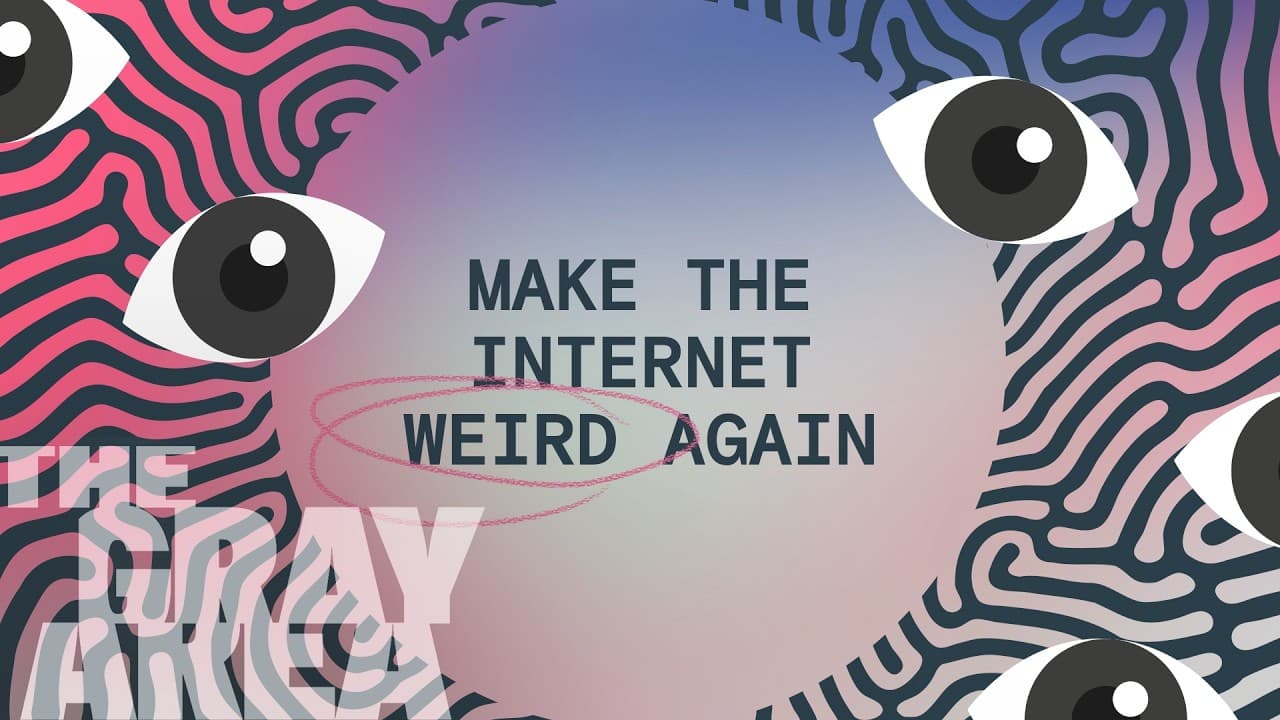
It’s time to get weird | The Gray Area
TL;DR
Exploring the internet's evolution and potential for a pro-human future.
Transcript
Hey, I'm Sean, host of the Gray Area. That's the show. This week, I talked to Douglas Rushkoff. He's a media theorist, a philosopher of technology, and the host of one of my favorite podcasts called Team Human. We talk about the early days of the internet, how the whole thing became a business dominated by algorithms and surveillance capitalism, an... Read More
Key Insights
- The internet began as a cultural frontier for creativity and connection but was quickly commercialized, prioritizing profit over innovation.
- Artificial intelligence presents an opportunity to reassess societal structures and potentially pivot towards a more pro-human, regenerative future.
- The monetization of the internet contributed to the loss of its original weirdness, as it became dominated by algorithms and surveillance capitalism.
- The concept of 'weirdness' involves making systems strange to objectively analyze and potentially redesign them for human benefit.
- Rushkoff emphasizes the importance of local, community-driven actions as a starting point for societal transformation.
- Current platforms often incentivize behaviors that reinforce existing power structures, but there are opportunities to use technology for positive social change.
- A shift towards nonprofit models and smaller, interest-based communities could foster more meaningful interactions online.
- Rushkoff advocates for a focus on care and compassion as a pathway to broader societal changes, emphasizing the importance of human connection.
Install to Summarize YouTube Videos and Get Transcripts
Explore YouTube Video Summarizer or Get YouTube Transcript Extractor
Questions & Answers
Q: What was the original vision of the internet according to Douglas Rushkoff?
Rushkoff describes the original internet as a cultural frontier full of creativity and connection, a space for experimentation and weirdness. It was seen as a tool to unleash collective creativity and foster new power dynamics. However, this vision was short-lived as commercialization took over.
Q: How does Rushkoff view the role of artificial intelligence in societal change?
Rushkoff sees artificial intelligence as a catalyst for asking fundamental questions about societal structures. He believes AI could create opportunities for a widespread reassessment of cultural, social, and economic systems, potentially leading to a more pro-human, regenerative civilization.
Q: What does Rushkoff mean by 'making things weird'?
Rushkoff suggests that by making societal norms and systems 'weird,' we can view them objectively and question their validity. This process involves denaturalizing power and questioning assumptions, which can lead to reimagining and redesigning systems in ways that better serve human needs.
Q: What are Rushkoff's views on the current internet platforms?
Rushkoff criticizes current internet platforms for incentivizing behaviors that reinforce existing power structures and economic models. He believes these platforms often prioritize profit over meaningful connections and suggests that alternative models focused on community and care could foster more positive interactions.
Q: How does Rushkoff propose we start transforming society?
Rushkoff advocates for starting with local, community-driven actions. He suggests simple acts like sharing resources and fostering neighborhood connections as initial steps towards a post-employment society. These actions can gradually lead to broader societal changes focused on human flourishing and community care.
Q: What is Rushkoff's perspective on the potential for societal change?
Rushkoff is cautiously optimistic about the potential for societal change. He believes that while current systems are deeply entrenched, there is still room for transformation through local actions, care, and compassion. He emphasizes the importance of human connection and community as pathways to broader change.
Q: How does Rushkoff suggest we address the challenges posed by current technologies?
Rushkoff suggests that instead of trying to overhaul technologies, we should focus on how they can reveal issues in other social systems. He emphasizes the need for courage to question and rethink societal values, advocating for a shift towards more pro-social, community-focused uses of technology.
Q: What role does Rushkoff see for nonprofit models in the future of the internet?
Rushkoff sees nonprofit models as a viable alternative to for-profit platforms, suggesting they can support meaningful online interactions without the pressure of generating profits for shareholders. He believes these models can help create more regenerative communities focused on human flourishing and care.
Summary & Key Takeaways
-
Douglas Rushkoff discusses the internet's transformation from a space of creativity to one dominated by corporate interests. He suggests that AI could prompt a reassessment of societal structures. Rushkoff emphasizes the importance of local actions and community-driven change to reclaim the internet's potential.
-
Rushkoff argues that the monetization of the internet has stifled its original weirdness and creativity. He proposes making societal systems 'weird' to analyze and redesign them for human benefit. He also highlights the potential of nonprofit models and smaller communities for fostering meaningful online interactions.
-
The conversation explores the internet's role in reinforcing power structures and the potential for technology to drive positive change. Rushkoff stresses the importance of care and compassion, suggesting that local, community-focused actions can lead to broader societal transformations.
Read in Other Languages (beta)
Share This Summary 📚
Summarize YouTube Videos and Get Video Transcripts with 1-Click
Try YouTube Summary with ChatGPT & Claude or YouTube Transcript Generator
Explore More Summaries from Vox 📚


Summarize YouTube Videos and Get Video Transcripts with 1-Click
Try YouTube Summary with ChatGPT & Claude or YouTube Transcript Generator