Vector components from initial and terminal points | Vectors | Precalculus | Khan Academy
TL;DR
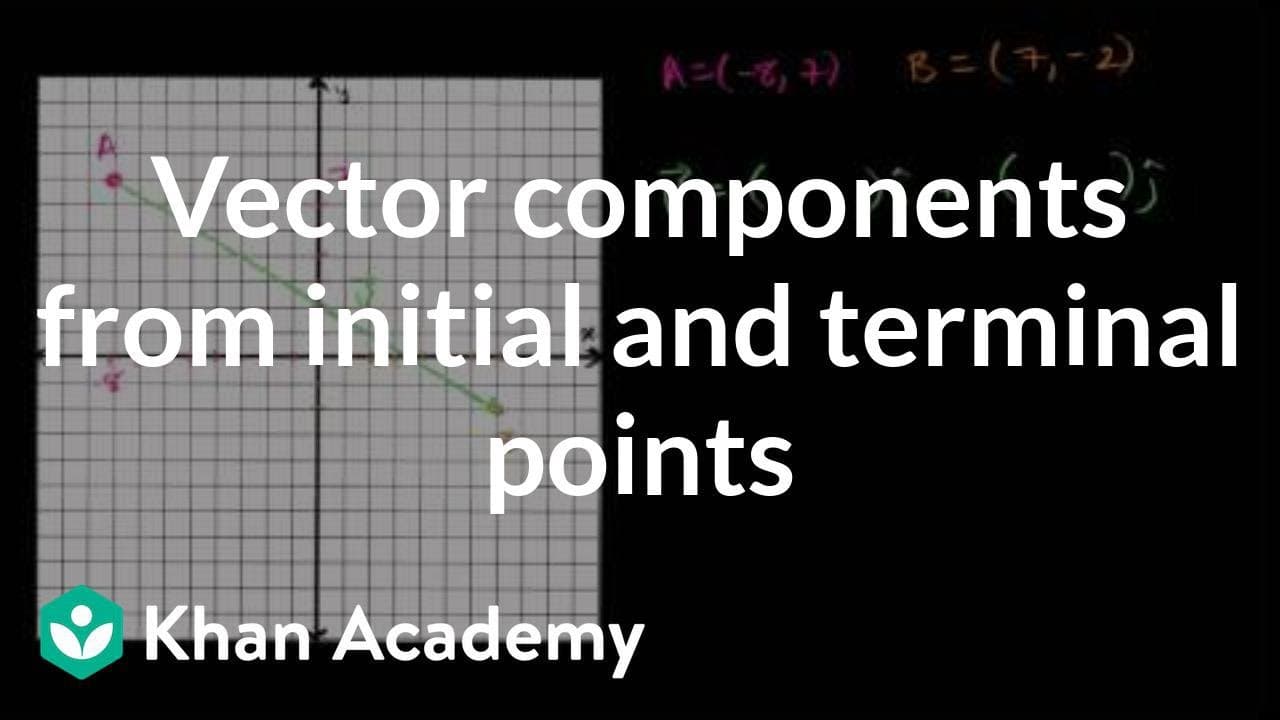
Learn how to find the x and y components of a vector using the coordinates of its initial and terminal points.
Transcript
We can never have too much practice getting familiar with vectors. What I want to do in this video in particular, be able to relate the x and y components of a vector to the initial and terminal points to where we place it in the coordinate planes. What am I talking about? Let's say we have some vector where its initial point is here at point a and... Read More
Key Insights
- 😥 Vectors in a coordinate plane have an initial point and a terminal point.
- 👈 The x component of a vector represents the change in x between the initial and terminal points.
- 💱 The y component of a vector represents the change in y between the initial and terminal points.
- 🇦🇪 Different notations can be used to represent vectors, such as unit vector notation, column vector notation, and numerical representation.
- ✈️ Shifting a vector in a coordinate plane does not alter its magnitude or direction, only its location.
Install to Summarize YouTube Videos and Get Transcripts
Explore YouTube Video Summarizer or Get YouTube Transcript Extractor
Questions & Answers
Q: How can we find the x and y components of a vector based on its initial and terminal points?
To find the x component, subtract the initial x coordinate from the terminal x coordinate. Similarly, for the y component, subtract the initial y coordinate from the terminal y coordinate. In this case, the x component is 15 and the y component is -9.
Q: What are the different notations used to represent vectors?
There are several notations, including unit vector notation (using i and j), column vector notation (placing the components in a column), and numerical representation (directly stating the components). All these notations convey the same vector.
Q: Can vectors be placed in different locations in a coordinate plane?
Yes, vectors can be shifted around in a coordinate plane without changing their magnitude or direction. The important aspect is that the x and y components remain the same.
Q: How is the x component of a vector represented graphically?
The x component of a vector is shown as a vector that is 15 times longer than the unit vector in the horizontal direction. It extends from the initial point to the terminal point along the x-axis.
Summary & Key Takeaways
-
The video explains how to determine the x and y components of a vector based on the coordinates of its initial and terminal points in a coordinate plane.
-
The x component is calculated by finding the change in x between the initial and terminal points, while the y component is found by determining the change in y.
-
Different notations can be used to represent vectors, including unit vector notation, column vector notation, and numerical representation.
Read in Other Languages (beta)
Share This Summary 📚
Summarize YouTube Videos and Get Video Transcripts with 1-Click
Try YouTube Summary with ChatGPT & Claude or YouTube Transcript Generator
Explore More Summaries from Khan Academy 📚



Summarize YouTube Videos and Get Video Transcripts with 1-Click
Try YouTube Summary with ChatGPT & Claude or YouTube Transcript Generator