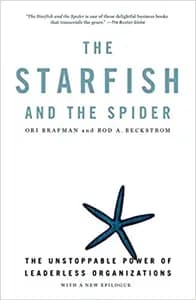
The Starfish and the Spider: The Unstoppable Power of Leaderless Organizations
by Ori Brafman
Recommended byChangpeng Zhao
About This Book
"The Starfish and the Spider" by Ori Brafman explores the power and influence of decentralized organizations and their ability to reshape traditional leadership models. Using examples ranging from successful open-source software communities to the resilient Apache tribe, Brafman sheds light on the transformative potential of non-hierarchical, loosely connected networks.
Through engaging anecdotes and thought-provoking analysis, the book illuminates the core principles behind decentralized organizations. It reveals that, unlike traditional centralized structures, these decentralized systems can thrive even when significant individuals or top-down control are absent. Starfish organization principles, such as shared ideology and the ability to self-organize, allow them to adapt quickly, resist disruption, and withstand attacks, leading to immense growth and innovation.
Brafman highlights how the dynamics of a starfish organization are rooted in decentralization, peer-to-peer relationships, and shared values. The book delves into the contrast between starfish and spider organizations, emphasizing the spider's vulnerability to the loss of central authority and the challenges it faces when confronting adversity.
"The Starfish and the Spider" also explores the broader implications of decentralization, discussing its potential impact on industries, social movements, and even governments. The book challenges traditional notions of leadership and encourages readers to harness the power of decentralization to foster transformative change in their own organizations.
Overall, Brafman's insightful and well-researched exploration of decentralized organizations offers valuable lessons for both individuals and institutions seeking to adapt to today's rapidly changing, interconnected world. By understanding the fundamental principles of starfish organizations, readers can harness their potential for innovation, resilience, and long-term success.
Through engaging anecdotes and thought-provoking analysis, the book illuminates the core principles behind decentralized organizations. It reveals that, unlike traditional centralized structures, these decentralized systems can thrive even when significant individuals or top-down control are absent. Starfish organization principles, such as shared ideology and the ability to self-organize, allow them to adapt quickly, resist disruption, and withstand attacks, leading to immense growth and innovation.
Brafman highlights how the dynamics of a starfish organization are rooted in decentralization, peer-to-peer relationships, and shared values. The book delves into the contrast between starfish and spider organizations, emphasizing the spider's vulnerability to the loss of central authority and the challenges it faces when confronting adversity.
"The Starfish and the Spider" also explores the broader implications of decentralization, discussing its potential impact on industries, social movements, and even governments. The book challenges traditional notions of leadership and encourages readers to harness the power of decentralization to foster transformative change in their own organizations.
Overall, Brafman's insightful and well-researched exploration of decentralized organizations offers valuable lessons for both individuals and institutions seeking to adapt to today's rapidly changing, interconnected world. By understanding the fundamental principles of starfish organizations, readers can harness their potential for innovation, resilience, and long-term success.
What People Are Saying
“I really wish every regulator on the planet would read this book. Regardless, it gives you an idea of how decentralized organizations operate”
Revisit Your Highlights, Deepen Your Understanding
Import your Kindle highlights to review, organize, and share the ideas that matter most to you.
Get the free browser extension
Share This Book
More Books in Business
View More
High Output Management
Andrew Grove

Principles
Ray Dalio

Shoe Dog
Phil Knight
Originals
Adam Grant

Rework
Jason Fried

The Ride of a Lifetime
Bob Iger

7 Powers
Hamilton Helmer
Good To Great
Jim Collins

Hopping Over The Rabbit Hole
Anthony Scaramucci
Only the Paranoid Survive
Andy Grove

The Outsiders
William Thorndike
Creativity, Inc.
Ed Catmull
Crossing the Chasm
Geoffrey Moore

Bad Blood
John Carreyrou
Loonshots
Safi Bahcall

Measure What Matters
John Doerr

Range
David Epstein

The Great CEO Within
Matt Mochary
The Power of Habit
Charles Duhigg
The Third Wave
Steve Case
Built To Last
Jim Collins

Getting to Yes
Roger Fisher

Lean In
Sheryl Sandberg

Made to Stick
Chip Heath

Negotiating The Impossible
Deepak Malhotra
No Rules Rules
Reed Hastings

Sam Walton
Sam Walton

Steve Jobs
Walter Isaacson
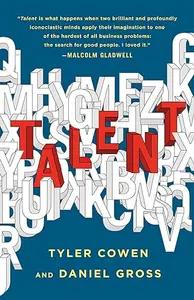
Talent
Tyler Cowen & Daniel Gross

The Fish That Ate The Whale
Rich Cohen
Popular Books Recommended by Great Minds 📚
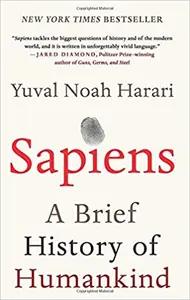
Sapiens
Yuval Noah Harari
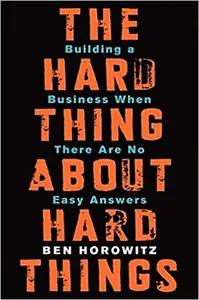
The Hard Thing About Hard Things
Ben Horowitz
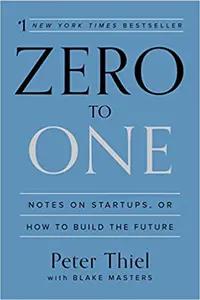
Zero to One
Peter Thiel
High Output Management
Andrew Grove
Principles
Ray Dalio
Shoe Dog
Phil Knight

Snow Crash
Neal Stephenson

Meditations
Marcus Aurelius
Originals
Adam Grant

Poor Charlie's Almanack
Charlie Munger

The Innovators Dilemma
Clayton Christensen
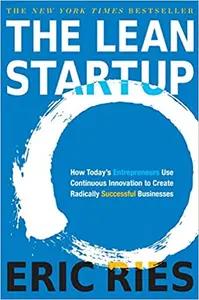
The Lean Startup
Eric Reis
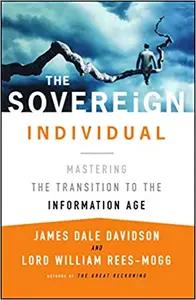
The Sovereign Individual
James Dale Davidson & William Rees-Mogg

High Growth Handbook
Elad Gil
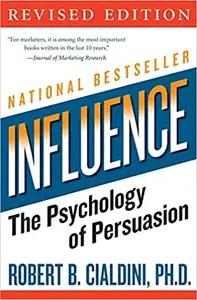
Influence
Robert Cialdini

Principles for Dealing With The Changing World Order
Ray Dalio
Rework
Jason Fried

Surely You're Joking Mr. Feynman
Richard Feynman
The Ride of a Lifetime
Bob Iger
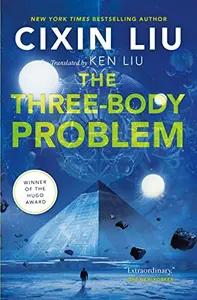
The Three Body Problem
Cixin Liu
Thinking, Fast and Slow
Daniel Kahneman
7 Powers
Hamilton Helmer

Antifragile
Nassim Nicholas Taleb
Atlas Shrugged
Ayn Rand

Blitzscaling
Reid Hoffman

Dune
Frank Herbert

Foundation
Isaac Asimov
Good To Great
Jim Collins
Hopping Over The Rabbit Hole
Anthony Scaramucci
Man's Search for Meaning
Viktor Frankl