Solving the mystery of dark matter | Avi Loeb and Lex Fridman
TL;DR
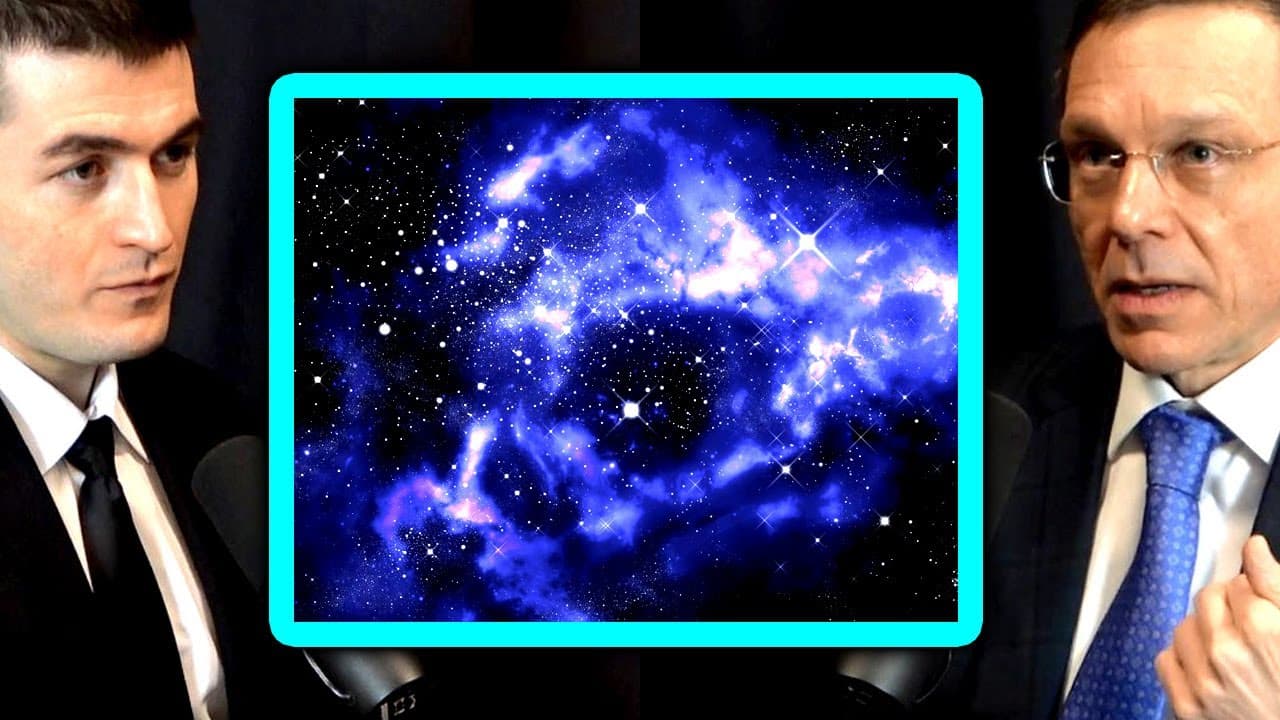
Scientists continue to search for clues about the nature of dark matter, a particle that eludes detection and interaction with light.
Transcript
because you've thought quite a bit about dark matter as well is do you have any kind of hypothesis interesting hypothesis we already mentioned a few about what is dark matter and what are the uh possible paths that we could take to unlock the mystery of dark what is dark matter yeah so what we need is some anomalies that would hint what the nature ... Read More
Key Insights
- 🙂 Dark matter is an elusive particle that does not interact with light, making its detection challenging.
- 🕶️ The Large Hadron Collider and theories like supersymmetry have not provided conclusive evidence about the nature of dark matter.
- 🍧 Speculative ideas, such as dark matter particles having a small electric charge, have been explored to explain anomalies.
- 👨🔬 Scientists approach dark matter research using the same scientific tools as any other field, making hypotheses and collecting data.
- 😥 Anomalies and unexpected observations serve as starting points for exploring new possibilities in understanding dark matter.
- 👨🔬 The search for dark matter involves both laboratory experiments and astronomical observations.
- 🤵 The nature and properties of dark matter particles remain unknown, leaving room for various theories and speculations.
Install to Summarize YouTube Videos and Get Transcripts
Explore YouTube Video Summarizer or Get YouTube Transcript Extractor
Questions & Answers
Q: What is dark matter and why is it challenging to detect?
Dark matter is believed to be a particle that does not interact with light. Its elusiveness makes it difficult to detect and study, as there are numerous possibilities for its nature and properties.
Q: Has the Large Hadron Collider provided any insights into dark matter?
Despite hopes of finding clues about dark matter from the Large Hadron Collider or theories like supersymmetry, scientists have not obtained conclusive evidence or leads from these sources.
Q: What are some proposed theories or explanations for dark matter?
Some theories suggest that dark matter particles may have a small electric charge or be linked to extensions of the standard model of particle physics. However, these are still speculative and lack supporting evidence.
Q: How do scientists approach the study of dark matter?
Scientists explore possibilities and anomalies related to dark matter by making hypotheses, collecting data, and searching for technological or observational signatures. It is a continuous scientific endeavor.
Summary & Key Takeaways
-
Dark matter is a particle that has not yet been detected and does not interact with light, posing a challenge in its exploration.
-
Scientists have searched for clues about dark matter through laboratory experiments and theories like supersymmetry, but have not found conclusive evidence.
-
Speculations, such as suggesting dark matter particles may have a small electric charge, have been explored to explain anomalies in scientific observations.
Read in Other Languages (beta)
Share This Summary 📚
Summarize YouTube Videos and Get Video Transcripts with 1-Click
Try YouTube Summary with ChatGPT & Claude or YouTube Transcript Generator
Explore More Summaries from Lex Clips 📚



Summarize YouTube Videos and Get Video Transcripts with 1-Click
Try YouTube Summary with ChatGPT & Claude or YouTube Transcript Generator