Measurement of Inductance by Anderson Bridge Problem no 1
TL;DR
Solving inductance measurement problem using Anderson's bridge to find unknown impedance values.
Transcript
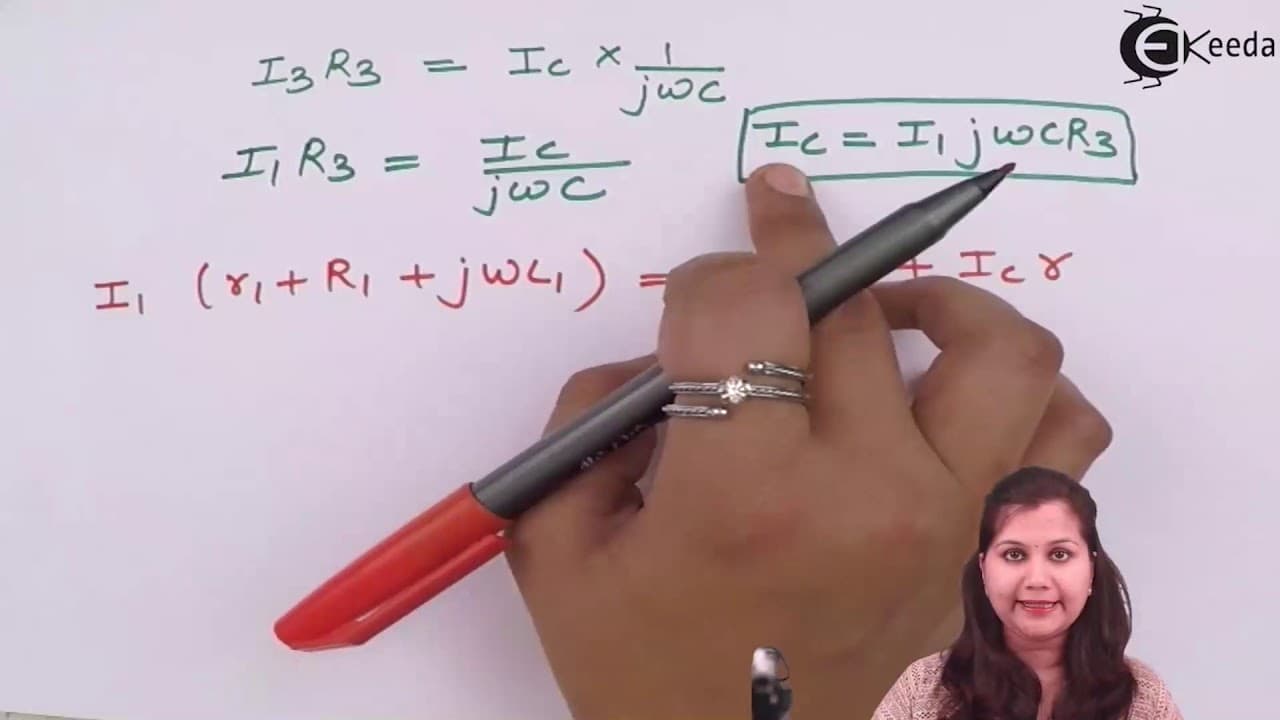
hello friends in this video we are going to solve a problem on the measurement of inductance using anderson's bridge so let us start with our problem we are given the arms of a five node bridge and the arms are as follows the arm a b it is an unknown impedance r1 l1 which is connected in series with a non-inductive resistor small r1 then on bc it i... Read More
Key Insights
- 🌉 Anderson's bridge setup involves known and unknown impedances for inductance measurement.
- ⚖️ Deriving equations through balance conditions helps find unknown resistance and inductance values.
- 🈸 Practical application involves substituting known values into equations to calculate unknown parameters accurately.
- 🌉 Understanding concepts of null deflection and potential equality in balancing bridge circuits is crucial.
- ❓ Numerical examples provide a step-by-step process for determining unknown impedance values.
- 🌉 Capacitors, resistors, and a detector are essential components in Anderson's bridge setup.
- 🌉 Anderson's bridge offers a practical method for precise inductance measurement in electrical circuits.
Install to Summarize YouTube Videos and Get Transcripts
Explore YouTube Video Summarizer or Get YouTube Transcript Extractor
Questions & Answers
Q: What is the setup of Anderson's bridge for inductance measurement?
The Anderson's bridge consists of arms with known and unknown impedances connected in a circuit for inductance measurement, balancing under certain conditions to find unknown values.
Q: How do we derive equations to find unknown impedance values?
By applying Kirchhoff's laws and balance condition principles, we can derive equations based on current equality and voltage drops to solve for unknown impedance parameters.
Q: What equations are used to calculate the unknown resistance and inductance?
The equations used are based on the balanced conditions where current and voltage drops across different arms of the bridge are equated to derive formulas for unknown resistance (r1) and inductance (l1).
Q: How can the unknown impedance be calculated in a practical scenario?
By substituting the known values of resistors, capacitors, and other parameters into the derived equations, one can calculate the unknown resistance and inductance under balanced conditions for practical applications.
Summary & Key Takeaways
-
Explaining the setup of Anderson's bridge for inductance measurement problem.
-
Deriving equations for finding unknown impedance values under balance conditions.
-
Solving numerical example to calculate unknown resistance (r1) and inductance (l1).
Read in Other Languages (beta)
Share This Summary 📚
Summarize YouTube Videos and Get Video Transcripts with 1-Click
Try YouTube Summary with ChatGPT & Claude or YouTube Transcript Generator
Explore More Summaries from Ekeeda 📚





Summarize YouTube Videos and Get Video Transcripts with 1-Click
Try YouTube Summary with ChatGPT & Claude or YouTube Transcript Generator