Low Pass RC network | Pulse input | Pulse Digital Circuits | Lec-04
TL;DR
Analyzes low pass RC networks response to pulse input signals.
Transcript
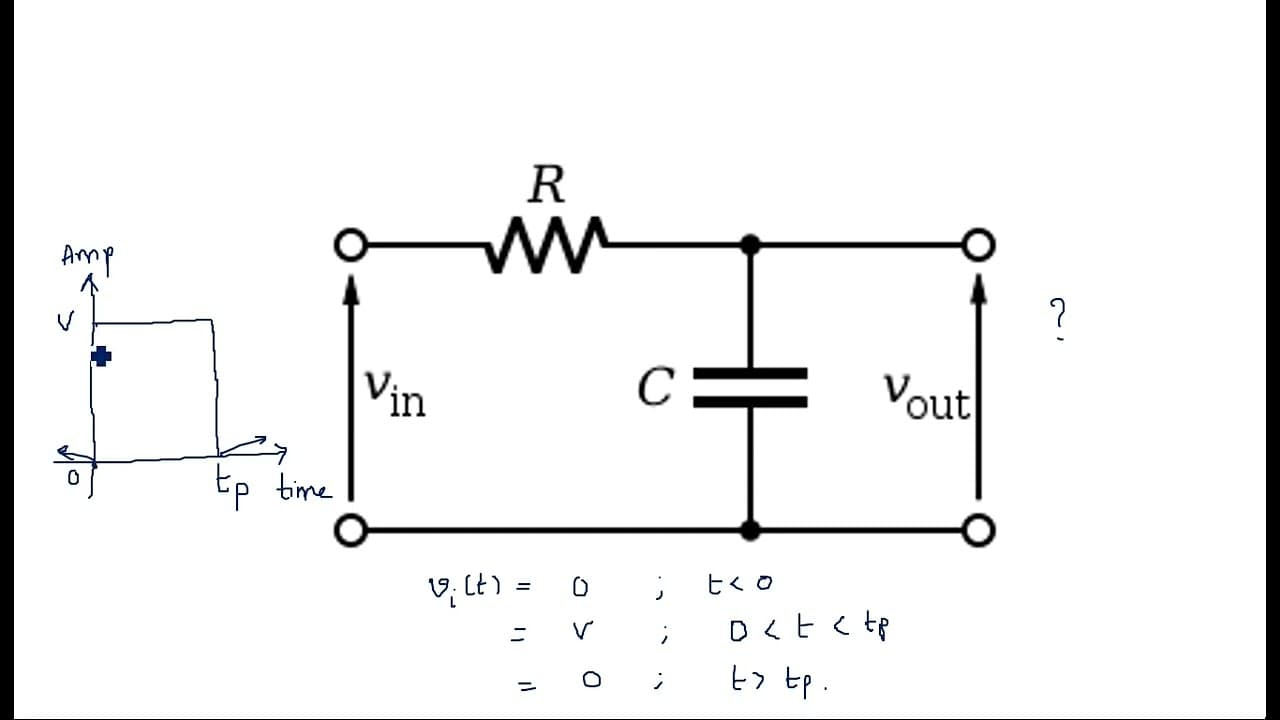
hi everyone in this video you are going to learn about the low pass RC network when it is applied with a pulse input in the previous videos we have seen when a low pass RC network is applied with a sinusoidal signal and later we have seen a step input also now if the step is extended with a negative or a delayed signal then a pulse will come like s... Read More
Key Insights
- 👻 Low pass RC networks filter out high-frequency components from signals while allowing low-frequency components to pass through.
- 📡 The behavior of the network depends significantly on the value of the RC product, influencing how the circuit responds to various signal inputs.
- ⚡ Capacitors maintain a smooth voltage transition, which alters the expected output waveform in response to abrupt changes in input voltage.
- 🥺 Different conditions of RC values lead to distinct waveforms: quick stabilization, delayed response, or immediate reach to steady states.
- ⚡ The mathematical modeling of output voltage considers both initial and final voltage states, emphasizing changes during pulse transitions and discharges.
- 🎮 The video provides a visual understanding of how capacitor charging and discharging occur through graphical representations of input and output waveforms.
- ☺️ The relationship between the pulse width and the circuit's 3 dB frequency is crucial for preserving input shapes in the output signal.
Install to Summarize YouTube Videos and Get Transcripts
Explore YouTube Video Summarizer or Get YouTube Transcript Extractor
Questions & Answers
Q: What is a low pass RC network, and how does it function with pulse inputs?
A low pass RC network filters high frequency signals and allows low frequency signals to pass through. When a pulse input is applied, the capacitor initially does not allow sudden changes, which impacts the output waveform relative to the input pulse.
Q: How is the pulse waveform characterized in this video?
The pulse waveform is described as a step followed by a negative signal. It is defined in terms of its amplitude and time period, showing how it exists only during specified intervals before returning to zero.
Q: Why do capacitors not allow sudden voltage changes in RC circuits?
Capacitors store electric energy and discharge gradually. When there is a sudden voltage change, the capacitor takes time to charge or discharge, causing a delayed response in the circuit output.
Q: What is the significance of the RC product in the response of the circuit?
The RC product determines how quickly the capacitor can charge and discharge. A larger RC value results in slower response times, whereas a smaller RC leads to quicker stabilization of the output signal, affecting the shape of the waveform.
Q: How can one derive the output voltage expression for a low pass RC network?
The output voltage, V_naught, can be derived based on final and initial voltage conditions. The expression incorporates the exponential decay function to describe the charging and discharging behavior of the capacitor over time.
Q: What conditions preserve the shape of a pulse signal in this analysis?
The shape of the pulse signal is preserved when the pulse width is approximately equal to the reciprocal of the 3 dB frequency of the RC network. This ensures that the output waveform closely resembles the input pulse.
Summary & Key Takeaways
-
This video explains the behavior of low pass RC networks when responding to pulse input signals, illustrating the differences from sinusoidal and step inputs.
-
The characteristics of capacitors in these networks are emphasized, showing that capacitors resist sudden voltage changes and affect how quickly the circuit responds.
-
Detailed analysis of output waveforms reveals how the product of resistance and capacitance (RC) influences the charge and discharge rates of the capacitor.
Read in Other Languages (beta)
Share This Summary 📚
Summarize YouTube Videos and Get Video Transcripts with 1-Click
Try YouTube Summary with ChatGPT & Claude or YouTube Transcript Generator