14.2.4 Non-volatile Storage; Using the Hierarchy
TL;DR
Non-volatile memories like flash memories offer higher performance but at a higher cost, whereas hard disk drives provide cost-effective storage with slow access times.
Transcript
Non-volatile memories are used to maintain system state even when the system is powered down. In flash memories, long-term storage is achieved by storing charge on an well-insulated conductor called a floating gate, where it will remain stable for years. The floating gate is incorporated in a standard MOSFET, placed between the MOSFET's gate and th... Read More
Key Insights
- ✋ Non-volatile memories, such as flash memories, offer higher performance and density compared to hard disk drives.
- 🐢 Hard disk drives provide cost-effective storage for large amounts of data but have slower access times.
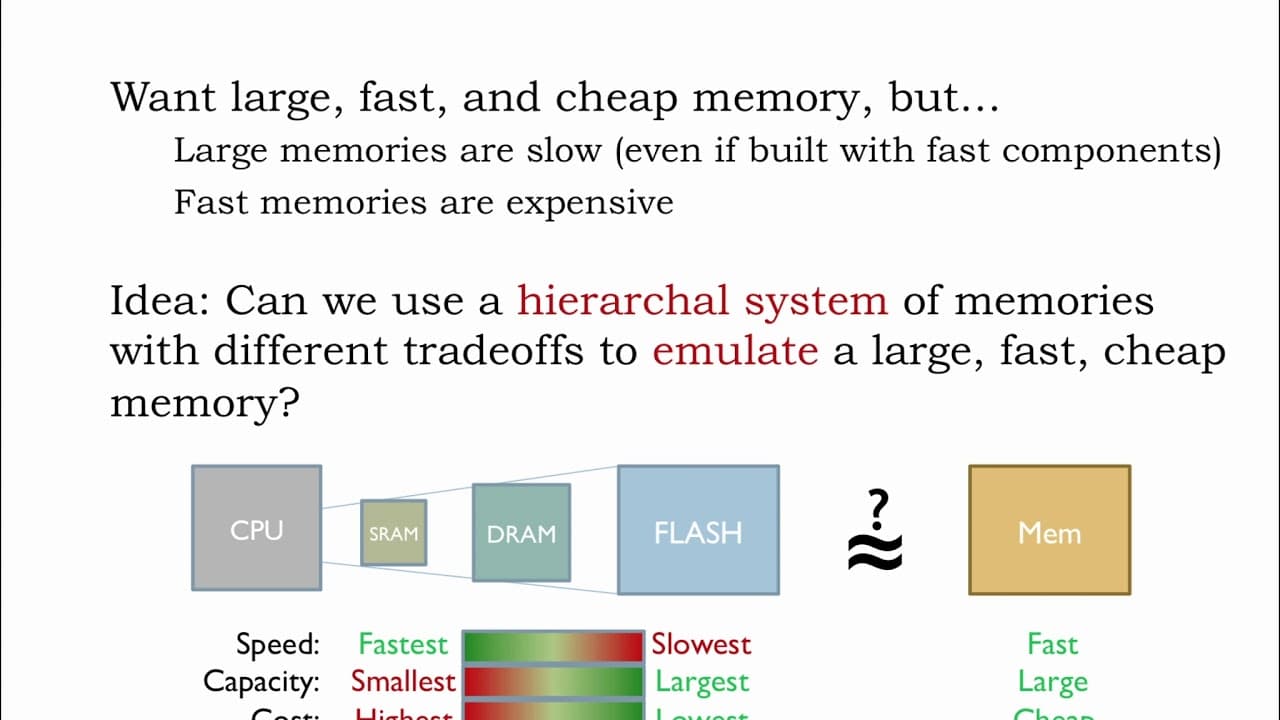
- 💻 The memory hierarchy system in computers can be managed either by programmers or automatically by the memory system.
- 😒 Flash memories use clever address mapping algorithms to work around their limited write endurance.
- 🐎 Non-volatile memories have helped bridge the performance gap between processor speeds and hard disk drives.
- ⏳ Designing low-latency, high-capacity memory systems is a challenge due to the widening gap between processor cycle times and DRAM access times.
- 💨 The choice between smaller and faster or larger and slower memory technologies depends on the desired tradeoffs in speed and size.
Install to Summarize YouTube Videos and Get Transcripts
Explore YouTube Video Summarizer or Get YouTube Transcript Extractor
Questions & Answers
Q: How do flash memories store data?
Flash memories store data by storing charge on a floating gate, and the presence or absence of charge determines whether the memory cell is conducting or not.
Q: How do flash memories achieve higher density compared to hard disk drives?
Flash memories can store multiple bits of information in one cell by varying the amount of charge on the floating gate, allowing for higher density compared to hard disk drives.
Q: What is the main advantage of hard disk drives?
Hard disk drives provide cost-effective and non-volatile storage for large amounts of data, although they have slower access times compared to flash memories.
Q: How does the memory hierarchy system in computers work?
The memory hierarchy system in computers can either expose the hierarchy to programmers, allowing them to manage different memory resources, or hide the hierarchy and automatically move data between different levels based on usage patterns.
Summary & Key Takeaways
-
Non-volatile memories, such as flash memories, use a floating gate to store charge and maintain system state even without power.
-
Flash memories can store multiple bits of information in one cell and have higher density compared to hard disk drives.
-
Hard disk drives use rotating platters and read/write heads to access data, providing cost-effective storage for large amounts of data.
Read in Other Languages (beta)
Share This Summary 📚
Summarize YouTube Videos and Get Video Transcripts with 1-Click
Try YouTube Summary with ChatGPT & Claude or YouTube Transcript Generator
Explore More Summaries from MIT OpenCourseWare 📚



Summarize YouTube Videos and Get Video Transcripts with 1-Click
Try YouTube Summary with ChatGPT & Claude or YouTube Transcript Generator