Mathematical Induction Inequality Proof with Recursive Function
TL;DR
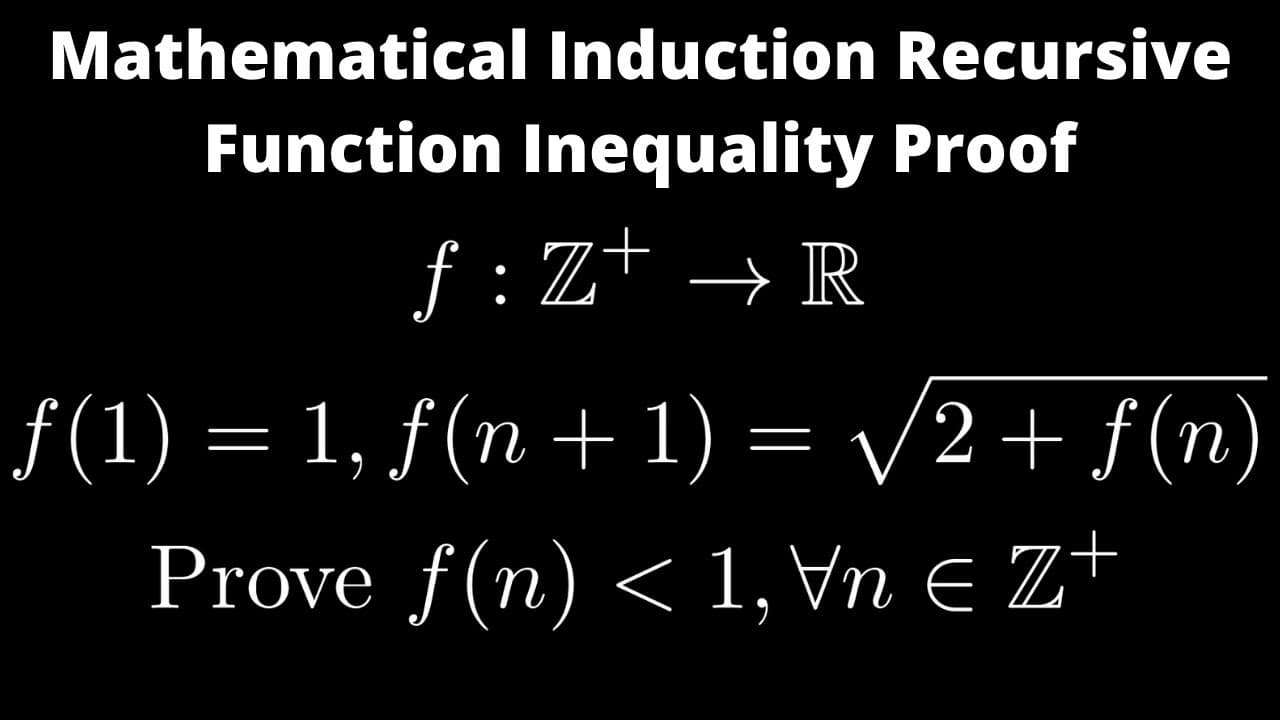
Understand and prove a recursive function is less than two for all positive integers through induction.
Transcript
in this problem we're going to do an induction proof so we have a function defined from the set of positive integers into the set of real numbers and it's given by f of one equals one and we have to end this here and we have to prove that f of n is less than two for all positive integers so our function is given by a recursive definition so f of 1 ... Read More
Key Insights
- 👍 The problem involves proving a recursive function's property for all positive integers.
- ⚾ Understanding the base case is crucial in initiating an induction proof.
- 🥹 The induction hypothesis assumes the property holds for a specific positive integer k.
- 🥹 The induction step shows that if the property holds for k, it also holds for k+1.
- ❓ Completing the induction step confirms the property's validity for all positive integers.
- 🏁 Finishing a proof with a satisfactory conclusion is essential for clarity.
- 👍 Recursive definitions in mathematics often require creative approaches to prove properties.
Install to Summarize YouTube Videos and Get Transcripts
Explore YouTube Video Summarizer or Get YouTube Transcript Extractor
Questions & Answers
Q: What is the first step in an induction proof?
The first step in an induction proof is establishing the base case, which shows that the statement is true for the smallest positive integer, in this case, n=1.
Q: What does the induction hypothesis assume?
The induction hypothesis assumes that the statement is true for some positive integer k, where f(k) is less than 2.
Q: How is the induction step carried out in this proof?
The induction step involves showing that the statement holds true for n=k+1, by using the assumption that f(k) is less than 2 to prove that f(k+1) is also less than 2.
Q: How is the proof concluded?
The proof is concluded by demonstrating that the statement holds true for all positive integers, as shown by the base case, induction hypothesis, and induction step.
Summary & Key Takeaways
-
The problem involves proving that a recursive function is less than two for all positive integers using induction.
-
The base case of n=1 is established by showing that f(1) equals 1, which is less than 2.
-
The induction hypothesis assumes f(k) is less than 2, and the induction step demonstrates f(k+1) is also less than 2, completing the proof.
Read in Other Languages (beta)
Share This Summary 📚
Summarize YouTube Videos and Get Video Transcripts with 1-Click
Try YouTube Summary with ChatGPT & Claude or YouTube Transcript Generator
Explore More Summaries from The Math Sorcerer 📚



Summarize YouTube Videos and Get Video Transcripts with 1-Click
Try YouTube Summary with ChatGPT & Claude or YouTube Transcript Generator