VHDL code for JK Flip flop | behavioural model | Digital Systems Design | Lec-79
TL;DR
This content explains the VHDL code for JK flip flops in digital circuits.
Transcript
hi everyone in this video I'm going to explain about the vhdl code for JK flip Lop so this JK flip Lop we have already discussed in the last class okay so JK flip Lop is nothing but which is an extension of Sr fpop what we have discussed already uh Sr fpop you know set reset and JK stands for Johnson and kby I think I might have forgot in the last ... Read More
Key Insights
- 🐬 JK flip flops are critical in digital circuit design due to their toggling capability and presence of preset and clear options.
- 👨💻 Understanding VHDL coding is essential for accurately implementing flip flop designs in digital circuits, emphasizing the importance of the library and entity definitions.
- 👻 The process block in VHDL allows for defining specific behaviors based on input conditions, which is vital for predictable circuit operation.
- 🐬 The clear and preset functionalities enable immediate control of output states, making JK flip flops useful in various applications requiring quick state toggles.
- 📡 The distinction between variables and signals in VHDL affects how changes are reflected during simulation and must be understood by developers.
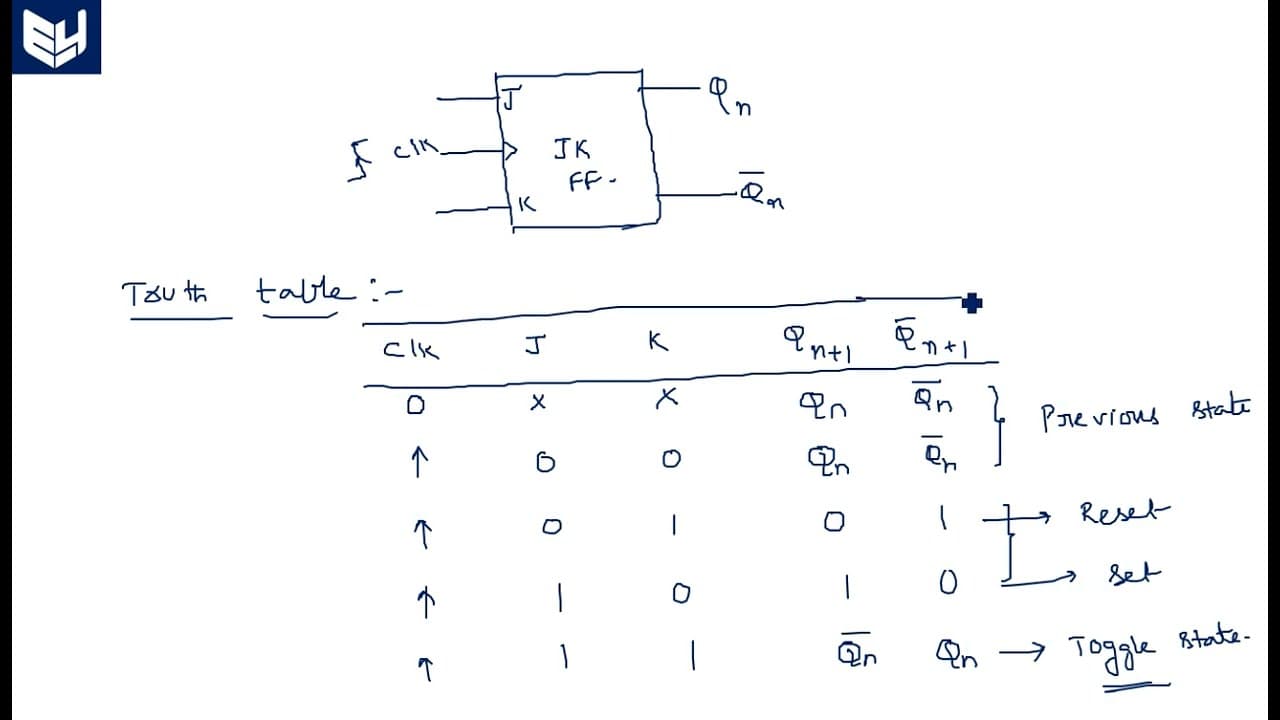
- 🐬 Transitioning between states in a JK flip flop involves specific conditions that can be captured through a truth table, serving as a foundational design tool.
- ⏰ The rising clock edge requirement enforces synchrony within digital circuits, ensuring accurate state changes only occur in tandem with clock signals.
Install to Summarize YouTube Videos and Get Transcripts
Explore YouTube Video Summarizer or Get YouTube Transcript Extractor
Questions & Answers
Q: What is a JK flip flop and how does it differ from other flip flops?
A JK flip flop is a versatile type of flip flop that overcomes limitations of the SR flip flop by incorporating J and K inputs that can toggle the flip flop state. The JK flip flop also includes preset and clear functionalities, making it relevant for various digital applications.
Q: How does the VHDL code for the JK flip flop begin?
The VHDL code for the JK flip flop typically begins with library declarations for necessary logic packages such as IEEE standard libraries, followed by the entity declaration that specifies the inputs and outputs. This sets the groundwork for defining the flip flop's behavior in the architecture section.
Q: What is the significance of the process block in the VHDL code?
The process block in VHDL is crucial as it encapsulates the behavior and response of the flip flop to its inputs and clock events. It defines how the outputs will react under different conditions, ensuring that all triggering mechanisms, such as clock edges and preset signals, are addressed.
Q: Can you explain how preset and clear inputs function in the JK flip flop?
The preset and clear inputs serve as control mechanisms that set or reset the output states directly regardless of other inputs. When the preset input is active (low), it forces the output to high, while an active clear input forces the output to low, allowing for immediate control over the flip flop’s state.
Q: What does the truth table of a JK flip flop illustrate?
The truth table illustrates the possible states and transitions of the JK flip flop based on combinations of its J and K inputs along with the clock signal. It serves as a reference to understand how the flip flop behaves in response to these inputs and how they influence its output state.
Q: How are variables and signals treated differently in VHDL coding?
In VHDL, variables are assigned using := and can change values immediately within a process, while signals are assigned using <= and will reflect changes at the next simulation time step. This distinction is essential for accurate modeling of hardware behaviors.
Q: What is the role of the clock edge in JK flip flop operation?
The clock edge, specifically the rising edge in this case, triggers the evaluation of the J and K inputs and determines the new state of the flip flop. Having clock-dependent behavior ensures synchronized operation in digital circuits, making it essential for timing.
Summary & Key Takeaways
-
The video details the functionality and purpose of the JK flip flop, which builds upon the SR flip flop by offering additional features such as preset and clear inputs.
-
A comprehensive overview is provided of the structure of VHDL code necessary for implementing the JK flip flop, including library declarations and entity definitions.
-
The tutorial walks through the behavioral model and various conditions under which different outputs are generated based on the states of inputs, employing a detailed coding approach.
Read in Other Languages (beta)
Share This Summary 📚
Summarize YouTube Videos and Get Video Transcripts with 1-Click
Try YouTube Summary with ChatGPT & Claude or YouTube Transcript Generator