State space model | standard form | CS | Control Systems | Lec-113
TL;DR
This content explains the standard form of the state model in control systems.
Transcript
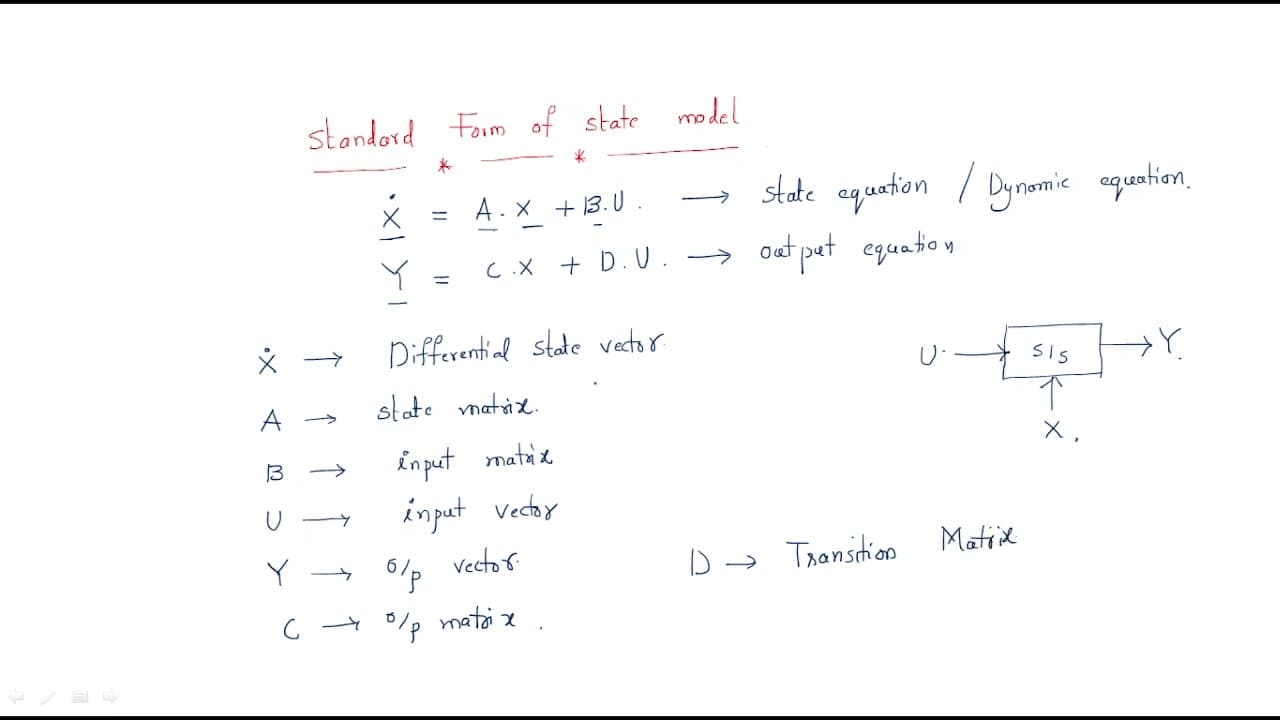
hello everyone the last session we discussed about introduction of the state space analysis what is the state and how to find out the state variables from the given circuit in this session we will discuss standard form of the state model how to make the standard from by using the state model here the standard form is like this the form is x dot equ... Read More
Key Insights
- 💁 The standard form of the state model provides a structured framework for analyzing linear time-invariant systems.
- 🔯 The differential state vector (x dot) denotes the rate of change of the state variables over time, which is central to control system dynamics.
- 🔙 Each matrix (A, B, C, D) has a specific role that contributes to the overall behavior of the system, crucial for modeling and control.
- 🔠 MIMO systems exemplify how interdependencies between multiple inputs and outputs can be effectively analyzed using state models.
- 😑 The ability to express systems in matrix form enhances the capacity to solve complex differential equations commonly encountered in control theory.
- 🫤 The transition matrix D is key for understanding how inputs directly influence outputs without going through the state.
- 👾 Techniques developed from state-space analysis are widely applicable in various engineering fields, including aerospace, electrical, and mechanical engineering.
Install to Summarize YouTube Videos and Get Transcripts
Explore YouTube Video Summarizer or Get YouTube Transcript Extractor
Questions & Answers
Q: What is the significance of the state equation in control systems?
The state equation, expressed as x dot equals ax plus bu, represents the dynamic behavior of a control system by describing how the state of the system evolves over time based on current inputs and state conditions. It is fundamental for understanding system stability and response characteristics.
Q: How do the matrices A, B, C, and D function in the state model?
In the state model, matrix A is the state matrix that defines state transitions, B is the input matrix relating inputs to state changes, C is the output matrix that maps state variables to outputs, and D is the feedforward (or transition) matrix that outlines direct dependencies between inputs and outputs, facilitating systems analysis.
Q: Can you explain what a MIMO system is?
A MIMO system stands for multi-input multi-output system, which incorporates multiple input variables to govern multiple output variables. This complexity allows for advanced control strategies, enabling more sophisticated system behavior and performance optimization in applications such as robotics, telecommunications, and automation.
Q: Why is it important to work in vector and matrix forms in state models?
Using vector and matrix forms allows for a compact and efficient representation of complex systems, facilitating calculations and analysis. This mathematical framework simplifies system design and allows the application of various techniques for stability analysis, system simulation, and control design.
Summary & Key Takeaways
-
The session focuses on defining the standard form of a state model, represented as x dot equals ax plus bu, with outputs calculated via y equals cx plus du.
-
Key components of the state model include the differential state vector (x dot), state matrix (A), input matrix (B), and output vector (Y), each playing a crucial role in system analysis.
-
The discussion also introduces MIMO (multi-input multi-output) systems, highlighting how multiple inputs (u1, u2, etc.) can influence various outputs (y1, y2, etc.) in control engineering.
Read in Other Languages (beta)
Share This Summary 📚
Summarize YouTube Videos and Get Video Transcripts with 1-Click
Try YouTube Summary with ChatGPT & Claude or YouTube Transcript Generator