What Is Unforced Damped Motion in Quadratic Equations?
TL;DR
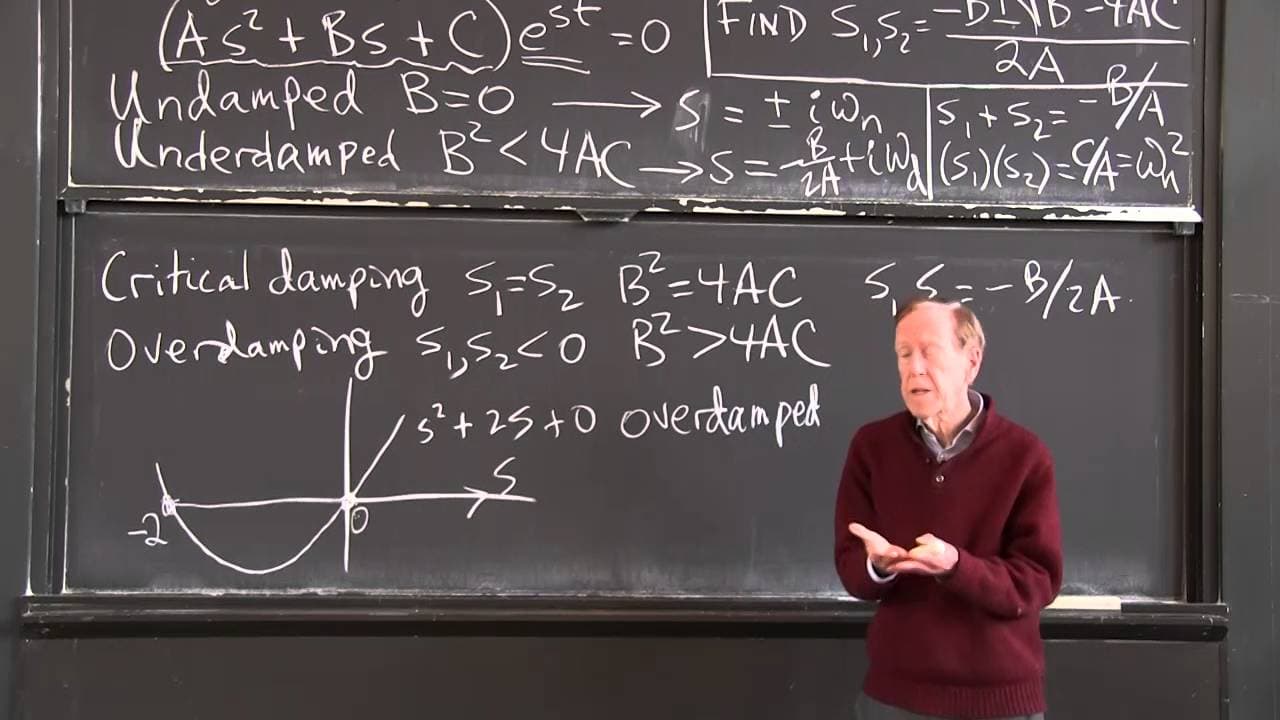
Unforced damped motion is defined by a quadratic equation that describes how damping affects the behavior of systems. Depending on the value of the damping coefficient, systems can exhibit oscillations (underdamping), converge slowly to rest (overdamping), or maintain critical damping without oscillations.
Transcript
GILBERT STRANG: OK. So today is unforced-- that means zero on the right-hand side, looking for null solutions-- damped-- that means there is a coefficient B in the first derivative. And what's the solution? This is really a basic, basic equation. In many applications, A would be the mass. In a spring, for example, A would be a mass. B is the dampin... Read More
Key Insights
- 🪈 The quadratic equation represents a second-order differential equation with damping.
- 🅰️ Different coefficients in the equation determine the type and magnitude of damping.
- 🥺 Underdamping involves oscillations with exponential decay, while overdamping leads to slow convergence to zero.
- 🫚 Critical damping occurs when the system has repeated real roots and no oscillations.
Install to Summarize YouTube Videos and Get Transcripts
Explore YouTube Video Summarizer or Get YouTube Transcript Extractor
Questions & Answers
Q: What are the three coefficients in the quadratic equation?
The three coefficients in the quadratic equation are A, B, and C. A represents the mass or stiffness, B represents the damping or resistance, and C represents the spring constant or force that pulls the system back.
Q: How does the value of B affect the solutions of the quadratic equation?
The value of B determines the amount of damping in the system. If B is smaller, it results in underdamping, with oscillations and exponential decay. If B is larger, it leads to overdamping, where the system gradually approaches zero without significant oscillations.
Q: What is critical damping?
Critical damping occurs when B squared is equal to 4AC. In this case, the system has repeated real roots and no oscillations. It represents the threshold between underdamping and overdamping.
Q: How does the value of C affect the solutions of the quadratic equation?
The value of C, or the constant term, affects the position of the graph of the quadratic equation. Increasing C lifts the graph, bringing the roots closer together. At a specific value of C, known as critical damping, the roots coincide.
Summary & Key Takeaways
-
The video introduces the quadratic equation, which represents a second-order differential equation with damping.
-
Different values of A, B, and C in the equation determine the type and magnitude of damping in various systems.
-
The video explores different possibilities of damping, including no damping, underdamping, overdamping, and critical damping.
Read in Other Languages (beta)
Share This Summary 📚
Summarize YouTube Videos and Get Video Transcripts with 1-Click
Try YouTube Summary with ChatGPT & Claude or YouTube Transcript Generator
Explore More Summaries from MIT OpenCourseWare 📚



Summarize YouTube Videos and Get Video Transcripts with 1-Click
Try YouTube Summary with ChatGPT & Claude or YouTube Transcript Generator