Ep. 6: Element Production (Fusion) -- Part 1
TL;DR
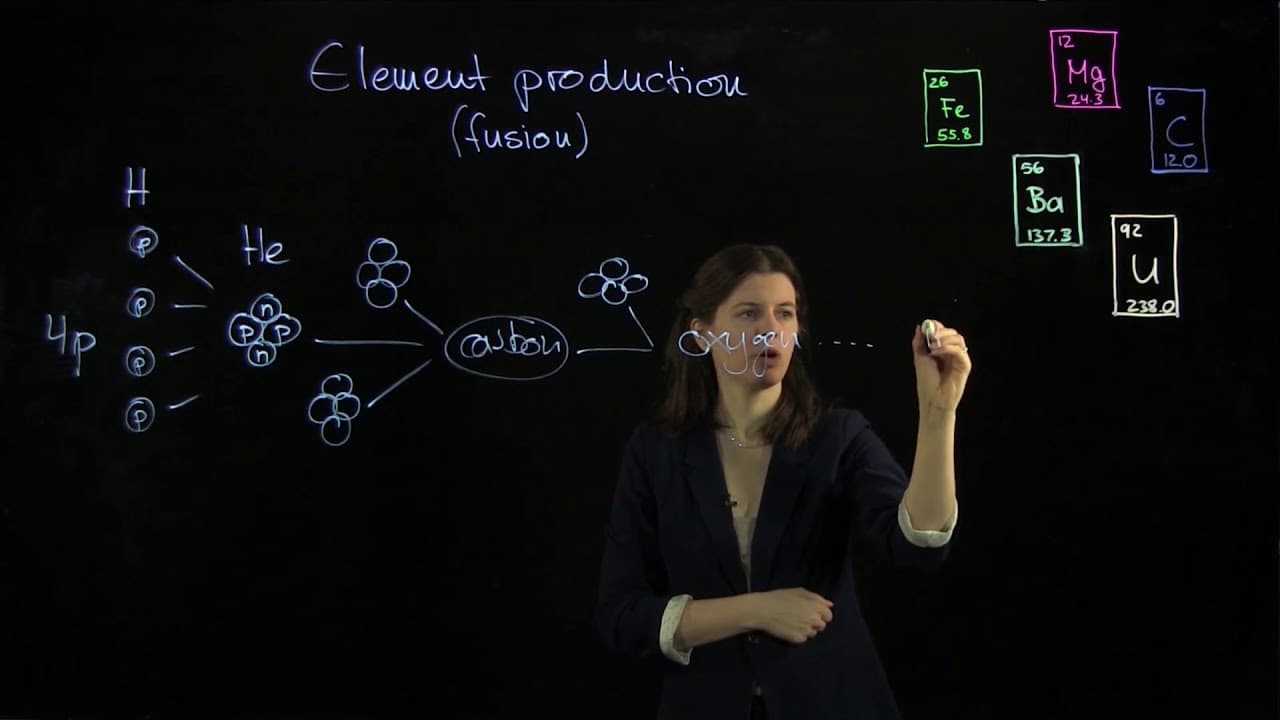
Nuclear fusion in stars creates chemical elements, with lighter elements producing more energy than heavier ones. Iron cannot undergo fusion, leading to the explosion of a star as a supernova.
Transcript
Have you ever wondered how all the chemical elements are made? Then join me as we are lifting all the star dust secrets to understand the cosmic origin of the chemical elements. Why do stars shine? Why do we have sunlight every day? Well it's because of nuclear fusion. Nuclear fusion is going on in the core of the Sun. Hydrogen to helium gets conve... Read More
Key Insights
- 🤩 Nuclear fusion in stars, particularly the Sun, powers their luminosity and energy output.
- 🦾 Quantum mechanical tunneling enables the fusion of protons into helium despite their repulsive charges.
- 🙂 Lighter elements like carbon and oxygen are formed from the fusion of helium nuclei.
- 🤩 Iron, the heaviest nucleus that cannot undergo fusion, leads to a star's explosive supernova death.
- 🙂 The equation E = mc^2 explains how a slight mass difference releases vast amounts of energy in nuclear fusion.
- 💆 The mass defect, where the combined mass of individual particles is less than the resulting nucleus, contributes to the energy released in fusion.
- 🙂 Lighter elements release more energy in fusion reactions compared to heavier elements like iron.
Install to Summarize YouTube Videos and Get Transcripts
Explore YouTube Video Summarizer or Get YouTube Transcript Extractor
Questions & Answers
Q: How does nuclear fusion in the Sun contribute to its luminosity for billions of years?
Nuclear fusion in the Sun's core converts hydrogen atoms to helium, releasing energy that sustains its luminosity for billions of years.
Q: What enables protons to combine and form a helium nucleus in the Sun despite their repulsive charges?
Quantum mechanical tunneling allows protons to overcome their repulsive charges and fuse to form a helium nucleus in the Sun due to the hot temperature.
Q: How do lighter elements like carbon and oxygen form through fusion reactions?
By adding helium nuclei or alpha particles, fusion reactions in stars can produce heavier elements like carbon and oxygen.
Q: Why do stars explode as supernovae when they have a big iron core?
Iron cannot undergo fusion to release energy, so when a star's core becomes predominantly iron, it can no longer sustain its energy source, leading to a supernova explosion.
Summary & Key Takeaways
-
Stars shine due to nuclear fusion in their cores, where hydrogen atoms combine to form helium, releasing energy.
-
Fusion reactions continue, leading to the formation of heavier elements like carbon, oxygen, and eventually iron.
-
Lighter elements release more energy during fusion, while iron cannot undergo fusion and leads to the explosion of a star as a supernova.
Read in Other Languages (beta)
Share This Summary 📚
Summarize YouTube Videos and Get Video Transcripts with 1-Click
Try YouTube Summary with ChatGPT & Claude or YouTube Transcript Generator
Explore More Summaries from MIT OpenCourseWare 📚



Summarize YouTube Videos and Get Video Transcripts with 1-Click
Try YouTube Summary with ChatGPT & Claude or YouTube Transcript Generator