Languages | Operations | TOC | Lec-05 | Bhanu Priya
TL;DR
This content explains the concept of languages in computation theory and their operations.
Transcript
hi students welcome back let's continue with this theory of computation we are discussing about the basic terminologies that is the basic definitions that we are going to use in this theory of competitions now let's discuss about the languages okay so actually here the language is nothing but it is a fine exit it is a finite set of non empty string... Read More
Key Insights
- 😫 Languages are defined as finite sets of non-empty strings, emphasizing their necessity to contain characters for expressibility.
- 🤬 Operations on languages include complementation, union, intersection, and concatenation, each with distinct mathematical symbols and definitions.
- 👻 Kleene closure allows for the generation of strings from a language multiple times, encompassing the empty string as a possible output.
- ❓ Positive closure is similar to Kleene closure but specifically excludes the empty string, mandating at least one occurrence of a character.
- 💁 The reversal operation provides versatility in string manipulation by transforming strings into their backward form.
- 👻 Union and intersection operations serve different functions in combining and filtering languages, allowing for various forms of string analysis.
- 🦻 Real-world examples illustrate theoretical concepts, aiding comprehension and application of language definitions in practical contexts.
Install to Summarize YouTube Videos and Get Transcripts
Explore YouTube Video Summarizer or Get YouTube Transcript Extractor
Questions & Answers
Q: What defines a language in the context of computation theory?
A language is defined as a finite set of non-empty strings. Importantly, it must contain at least one character; otherwise, it is not considered a language. A single character, symbol, or alphabet can represent a language, as long as it satisfies the condition of being non-empty.
Q: Can you explain the concept of Kleene closure?
Kleene closure is a crucial operation in language theory represented by the symbol L*. It entails combining a language L with itself zero or more times, which means it can produce the empty string (epsilon) and any possible concatenation of strings from L. This closure helps in defining patterns and expressions in automata and formal languages.
Q: How do the union and intersection operations differ when applied to languages?
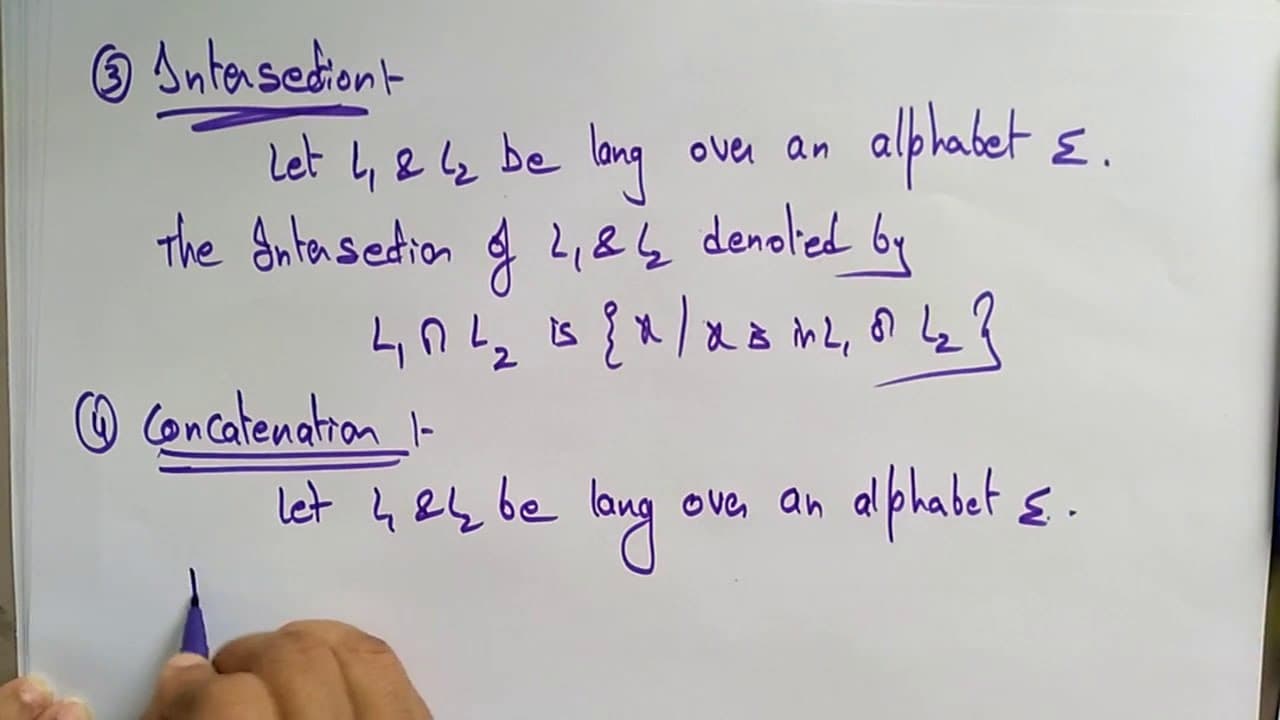
The union of two languages, denoted as L1 ∪ L2, combines all distinct strings from both languages, meaning a string is included if it exists in either L1 or L2. On the other hand, intersection, denoted as L1 ∩ L2, includes only those strings that are present in both languages, representing their common elements.
Q: What is the difference between Kleene closure and positive closure?
Kleene closure, represented by L*, includes all strings formed by concatenating elements of a language L any number of times, including the empty string (epsilon). In contrast, positive closure, denoted by L+, includes strings formed by concatenating elements of L at least once, excluding the empty string, thus starting with at least one character from L.
Q: What is the significance of using formal operations like complementation on languages?
Complementation, denoted by L̅, represents the set of all strings over an alphabet Sigma that are not part of the language L. This operation is significant in defining language properties and creating automata that can recognize negative matches, enhancing the power of computational models.
Q: How is the reversal operation on a language defined and what does it entail?
The reversal operation, denoted by L^R, transforms each string in language L into its reverse form. This means that for every string w in L, the new language consists of strings that are identical to w but written backward. This operation is valuable in various applications, including parsing and string processing.
Q: What role do examples like legal English words serve in explaining languages?
Real-world examples, such as legal English words or valid C programs, ground theoretical concepts in familiar contexts, making abstract definitions more understandable. They demonstrate how languages function in practice, helping learners grasp the intricacies of language definitions and operations in computation theory.
Q: Can you define concatenation in the context of languages?
Concatenation is an operation that combines two languages, denoted as L1 · L2, creating a new language formed by all possible strings that result from pairing each string in L1 with every string in L2. This operation is fundamental in forming complex strings and understanding the composition of languages in computation.
Summary & Key Takeaways
-
The discussion introduces the concept of languages in computation theory, defining them as finite sets of non-empty strings, emphasizing the importance of including at least one character.
-
Various operations on languages, including complementation, union, intersection, concatenation, reversal, Kleene closure, and positive closure, are described with their corresponding mathematical notations and definitions.
-
Examples such as legal English words and specific string sets illustrate the definition and application of languages, showcasing their operations in a practical context.
Read in Other Languages (beta)
Share This Summary 📚
Summarize YouTube Videos and Get Video Transcripts with 1-Click
Try YouTube Summary with ChatGPT & Claude or YouTube Transcript Generator