Network Charts: What's the Difference between PERT and CPM?
TL;DR
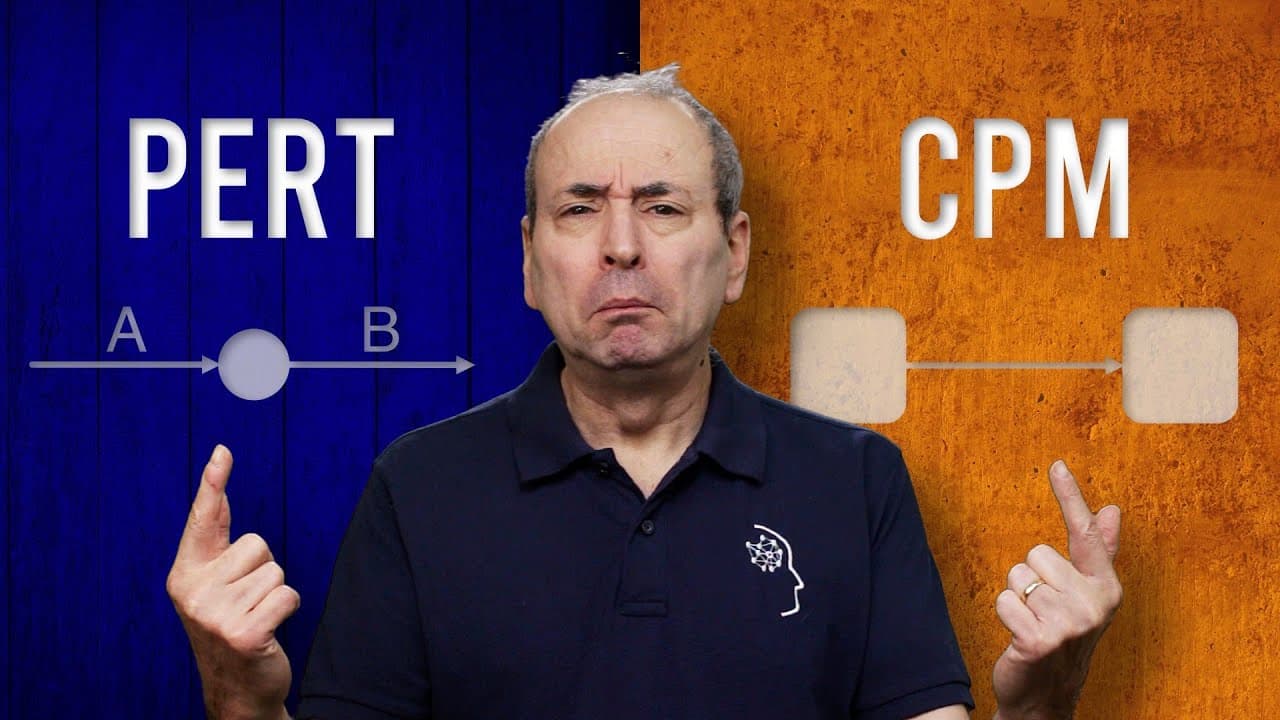
The program evaluation and review technique (PERT) and the critical path method (CPM) are similar but have key differences in representing activities, estimating durations, and their suitability for different types of projects.
Transcript
per and CPM are two different forms of network charts which are represented differently and calculate schedule in a slightly different way but both have their origins in the 1940s and the way that the famous Manhattan Project was planned question is what's the difference my intention is not not to give you a detailed explanation of either the progr... Read More
Key Insights
- 🧻 PERT and CPM were developed in the 1950s, with PERT being slightly earlier and developed by the US Navy and Consultants Booze Allen Hamilton, while CPM was developed by Dupont and Remington Rand.
- 🫥 PERT represents activities as lines with nodes, while CPM represents activities in boxes with arrows.
- 😒 PERT uses three-point estimates for activity durations, combining optimistic, most likely, and pessimistic durations, while CPM uses single point estimates.
- 📽️ PERT is suitable for projects with high uncertainty and risk, while CPM is more appropriate for familiar and repetitive projects.
- 📆 PERT focuses on optimizing and controlling the schedule, while CPM considers both schedule and budget trade-offs.
- 🔨 There is an increasing hybridization of PERT and CPM approaches, with tools drawing from elements of both methodologies.
- 📽️ The use of PERT and CPM is more prevalent in highly structured large projects, while smaller projects and more agile frameworks prioritize adaptability and incrementalism.
Install to Summarize YouTube Videos and Get Transcripts
Explore YouTube Video Summarizer or Get YouTube Transcript Extractor
Questions & Answers
Q: What are the main differences between PERT and CPM?
The main differences lie in how activities are represented (lines with nodes vs. boxes with arrows), estimating durations (three-point estimates vs. single point estimates), and suitability for different project types (high uncertainty vs. low uncertainty).
Q: When should PERT be used over CPM?
PERT is more suitable for novel, unusual, and high-risk projects where there is high uncertainty. It helps optimize and control the schedule, understanding possible schedule outcomes for each activity.
Q: When is CPM more appropriate?
CPM is suitable for familiar, repetitive projects or those with lower uncertainty. It is used to control both schedule and budget, understanding the trade-offs between the two.
Q: What is the significance of PERT's three-point estimates?
PERT's three-point estimates (optimistic, most likely, pessimistic) allow for a more probabilistic approach, considering best and worst-case scenarios to calculate a balanced estimate. It acknowledges the variability in durations.
Summary & Key Takeaways
-
PERT and CPM were developed in the 1950s, with PERT developed by the US Navy and the Consultants Booze Allen Hamilton, and CPM developed by Dupont and Remington Rand.
-
PERT represents activities as lines with nodes, while CPM represents activities in boxes with arrows representing dependencies.
-
PERT uses three-point estimates (optimistic, most likely, pessimistic) to calculate the duration of activities, while CPM uses single point estimates.
-
PERT is more appropriate for projects with high uncertainty and risk, while CPM is suitable for familiar, repetitive projects.
Read in Other Languages (beta)
Share This Summary 📚
Summarize YouTube Videos and Get Video Transcripts with 1-Click
Try YouTube Summary with ChatGPT & Claude or YouTube Transcript Generator
Explore More Summaries from Online PM Courses - Mike Clayton 📚






Summarize YouTube Videos and Get Video Transcripts with 1-Click
Try YouTube Summary with ChatGPT & Claude or YouTube Transcript Generator