Products
Features
YouTube Video Summarizer
Summarize YouTube videos
Web & PDF Highlighter
Highlight web pages & PDFs
Chat with PDF
Ask any PDF questions with AI
Ask AI Clone
Chat with your highlights & memories
Audio Transcriber
Transcribe audio files to text
Glasp Reader
Read and highlight articles
Kindle Highlight Export
Export your Kindle highlights
Idea Hatch
Hatch ideas from your highlights
Integrations
Obsidian Plugin
Notion Integration
Pocket Integration
Instapaper Integration
Medium Integration
Readwise Integration
Snipd Integration
Hypothesis Integration
Apps & Extensions
Chrome Extension
Safari Extension
Edge Add-ons
Firefox Add-ons
iOS App
Android App
Discover
Discover
Ideas
Discover new ideas and insights
Articles
Curated articles and insights
Books
Book recommendations by great minds
Posts
Essays and notes from readers
Quotes
Inspiring quotes collection
Videos
Curated videos and summaries
Explore Glasp
Glasp Newsletter
Weekly insights and updates
Glasp Talk
Interview series with great minds
Glasp Blog
Latest news and articles
Glasp Use Cases
Learn how others use Glasp
Build & Support
Glasp API
Access Glasp's API for developers
MCP Connector
Connect Glasp to Claude & ChatGPT
Community
Glasp Reddit Community
Students
Student discount and benefits
FAQs
Frequently Asked Questions
AboutPricing
DashboardLog inSign up

How to Calculate Oxidation Numbers for Compounds
1.1M views
•
June 16, 2015
by
Tyler DeWitt
YouTube video player
How to Calculate Oxidation Numbers for Compounds

TL;DR

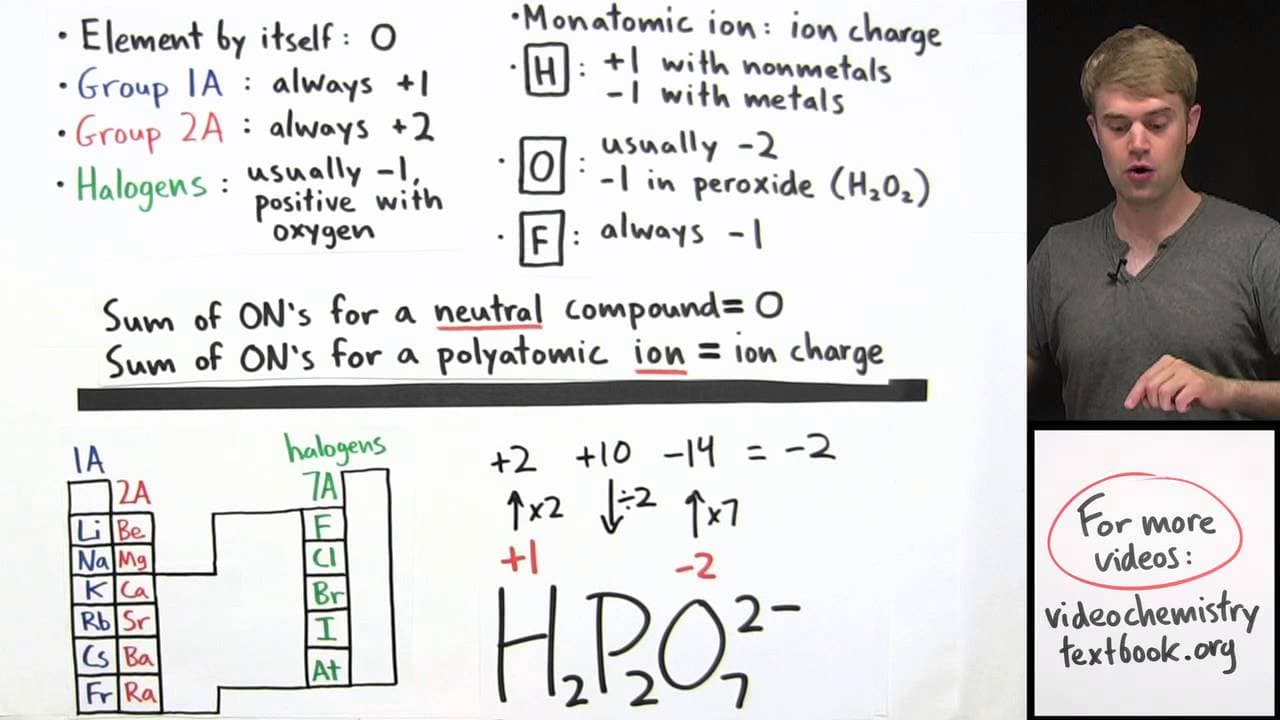
To calculate oxidation numbers in compounds, identify the oxidation states based on established rules: elements in group 1A and 2A have fixed positive charges, oxygen is typically -2, and halogens are usually -1 unless paired with oxygen. Sum all oxidation numbers to equal zero for neutral compounds, considering the effects of coefficients and parentheses in formulas.

Transcript

in this video we are going to get really good at figuring out the oxidation numbers for elements in a chemical compound because we are going to do a ton of examples we're going to start out with some examples that are pretty basic and straightforward and then we will go step by step into problems that are a little bit more challenging okay so these... Read More

Key Insights

  • #️⃣ Group 2a elements have an oxidation number of +2.
  • ⚾ Oxygen generally has an oxidation number of -2 but can vary based on compound type.
  • #️⃣ Halogens usually have an oxidation number of -1 but can be positive in certain situations.
  • 😐 The sum of oxidation numbers in a neutral compound should equal zero.
  • 🫀 Multiplication is used to account for multiple atoms of an element in a compound.
  • 🚰 Periodic table placement helps in determining oxidation numbers for elements.
  • #️⃣ Parentheses and coefficients affect the calculation of oxidation numbers in compounds.

Install to Summarize YouTube Videos and Get Transcripts

Explore YouTube Video Summarizer or Get YouTube Transcript Extractor

Questions & Answers

Q: How do you determine the oxidation number for Group 2a elements?

Group 2a elements, like calcium, have a standard oxidation number of +2 due to their position on the periodic table.

Q: What is the oxidation number for oxygen in chemical compounds?

Oxygen typically has an oxidation number of -2 in most compounds, but that can vary based on specific scenarios like peroxides.

Q: How is the overall oxidation number determined for neutral compounds?

The sum of oxidation numbers for neutral compounds should always equal zero, allowing for the calculation of unknown oxidation numbers for elements like iodine.

Q: Why do halogens like chlorine sometimes have positive oxidation numbers?

In cases where halogens like chlorine bond with oxygen, their oxidation numbers can become positive to maintain balance in the compound.

Summary & Key Takeaways

  • Detailed explanation of how to determine oxidation numbers for elements in chemical compounds.

  • Examples provided from basic to complex scenarios with step-by-step guidance.

  • Rules outlined for elements like hydrogen, oxygen, halogens, and neutral compounds.


Read in Other Languages (beta)

English

Share This Summary 📚

Summarize YouTube Videos and Get Video Transcripts with 1-Click

Download browser extensions on:

Try YouTube Summary with ChatGPT & Claude or YouTube Transcript Generator

Explore More Summaries from Tyler DeWitt 📚

Cellscape VR Biology Guided Tour thumbnail
Cellscape VR Biology Guided Tour
Tyler DeWitt
What's the difference between a Mole and a Molecule? thumbnail
What's the difference between a Mole and a Molecule?
Tyler DeWitt
Using Significant Figures Practice Problems (1.9) thumbnail
Using Significant Figures Practice Problems (1.9)
Tyler DeWitt
Cellscape VR Biology Guided Tour for Kids thumbnail
Cellscape VR Biology Guided Tour for Kids
Tyler DeWitt
Converting Between Grams and Moles (Part 2) thumbnail
Converting Between Grams and Moles (Part 2)
Tyler DeWitt
Food Calorimetry: Common Mistakes thumbnail
Food Calorimetry: Common Mistakes
Tyler DeWitt

Summarize YouTube Videos and Get Video Transcripts with 1-Click

Download browser extensions on:

Try YouTube Summary with ChatGPT & Claude or YouTube Transcript Generator

Apps & Extensions

  • Chrome Extension
  • Safari Extension
  • Edge Add-ons
  • Firefox Add-ons
  • iOS App
  • Android App

Key Features

  • YouTube Video Summarizer
  • Web & PDF Summarizer
  • Web & PDF Highlighter
  • Chat with PDF
  • Ask AI Clone
  • Audio Transcriber
  • Glasp Reader
  • Kindle Highlight Export
  • Idea Hatch

Integrations

  • Obsidian Plugin
  • Notion Integration
  • Pocket Integration
  • Instapaper Integration
  • Medium Integration
  • Readwise Integration
  • Snipd Integration
  • Hypothesis Integration

More Features

  • APIs
  • MCP Connector
  • Blog & Post
  • Embed Links
  • Image Highlight
  • Personality Test
  • Quote Shots

Company

  • About us
  • Blog
  • Community
  • FAQs
  • Job Board
  • Newsletter
  • Pricing
Terms

•

Privacy

•

Guidelines

© 2026 Glasp Inc. All rights reserved.