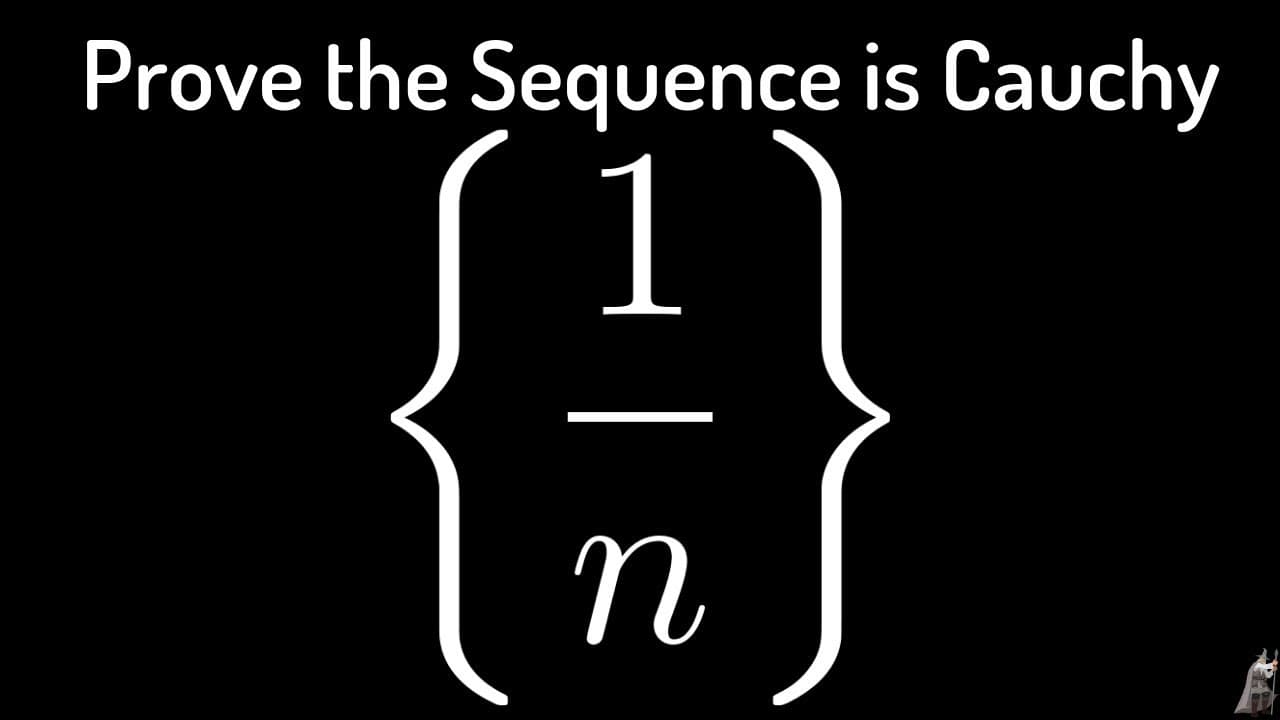
Proof that the Sequence {1/n} is a Cauchy Sequence
TL;DR
Direct proof using the definition of Cauchy sequence that 1/N is a Cauchy sequence of real numbers.
Transcript
hey YouTube in this video we're going to give a direct proof using the definition of Cauchy sequence to prove that the sequence 1 over N is in fact a Cauchy sequence of real numbers so proof so first recall what it means for a sequence to be Cauchy so recall that the sequence X sub n is said to be a Cauchy sequence is Cauchy if its terms get infini... Read More
Key Insights
- 😚 Cauchy sequence defined as terms getting infinitely close.
- ❓ Use of Archimedean property crucial in the proof.
- ❓ Triangle inequality simplifies distance analysis.
- 😚 Importance of terms getting closer for sequence convergence.
- 👔 Formal proof involves choosing a natural number using Archimedean property.
- 👍 1/N sequence proven to be Cauchy through proper selection of natural numbers.
- 🙈 Understanding the concept behind the proof aids in seeing its validity.
Install to Summarize YouTube Videos and Get Transcripts
Explore YouTube Video Summarizer or Get YouTube Transcript Extractor
Questions & Answers
Q: What is a Cauchy sequence?
A Cauchy sequence is one where terms get arbitrarily close to each other as the sequence progresses, ensuring the terms converge towards each other.
Q: How is the Archimedean property used in the proof?
The Archimedean property allows us to choose a natural number greater than any given real number, crucial in proving the sequence is Cauchy.
Q: Why is it necessary for the terms to get infinitely closer together in a Cauchy sequence?
The closeness of terms ensures the convergence of the sequence, indicating that it has a well-defined limit in the real number system.
Q: How does the triangle inequality help in proving the Cauchy sequence?
By breaking down the absolute difference between terms into smaller parts, the triangle inequality simplifies the proof by focusing on each component's size relative to Epsilon.
Summary & Key Takeaways
-
Definition of a Cauchy sequence: a sequence where terms get infinitely closer together.
-
Strategy of proof: using the Archimedean property to choose a natural number bigger than 2/Epsilon.
-
Formal proof: By showing the difference between 1/N and 1/m is less than Epsilon, proving 1/N is a Cauchy sequence.
Read in Other Languages (beta)
Share This Summary 📚
Summarize YouTube Videos and Get Video Transcripts with 1-Click
Try YouTube Summary with ChatGPT & Claude or YouTube Transcript Generator
Explore More Summaries from The Math Sorcerer 📚


Summarize YouTube Videos and Get Video Transcripts with 1-Click
Try YouTube Summary with ChatGPT & Claude or YouTube Transcript Generator