Parasitic Wasps Found Inside 30 Million-Year-Old Flies | SciShow News
TL;DR
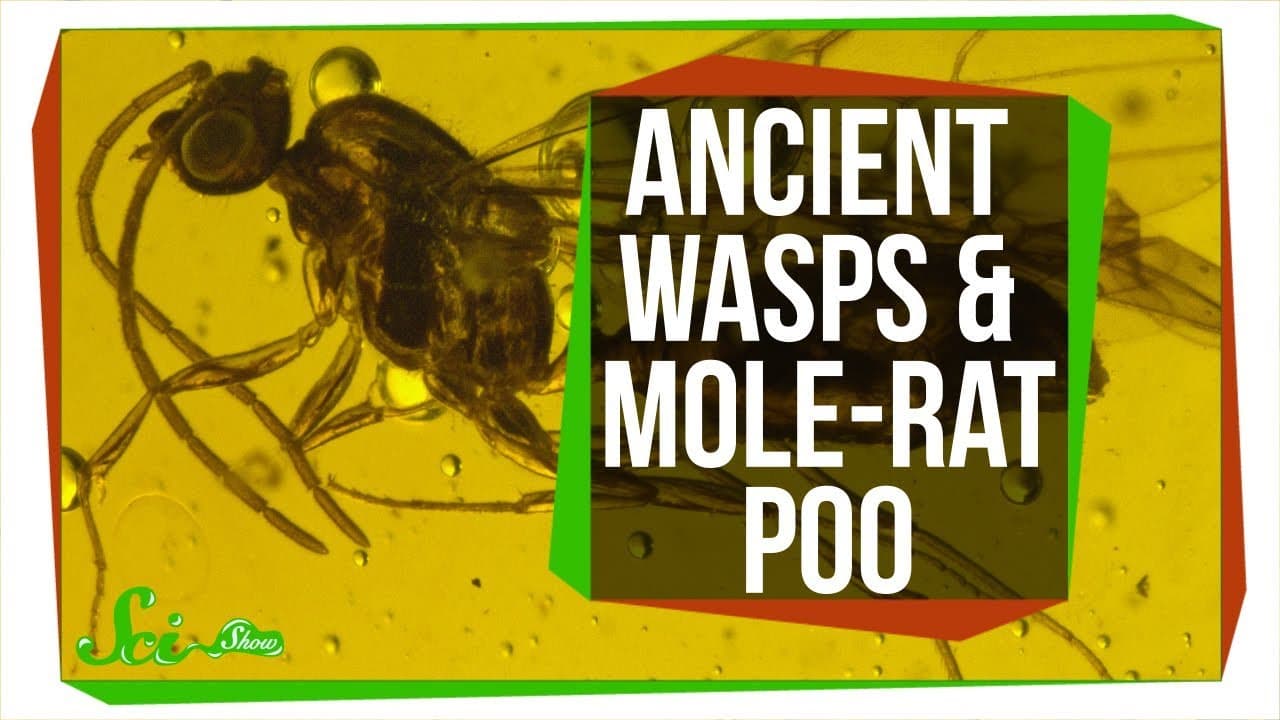
Fossilized wasps and mole-rats show intriguing behavior from millions of years ago, shedding light on ancient ecology.
Transcript
[ INTRO ] Many wasps are brutal assassins, taking over the bodies of unsuspecting insects and killing them from the inside out. And last week, in the journal Nature Communications, German researchers reported the first clear evidence that they’ve been doing this for over 30 million years. There are hundreds of thousands of parasitic wasp species, a... Read More
Key Insights
- 😌 Parasitic wasps lay eggs in hosts and consume them internally, leaving behind fossils discovered inside fly pupae.
- 👻 High-resolution scans allow detailed examination of well-preserved ancient wasp fossils in hosts.
- 🥳 Mole-rats care for young by ingesting queen's poop with estradiol hormone inducing parenting behaviors.
- 🥳 Subordinate mole-rats respond to pup cries after consuming queen's feces containing estradiol.
- 🥳 Naked mole-rats influence behavior through hormone consumption, differentiating from pheromone-based signals.
- 🥳 Researchers aim to study neural changes in mole-rat brains to understand the mechanism behind parenting behavior induction.
- 🥳 Understanding ancient mole-rat and wasp behavior provides insight into ecology and evolution millions of years ago.
Install to Summarize YouTube Videos and Get Transcripts
Explore YouTube Video Summarizer or Get YouTube Transcript Extractor
Questions & Answers
Q: How do parasitic wasps reproduce and develop inside hosts?
Female parasitic wasps lay eggs in or on hosts, and the hatched larvae devour the host from the inside as they mature, eventually emerging or pupating inside the hollowed-out shell.
Q: How did researchers discover fossilized wasps inside fly pupae?
Researchers used new x-ray scanning technology to create detailed 3D images of mineralized fly pupae fossils, finding 55 parasitized pupae and identifying new wasp species.
Q: Why do subordinates in naked mole-rat colonies care for pups?
Subordinates care for pups due to increased estradiol levels linked to the postpartum period of the queen, which subordinates ingest by eating the queen's feces containing the hormone.
Q: How do naked mole-rats influence subordinate behavior through hormone consumption?
Mole-rats induce parenting behaviors in subordinates by providing hormones through the queen's feces, leading to increased estradiol levels and responsiveness to pup cries.
Summary & Key Takeaways
-
Ancient parasitic wasps laid eggs in hosts, consuming them from inside out.
-
High-resolution scanning technology reveals well-preserved wasp fossils inside fly pupae.
-
Mole-rats parentally care for pups by eating queen's poop containing estradiol hormone.
Read in Other Languages (beta)
Share This Summary 📚
Summarize YouTube Videos and Get Video Transcripts with 1-Click
Try YouTube Summary with ChatGPT & Claude or YouTube Transcript Generator
Explore More Summaries from SciShow 📚


Summarize YouTube Videos and Get Video Transcripts with 1-Click
Try YouTube Summary with ChatGPT & Claude or YouTube Transcript Generator