Forced Harmonic Motion
TL;DR
This video discusses second order differential equations with constant coefficients and a forcing term, explaining the concept of resonance and solving for particular solutions.
Transcript
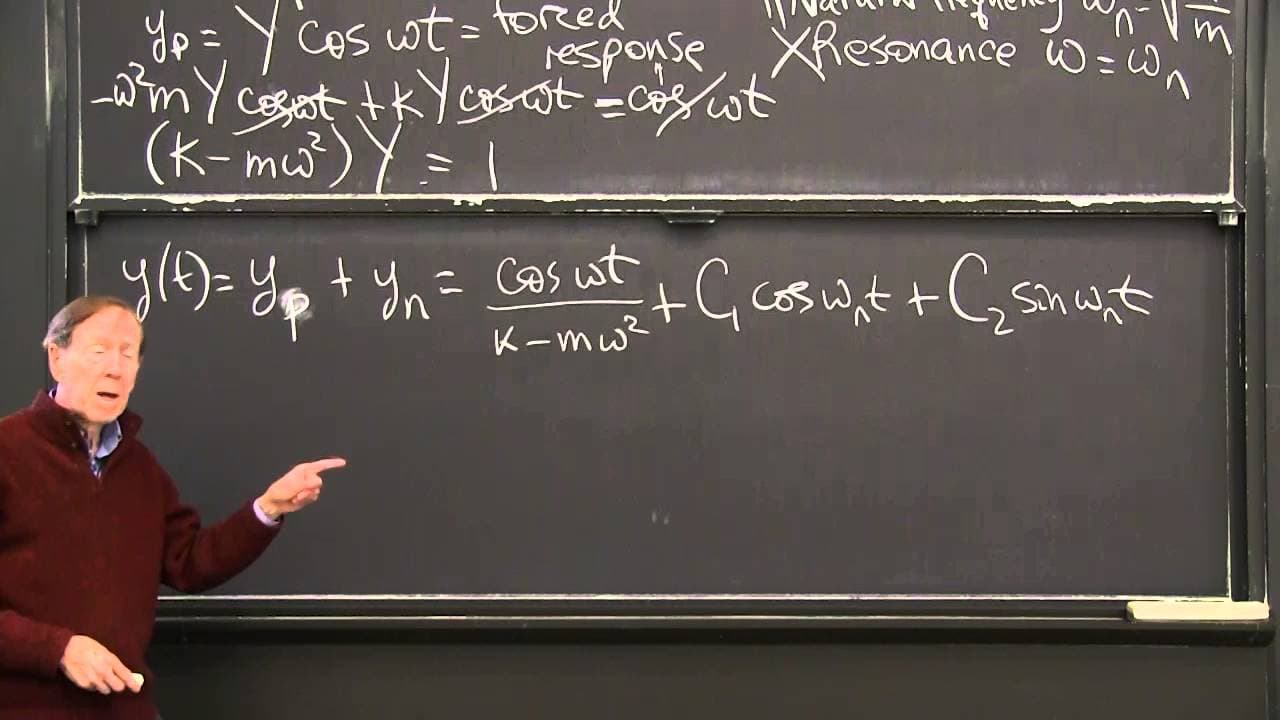
GILBERT STRONG: This is the second video on second order differential equations, constant coefficients, but now we have a right hand side. And the first one was free harmonic motion with a zero, but now I'm making this motion, I'm pushing this motion, but at a frequency omega. This is my forcing term. So I think I'm having a forcing frequency, omeg... Read More
Key Insights
- 😚 Resonance occurs when the forcing frequency is close to or equal to the natural frequency of the system, leading to amplification of the response.
- 🍉 The formula for the particular solution is derived by assuming the particular solution is a multiple of the forcing function and canceling terms in the differential equation.
- 🍹 The response of the system to a forcing function can be obtained by finding the forced response, which is the sum of the particular solution and the complementary solution.
- 🧑🏭 The frequency response factor determines the amplification of a pure frequency forcing term in the response of the system.
- 🍉 The impulse response is the solution to the differential equation with a delta function as the forcing term and represents the system's response to an instantaneous force.
Install to Summarize YouTube Videos and Get Transcripts
Explore YouTube Video Summarizer or Get YouTube Transcript Extractor
Questions & Answers
Q: What is the importance of the separation between the forcing frequency and the natural frequency in the context of resonance?
The separation between the forcing frequency and the natural frequency determines whether the system oscillates excessively or becomes unstable. When the two frequencies are well separated, the system remains stable. However, if they are close or equal, resonance occurs, leading to significant amplification of the response.
Q: How is the formula for finding a particular solution derived when the forcing function is a cosine?
When the forcing function is a cosine, a particular solution can be obtained by assuming it to be a multiple of the cosine function. By plugging this assumption into the differential equation and canceling the cosines, the value of the particular solution can be determined.
Q: What is the frequency response factor for a pure frequency forcing term?
The frequency response factor is given by 1 over the difference squared between the squared natural frequency and the squared forcing frequency. This factor determines the extent to which the forcing frequency is amplified in the response of the system.
Q: How are the constants C1 and C2 determined in the final solution?
The constants C1 and C2 in the final solution are determined by the initial conditions of the system. By plugging in t equals 0 and the initial velocity at t equals 0, the values of these constants can be determined.
Summary & Key Takeaways
-
The video introduces second order differential equations with constant coefficients and a forcing term, focusing on a forcing frequency of omega.
-
Resonance is discussed, with emphasis on the importance of the separation between the forcing frequency and the natural frequency.
-
The formula for finding a particular solution to the differential equation with a forcing term is derived, using the example of a cosine function as the forcing function.
-
The concept of response is introduced, referring to the output of the system, and the solution for the forced response is obtained.
-
The video concludes by mentioning the impulse response, which is the solution to the differential equation with a delta function as the forcing term.
Read in Other Languages (beta)
Share This Summary 📚
Summarize YouTube Videos and Get Video Transcripts with 1-Click
Try YouTube Summary with ChatGPT & Claude or YouTube Transcript Generator
Explore More Summaries from MIT OpenCourseWare 📚



Summarize YouTube Videos and Get Video Transcripts with 1-Click
Try YouTube Summary with ChatGPT & Claude or YouTube Transcript Generator