Products
Features
YouTube Video Summarizer
Summarize YouTube videos
Web & PDF Highlighter
Highlight web pages & PDFs
Chat with PDF
Ask any PDF questions with AI
Ask AI Clone
Chat with your highlights & memories
Audio Transcriber
Transcribe audio files to text
Glasp Reader
Read and highlight articles
Kindle Highlight Export
Export your Kindle highlights
Idea Hatch
Hatch ideas from your highlights
Integrations
Obsidian Plugin
Notion Integration
Pocket Integration
Instapaper Integration
Medium Integration
Readwise Integration
Snipd Integration
Hypothesis Integration
Apps & Extensions
Chrome Extension
Safari Extension
Edge Add-ons
Firefox Add-ons
iOS App
Android App
Discover
Discover
Ideas
Discover new ideas and insights
Articles
Curated articles and insights
Books
Book recommendations by great minds
Posts
Essays and notes from readers
Quotes
Inspiring quotes collection
Videos
Curated videos and summaries
Explore Glasp
Glasp Story
How we grew from 0 to 3 million users
Glasp Newsletter
Weekly insights and updates
Glasp Talk
Interview series with great minds
Glasp Blog
Latest news and articles
Glasp Use Cases
Learn how others use Glasp
Build & Support
Glasp API
Access Glasp's API for developers
MCP Connector
Connect Glasp to Claude & ChatGPT
Community
Glasp Reddit Community
Students
Student discount and benefits
FAQs
Frequently Asked Questions
AboutPricing
DashboardLog inSign up

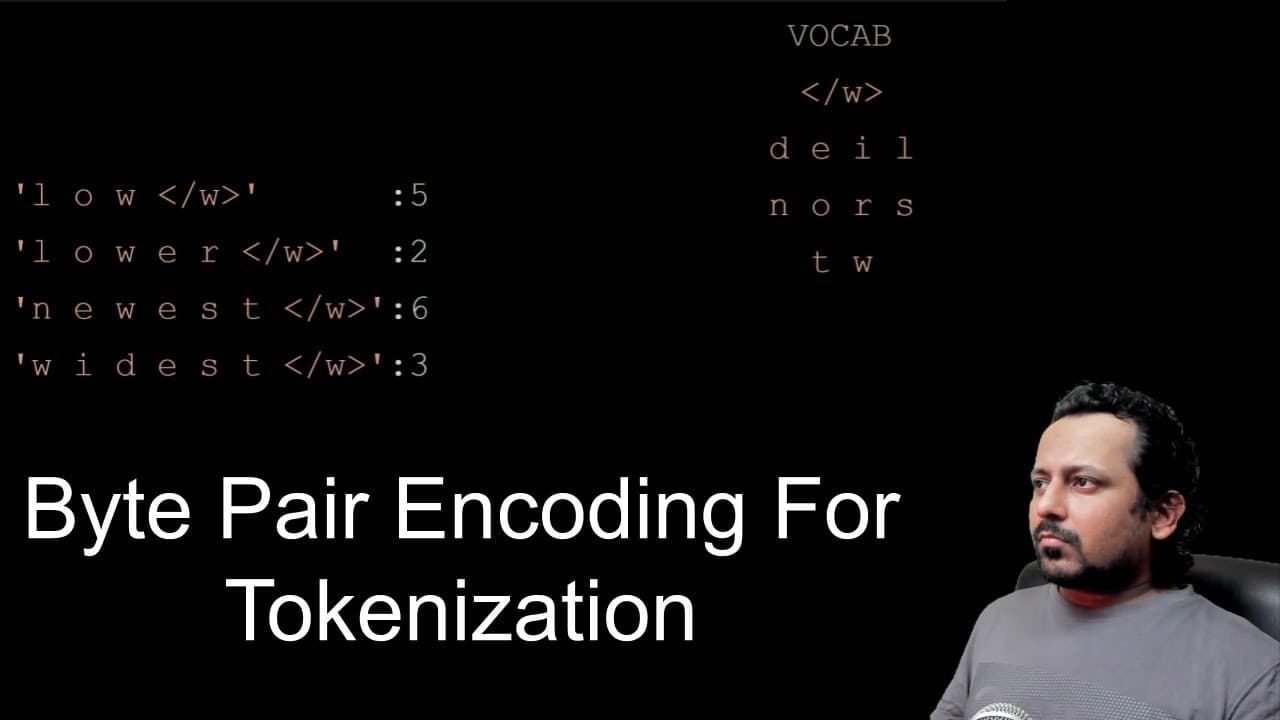
Subword Tokenization: Byte Pair Encoding
November 11, 2020
by
Abhishek Thakur
YouTube video player
Subword Tokenization: Byte Pair Encoding

TL;DR

Byte pair encoding is a subword tokenization algorithm that can handle unknown words by splitting them into smaller parts, making it useful for NLP tasks.

Transcript

hello everyone and welcome to my new video in this video i'm going to talk about bike parent coding and natural language processing so why is bite pair encoding important and um how it works we're going to take a look at that it's not very difficult to understand and there won't be a lot of coding involved today i'm just going to talk about and sho... Read More

Key Insights

  • ❓ Byte pair encoding (BPE) is a subword tokenization algorithm used in natural language processing.
  • 🥳 BPE allows for the handling of unknown words by splitting them into smaller parts based on the most frequent character pairs.
  • 🔑 BPE is particularly useful for languages that combine words and for representing unknown words in NLP tasks.
  • 😒 BPE can be extended to handle different languages, such as Chinese or Japanese, by modifying the algorithm to use byte-level encoding.
  • ❓ BPE is an important technique used in models like GPT-2 and BERT for effective language processing.
  • 🕰️ Alternative techniques like word piece tokenization, used in models like BERT, incorporate probabilities to determine character combinations rather than relying on counts.

Install to Summarize YouTube Videos and Get Transcripts

Explore YouTube Video Summarizer or Get YouTube Transcript Extractor

Questions & Answers

Q: What is byte pair encoding (BPE)?

Byte pair encoding is a subword tokenization algorithm used in natural language processing to handle unknown words by splitting them into smaller parts based on the most frequent character pairs.

Q: How does BPE handle unknown words?

BPE handles unknown words by incorporating them in the corpus and finding the largest possible merges of characters from the existing vocabulary, thereby splitting the word into recognizable subwords.

Q: What are some benefits of using BPE in NLP tasks?

BPE allows for the representation of unknown words, improves vocabulary coverage, and enables the handling of words that are combinations of existing words in different languages.

Q: How does BPE differ from word piece tokenization?

BPE and word piece tokenization are both techniques used in NLP, but word piece tokenization incorporates a probability-based approach instead of counting occurrences, as BPE does. Word piece tokenization is commonly used in models like BERT.

Summary & Key Takeaways

  • Byte pair encoding (BPE) is a subword tokenization algorithm that can handle unknown words by splitting them into smaller parts.

  • BPE starts with a corpus and creates an initial vocabulary by finding the most commonly occurring pairs of characters.

  • The algorithm then iteratively combines the most frequent pairs to create a new vocabulary, allowing for the representation of unknown words.


Read in Other Languages (beta)

English

Share This Summary 📚

Summarize YouTube Videos and Get Video Transcripts with 1-Click

Download browser extensions on:

Try YouTube Summary with ChatGPT & Claude or YouTube Transcript Generator

Explore More Summaries from Abhishek Thakur 📚
Kaggle's 30 Days Of ML (Day-10): Underfitting, Overfitting & Random Forests thumbnail
Kaggle's 30 Days Of ML (Day-10): Underfitting, Overfitting & Random Forests
Abhishek Thakur
What Is Cross Validation and How Is It Used in ML? thumbnail
What Is Cross Validation and How Is It Used in ML?
Abhishek Thakur
Best computer vision competitions on Kaggle (for beginners) thumbnail
Best computer vision competitions on Kaggle (for beginners)
Abhishek Thakur
Talks S2E5 (Luca Massaron): Hacking Bayesian Optimization thumbnail
Talks S2E5 (Luca Massaron): Hacking Bayesian Optimization
Abhishek Thakur
Song Popularity Prediction: EDA with Martin Henze (Part-2) thumbnail
Song Popularity Prediction: EDA with Martin Henze (Part-2)
Abhishek Thakur
I just got access to GitHub's Codespaces and it's amazing! thumbnail
I just got access to GitHub's Codespaces and it's amazing!
Abhishek Thakur

Summarize YouTube Videos and Get Video Transcripts with 1-Click

Download browser extensions on:

Try YouTube Summary with ChatGPT & Claude or YouTube Transcript Generator

Apps & Extensions

  • Chrome Extension
  • Safari Extension
  • Edge Add-ons
  • Firefox Add-ons
  • iOS App
  • Android App

Key Features

  • YouTube Video Summarizer
  • Web & PDF Summarizer
  • Web & PDF Highlighter
  • Chat with PDF
  • Ask AI Clone
  • Audio Transcriber
  • Glasp Reader
  • Kindle Highlight Export
  • Idea Hatch

Integrations

  • Obsidian Plugin
  • Notion Integration
  • Pocket Integration
  • Instapaper Integration
  • Medium Integration
  • Readwise Integration
  • Snipd Integration
  • Hypothesis Integration

More Features

  • APIs
  • MCP Connector
  • Blog & Post
  • Embed Links
  • Image Highlight
  • Personality Test
  • Quote Shots
  • Open Graph Checker

Company

  • About us
  • Our Story
  • Blog
  • Community
  • FAQs
  • Job Board
  • Newsletter
  • Pricing
Terms

•

Privacy

•

Guidelines

© 2026 Glasp Inc. All rights reserved.