D latch implementation | VHDL | Digital Systems Design | Lec-127
TL;DR
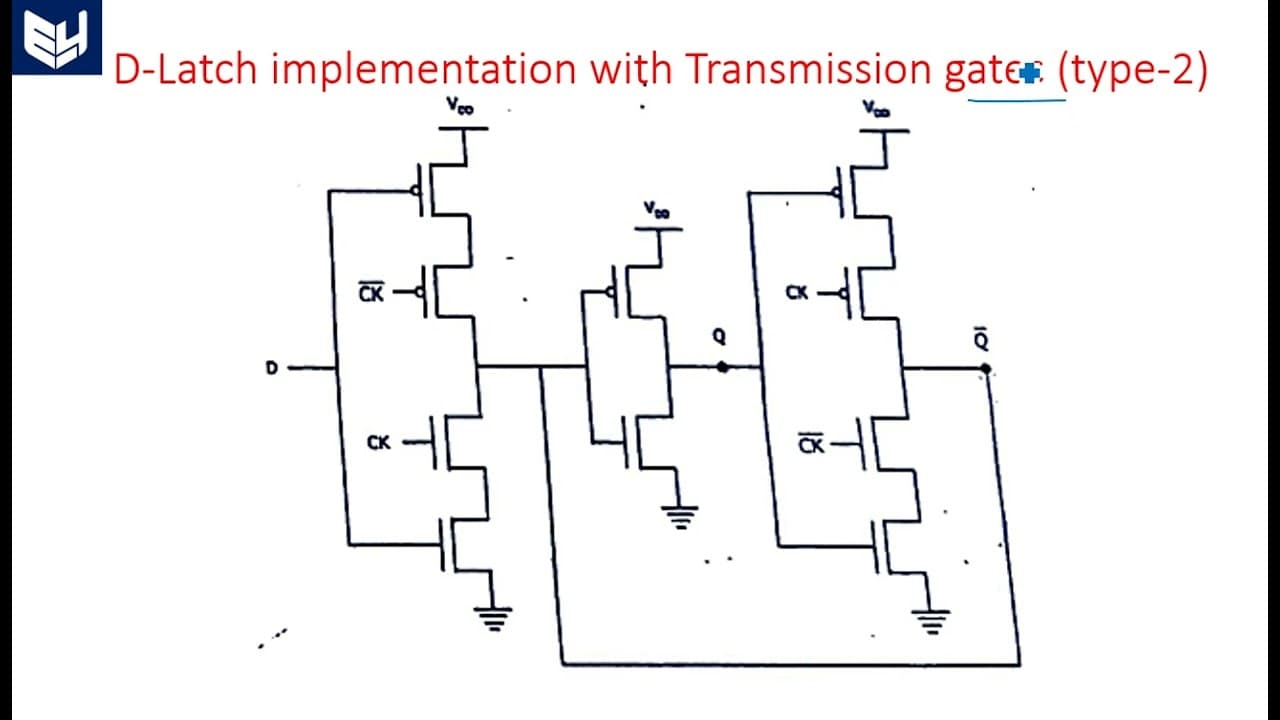
The video explains the D Flip Flop and its implementation using SR Latch and transmission gates.
Transcript
hi everyone in this video I'm going to explain about the implementation of DCH in the previous videos we have seen yesr clock latch JK clock ledge the followed one is the D L which is made up of VSR clock ledge If You observe the implementation of the D the first part is nothing but a gating circuit the first part is gating circuit any any clock la... Read More
Key Insights
- 🫦 D Flip Flops are fundamental components in digital electronics, serving as memory elements for bit storage synchronized with clock signals.
- 😄 The SR latch configuration is crucial in D latch implementation, employing inversion to facilitate proper data storage and retrieval.
- 💗 The gating circuit's design ensures that data input aligns correctly with clock pulses, preventing misreads in sequential circuits.
- ⚡ Dynamic logic and transmission gates significantly improve output performance while reducing the likelihood of threshold voltage issues in circuit designs.
- 🔁 The nature of sequential circuits requires feedback loops, enabling outputs to influence current input states for consistency and reliability in data handling.
- 🎨 Variations in D Flip Flop design illustrate the flexibility in digital logic design, accommodating various applications and operational needs.
- 🐬 Understanding clocked flip flops involves recognizing their role in defining timing relationships and data movement in synchronous systems.
Install to Summarize YouTube Videos and Get Transcripts
Explore YouTube Video Summarizer or Get YouTube Transcript Extractor
Questions & Answers
Q: What is the primary purpose of a D Flip Flop in digital circuits?
The primary purpose of a D Flip Flop is to store a single data bit, synchronizing the input with a clock signal. It allows data to be captured and stored at specific intervals defined by the clock, maintaining data integrity in digital systems.
Q: How does the gating circuit function in the D Flip Flop implementation?
The gating circuit in a D Flip Flop functions by controlling the flow of input signals to the latch. It consists of AND gates and NOT gates that determine when the input data should be captured and stored based on the clock signal, ensuring the correct timing of operations.
Q: Can you explain the role of transmission gates in D Flip Flop construction?
Transmission gates are integral in D Flip Flop construction as they allow for efficient control of data flow by using both NMOS and PMOS transistors. When activated by control signals, they enable high-quality output while minimizing threshold voltage loss, ensuring a more accurate replication of input signals.
Q: What are the advantages of using dynamic logic over traditional methods?
Dynamic logic offers significant advantages such as lower power consumption and faster operation speeds due to reduced static power dissipation. Additionally, dynamic logic circuits can achieve higher density integration, allowing for more complex functions in a smaller area, enhancing overall circuit efficiency.
Summary & Key Takeaways
-
The video discusses how to implement a D Flip Flop using D latch constructed from an SR latch, detailing signal connections and the gating circuit involved.
-
It elaborates on the operation of the D latch, explaining how it processes input signals and the relation between the D input and output states during clock cycles.
-
Implementation variations using transmission gates and dynamic logic are introduced, highlighting advantages such as reduced threshold voltage drop for better output quality.
Read in Other Languages (beta)
Share This Summary 📚
Summarize YouTube Videos and Get Video Transcripts with 1-Click
Try YouTube Summary with ChatGPT & Claude or YouTube Transcript Generator