How to Find Power Series for Sine and Cosine at 0
TL;DR
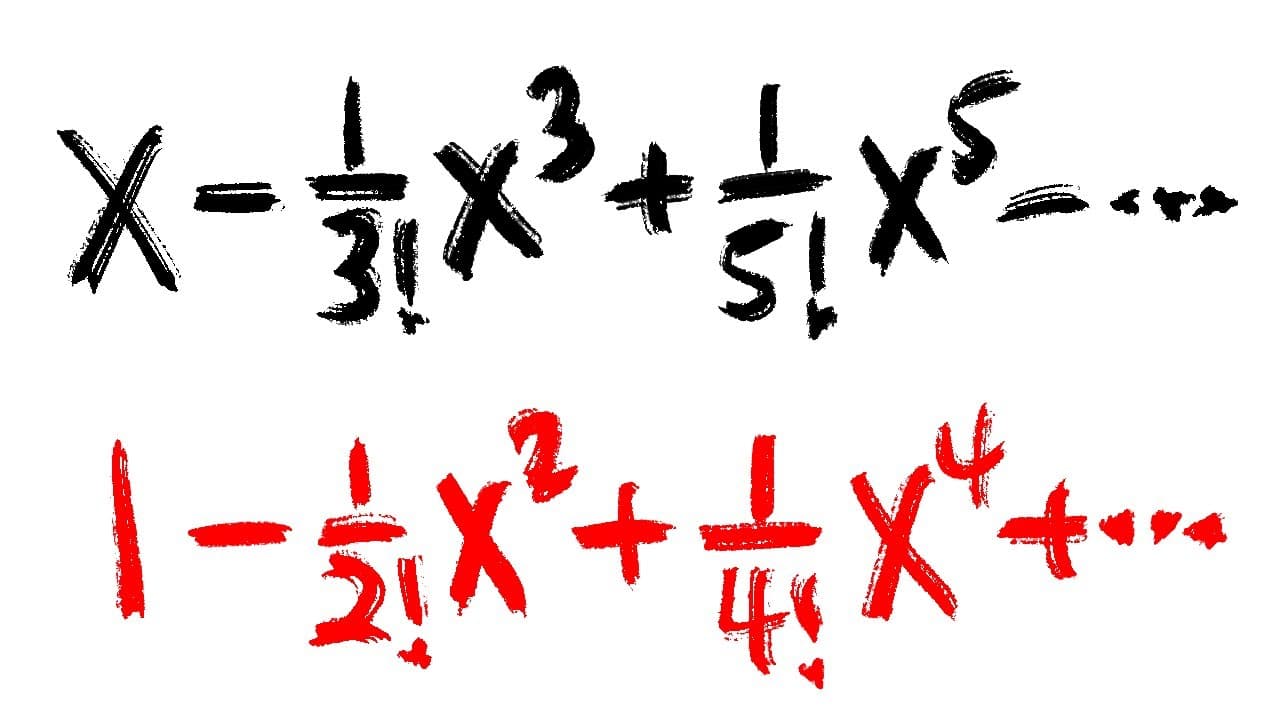
To find the power series expansions for sine and cosine at zero, use Taylor series. For sine, the series is an infinite sum of terms with alternating signs based on odd powers of x, while for cosine, it uses even powers. Each series has infinite radius of convergence, allowing evaluation of the functions over all real numbers.
Transcript
okay next video I'll show you guys how to find the power series expansion for sex and also Cossacks sent 30 at zero and yes some people call this the Taylor series because we are going to use the Taylor formula and some people also call this to be the macarons series because we have a Taylor series centered at zero but oh no they are just power ser... Read More
Key Insights
- ✊ Taylor series are fundamental in obtaining precise power series expansions around a specified center.
- ✊ Power series expansions for sine and cosine involve an iterative process of differentiation and calculation.
- ✊ Sine functions exhibit odd properties in power series expansions, while cosine functions display even characteristics.
- ✊ Differentiating power series maintains the radius of convergence, preserving convergence properties.
- ✊ Checking convergence at the supposed endpoints is crucial in ensuring the validity of power series expansions.
- ✊ Power series expansions provide a systematic approach to representing functions as infinite series.
- ✊ Understanding the alternating nature of sine and cosine power series aids in accurately deriving expansions.
Install to Summarize YouTube Videos and Get Transcripts
Explore YouTube Video Summarizer or Get YouTube Transcript Extractor
Questions & Answers
Q: What is the significance of using a Taylor series for finding power series expansions?
Using a Taylor series allows for an iterative method of differentiation to find power series expansions accurately around a specific center, like zero.
Q: Why are sine and cosine functions considered to be even and odd functions, respectively?
Sine functions exhibit odd symmetry, with only odd exponents contributing, while cosine functions display even symmetry with only even powers involved.
Q: How does differentiation affect the radius of convergence in power series expansions?
Differentiating a power series does not alter the radius of convergence, ensuring that the convergence properties remain consistent in the derived series.
Q: Why is it necessary to check convergence at the endpoints of the interval in power series differentiation?
Although the interval may extend to infinity, checking convergence at the supposed endpoints ensures the validity of the derived power series.
Summary & Key Takeaways
-
Demonstrates finding power series expansions for sine and cosine using Taylor series centered at zero.
-
Shows the iterative process of differentiation to obtain the power series.
-
Highlights the even and odd properties of sine and cosine functions in the context of power series.
Read in Other Languages (beta)
Share This Summary 📚
Summarize YouTube Videos and Get Video Transcripts with 1-Click
Try YouTube Summary with ChatGPT & Claude or YouTube Transcript Generator
Explore More Summaries from blackpenredpen 📚
Summarize YouTube Videos and Get Video Transcripts with 1-Click
Try YouTube Summary with ChatGPT & Claude or YouTube Transcript Generator