How Do NMOS Transistors Work in Enhancement Mode?
TL;DR
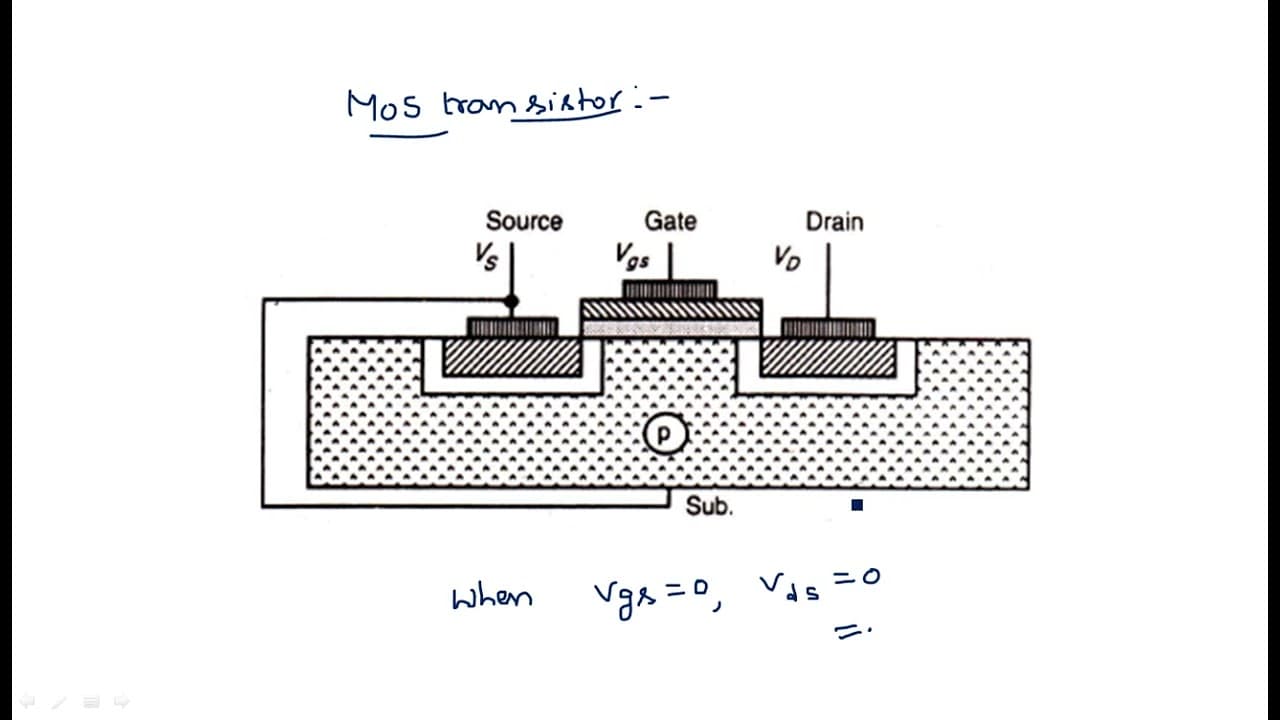
NMOS transistors operate in three regions: cutoff, linear, and saturation, depending on applied gate and drain-source voltages. In enhancement mode, a channel forms when the gate-to-source voltage exceeds the threshold voltage, allowing current flow. The characteristics differ in depletion mode, where the channel exists without the need for VGS, leading to initially high current that decreases with increased VDS.
Transcript
hi everyone in this video I am going to explain about the characteristics of enhancement mode and most transistor so we can understand the operation of the nmos transistor in the enhancement mode and as well as in the depletion mode once if you know the complete characteristics that means what should be the voltage and in which region the transisto... Read More
Key Insights
- ⚡ NMOS transistors function in distinct operational regions where their behavior varies based on applied voltages.
- ⚡ The cutoff region signifies an off-state with no channel, while saturation indicates a stable current despite voltage increases.
- 👻 The linear region allows current to vary with applied voltage, resembling resistive behavior in certain applications.
- ⚡ Understanding threshold and effective gate voltages is fundamental to predicting NMOS performance in circuits.
- ⚡ Enhancement mode requires careful voltage application to create and maintain the conductive channel in the transistor.
- 📳 In depletion mode, the absence of VGS indicates an already conductive channel, maximizing current initially.
- ⚡ NMOS behavior changes significantly with the applied drain-source voltage, influencing design and application in electronics.
Install to Summarize YouTube Videos and Get Transcripts
Explore YouTube Video Summarizer or Get YouTube Transcript Extractor
Questions & Answers
Q: What are the main operational regions of an NMOS transistor?
An NMOS transistor operates in three main regions: cutoff, saturation, and linear. In the cutoff region, the transistor is off, acting as an open circuit with no current flow. In the saturation region, even with increased voltage, the current remains constant. In the linear region, current increases proportionally with voltage, allowing the transistor to function like a resistor.
Q: How does threshold voltage affect NMOS transistor operation?
The threshold voltage (VT) is crucial in determining whether a channel in the NMOS transistor is created. If the gate-source voltage (VGS) is greater than or equal to VT, a channel forms, allowing current to flow. If VGS is less than VT, the channel does not exist, preventing current from moving through the transistor.
Q: What is the significance of effective gate voltage in NMOS operation?
Effective gate voltage is calculated as VGS minus the threshold voltage (VT). This effective voltage influences how easily current can flow through the channel once it's established. For the transistor to allow current flow in the linear region, the drain-source voltage (VDS) must be less than the effective gate voltage, ensuring proper operation.
Q: How do enhancement mode and depletion mode transistors differ?
In enhancement mode transistors, the channel forms only when sufficient VGS is applied, and current behavior increases with voltage until saturation occurs. In contrast, depletion mode transistors start with a channel already established, resulting in maximum current flow without initial VGS. As VDS increases, the current in depletion mode decreases, showcasing contrasting characteristics.
Summary & Key Takeaways
-
The video explains NMOS transistor operation in both enhancement and depletion modes, detailing voltage requirements for channel creation.
-
It describes the three operational regions of NMOS transistors: cutoff, saturation, and linear, highlighting current behavior in each region.
-
Key concepts include threshold voltage, effective gate voltage, and how these factors influence current flow between source and drain.
Read in Other Languages (beta)
Share This Summary 📚
Summarize YouTube Videos and Get Video Transcripts with 1-Click
Try YouTube Summary with ChatGPT & Claude or YouTube Transcript Generator