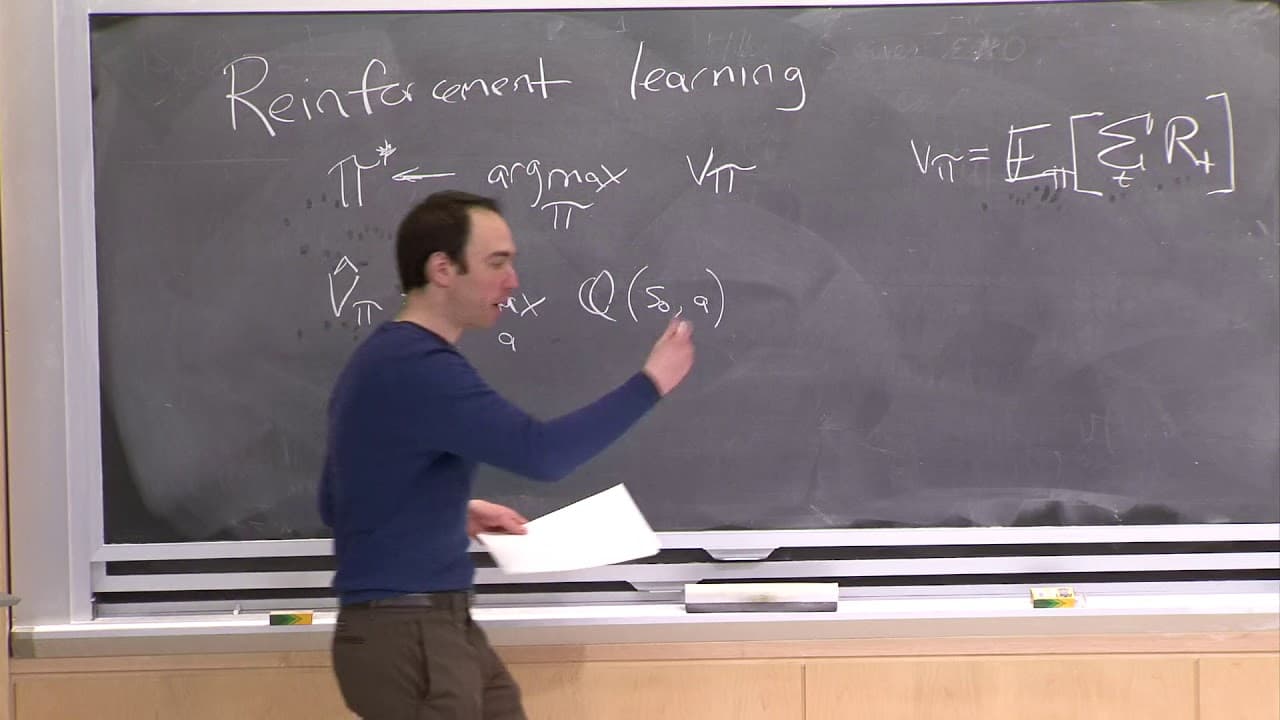
17. Reinforcement Learning, Part 2
TL;DR
This analysis uses g-methods, specifically the parametric g-formula, to evaluate the effect of adhering to guideline-based physical activity interventions on survival among men with prostate cancer.
Transcript
DAVID SONTAG: A three-part lecture today, and I'm still continuing on the theme of reinforcement learning. Part one, I'm going to be speaking, and I'll be following up on last week's discussion about causal inference and Tuesday's discussion on reinforcement learning. And I'll be going into sort of one more subtlety that arises there and where we c... Read More
Key Insights
- ❓ Dynamic treatment strategies are more clinically relevant but require specialized methods to properly evaluate their effects.
- ♊ G-methods, such as the parametric g-formula, provide a valid and powerful approach to estimate the effects of dynamic treatment strategies.
- 💁♂️ Using g-methods, the effects of guideline-based physical activity interventions on survival in men with prostate cancer were estimated, providing actionable insights to inform clinical decision-making.
- ❓ Sensitivity analyses were conducted to explore potential unmeasured confounding, further supporting the validity of the estimated effects.
Install to Summarize YouTube Videos and Get Transcripts
Explore YouTube Video Summarizer or Get YouTube Transcript Extractor
Questions & Answers
Q: What are dynamic treatment strategies?
Dynamic treatment strategies adapt to individuals' evolving characteristics over time, making them more clinically relevant but challenging to evaluate.
Q: How do g-methods help evaluate dynamic treatment strategies?
G-methods, such as the parametric g-formula, are specialized methods that account for treatment confounder feedback, allowing for accurate estimation of the effects of dynamic treatment strategies.
Q: What data was used in the case study on physical activity interventions in men with prostate cancer?
The analysis leveraged data from the Health Professionals Follow-up Study, a prospective cohort study, to estimate the effects of adhering to guideline-based physical activity interventions on survival.
Q: How were the effects of different physical activity strategies estimated?
The effects were estimated using the parametric g-formula, which involved simulating the outcome distribution under each treatment strategy based on the observed data. Bootstrap confidence intervals were also calculated.
Summary & Key Takeaways
-
The analysis focuses on dynamic treatment strategies, which adapt to individuals' evolving characteristics over time.
-
The g-methods, including the parametric g-formula, are used in combination with observational data to estimate the effects of these strategies.
-
A case study on physical activity interventions in men with prostate cancer demonstrates the application of g-methods and provides insights into the optimal strategies.
Read in Other Languages (beta)
Share This Summary 📚
Summarize YouTube Videos and Get Video Transcripts with 1-Click
Try YouTube Summary with ChatGPT & Claude or YouTube Transcript Generator
Explore More Summaries from MIT OpenCourseWare 📚



Summarize YouTube Videos and Get Video Transcripts with 1-Click
Try YouTube Summary with ChatGPT & Claude or YouTube Transcript Generator