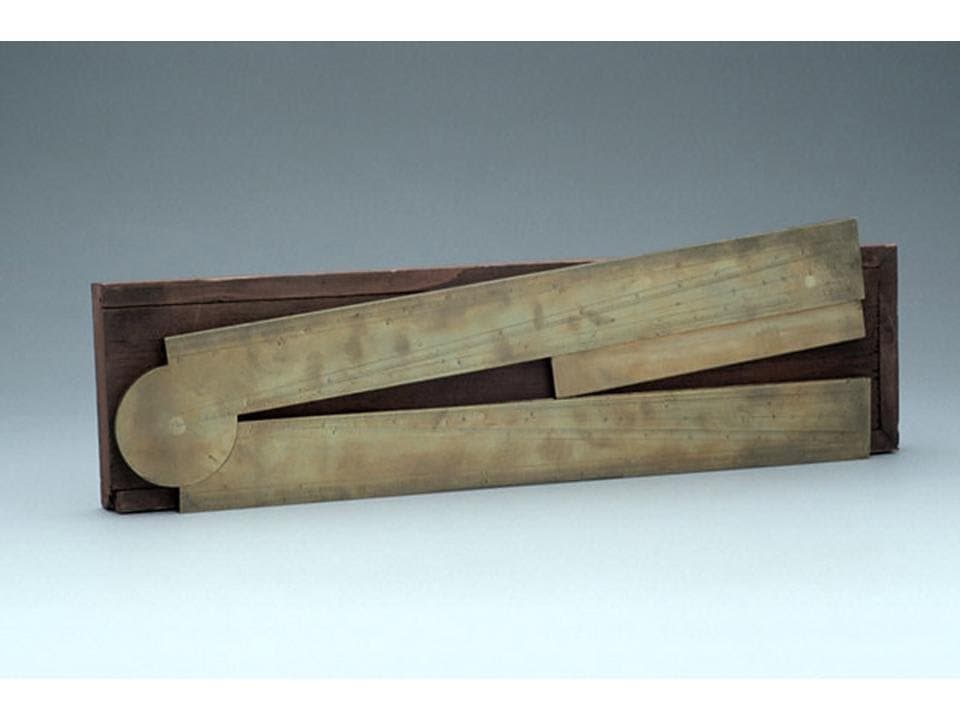
The Early Mathematical Instruments of the Royal Society - Dr Jim Bennett
TL;DR
The historical evolution of mathematical instruments from 17th-century practical mathematics to the emergence of experimental natural philosophy.
Transcript
well when the invitation came to speak today on early mathematical instruments my first thought was that the early Royal Society didn't have very much interest in mathematical instruments in the well-established meaning of the term in the 17th century this was the Royal Society of London for the Improvement of natural knowledge which was not the sa... Read More
Key Insights
- 🫚 Mathematical instruments in the 17th century were rooted in practical problem-solving, leveraging geometric techniques for various applications.
- ⌛ The Royal Society's focus on optical and natural philosophy instruments overshadowed the significance of mathematical instruments at the time.
- 🙈 The shift towards experimental natural philosophy saw a blending of practical mathematical methodologies with new approaches to scientific inquiry.
- 💦 The legacy of mathematical instruments persisted despite the dominance of experimental natural philosophy in the Royal Society's work.
- 😫 The evolution of mathematical instruments showcased the diverse skill sets and innovative designs of English mathematicians and instrument makers.
- 🏑 The importance of established craftsmanship and expertise in mathematical instrument making highlighted the specialized nature of this field.
- 🚙 The development of instruments like the Gunter sector and Gunter's rule demonstrated the practical utility of mathematical tools in various professions.
Install to Summarize YouTube Videos and Get Transcripts
Explore YouTube Video Summarizer or Get YouTube Transcript Extractor
Questions & Answers
Q: How did the Royal Society view mathematical instruments compared to optical instruments and instruments of natural philosophy?
The Royal Society showed more interest in optical instruments and those of natural philosophy, like telescopes and microscopes, rather than mathematical instruments, which were focused on practical problem-solving.
Q: What was the significance of the term "theoric" in the context of 17th-century mathematical instruments?
The term "theoric" referred to an encapsulation of information secured in a geometric device, used for practical calculations rather than causal explanations, distinguishing it from natural philosophy.
Q: How did the evolution of mathematical instruments impact the development of experimental natural philosophy?
While mathematical instruments were not central to the Royal Society's early work on experimental natural philosophy, the skills and methodologies from practical mathematics provided a foundation for experimental approaches.
Q: What was the role of prominent figures like Ren, Hook, and Petty in shaping the trajectory of mathematical instrument development in the 17th century?
Ren, Hook, and Petty all contributed to the evolving landscape of mathematical instruments, with Ren's theoretical approach, Hook's practical designs, and Petty's proposal for a unified apparatus of experimental instruments marking key milestones.
Summary & Key Takeaways
-
Mathematical instruments in the 17th century had a long tradition, with a focus on geometry for practical applications.
-
The Royal Society emphasized optical instruments and instruments of natural philosophy over mathematical instruments.
-
There was a shift towards experimental natural philosophy, but the legacy of practical mathematics persisted.
Read in Other Languages (beta)
Share This Summary 📚
Summarize YouTube Videos and Get Video Transcripts with 1-Click
Try YouTube Summary with ChatGPT & Claude or YouTube Transcript Generator
Explore More Summaries from Gresham College 📚

Summarize YouTube Videos and Get Video Transcripts with 1-Click
Try YouTube Summary with ChatGPT & Claude or YouTube Transcript Generator