Shear Plane and Shear Angle- Metal Cutting Theory and Dynamometry-Machining Sciences and Tool Design
TL;DR
Shear plane and shear angle in metal cutting theory, understanding chip thickness ratio and its significance.
Transcript
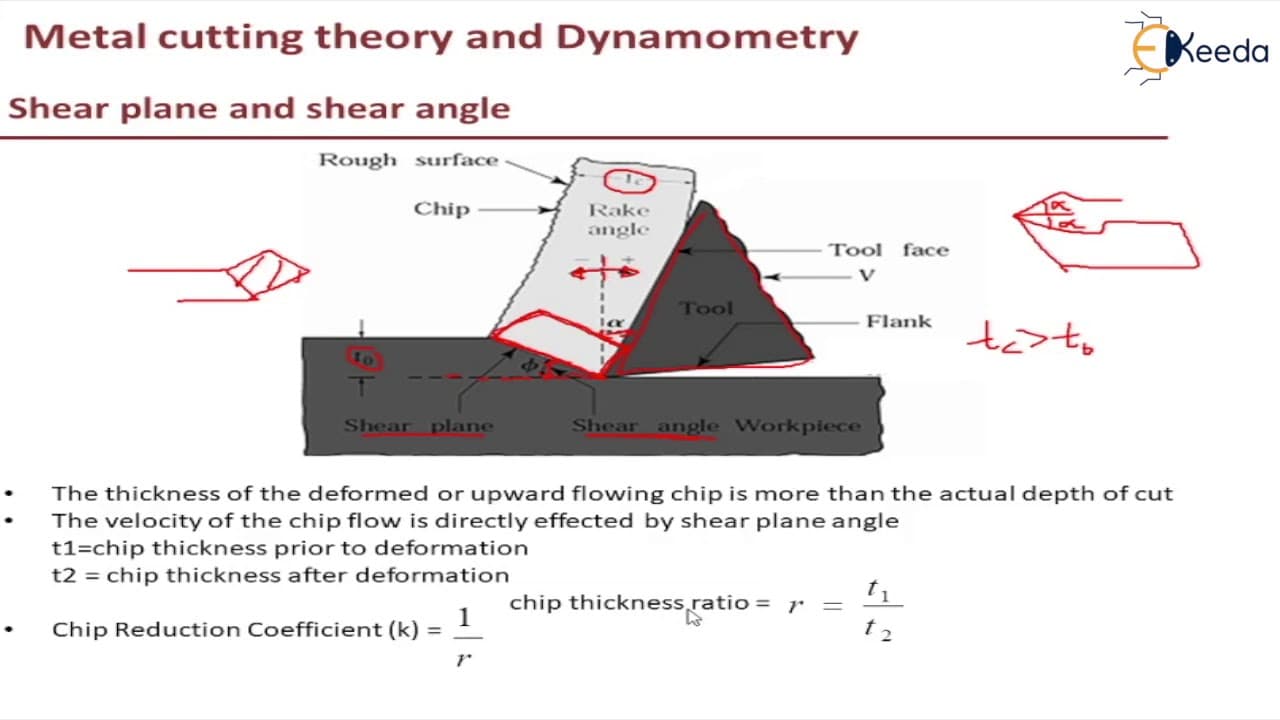
hello students my name is santosh kumar i am the course instructor for machining sciences and tool design we are discussing module number one metal cutting theory and dynamometry we will discuss in this video a topic called shear plane and shear angle so you can see in the sketch this is the cutting tool which is striking the work piece as it is al... Read More
Key Insights
- 🤘 Shear plane is where shearing takes place in metal cutting, affecting chip formation.
- 💇 Positive rake angles offer advantages like improved chip control and reduced cutting forces.
- 🥳 Chip thickness ratio influences cutting action, with higher ratios indicating better performance.
- 🔺 Understanding shear angle is crucial for optimizing cutting processes and efficiency.
- 💇 The nomenclature of cutting tools includes positive and negative rake angles for different applications.
- 🥳 Calculation of chip thickness ratio and shear angle is essential for determining cutting performance.
- 🔺 Graphs can be used to visualize relationships between chip thickness ratio, rake angle, and shear angle.
Install to Summarize YouTube Videos and Get Transcripts
Explore YouTube Video Summarizer or Get YouTube Transcript Extractor
Questions & Answers
Q: What is a shear plane in metal cutting theory?
In metal cutting, the shear plane is where the material undergoes shearing due to the cutting tool's action, leading to chip formation. It is a critical aspect of understanding the cutting process.
Q: How does chip thickness ratio influence cutting action?
Chip thickness ratio, defined as the ratio of chip thickness before and after deformation, directly affects cutting action. A higher ratio indicates better cutting performance, enhancing the effectiveness of the process.
Q: What is the significance of positive and negative rake angles in cutting tools?
Positive rake angles provide improved chip control and reduced cutting forces, enhancing tool life and surface finish. Negative rake angles are suitable for high-strength materials but can lead to higher cutting forces.
Q: How is shear angle calculated and why is it important?
Shear angle is calculated using the chip thickness ratio and rake angle of the cutting tool. It is crucial as it determines the efficiency of the cutting process, affecting factors like cutting forces and chip formation.
Summary & Key Takeaways
-
The video discusses shear plane and shear angle in metal cutting theory, explaining the concept of chip formation and the role of shear angle in cutting.
-
It delves into the nomenclature of cutting tools, including positive and negative rake angles, and their advantages.
-
The significance of chip thickness ratio and its impact on cutting action is explored, along with a detailed explanation of how to calculate shear angle.
Read in Other Languages (beta)
Share This Summary 📚
Summarize YouTube Videos and Get Video Transcripts with 1-Click
Try YouTube Summary with ChatGPT & Claude or YouTube Transcript Generator
Explore More Summaries from Ekeeda 📚





Summarize YouTube Videos and Get Video Transcripts with 1-Click
Try YouTube Summary with ChatGPT & Claude or YouTube Transcript Generator